Ovulation After Stopping the Pill: When Your Fertility Returns
When ovulation returns after each contraceptive type, how long until your cycle regulates, and preconception steps to take now

You've been on the pill for years — maybe a decade or more. You've just stopped, and now you're staring at your calendar wondering: when will I ovulate? Is my fertility damaged? Why is my body so confused? I hear this from my clients constantly.
I always reassure my clients with this: here's the short answer: the pill suppresses ovulation, but it doesn't destroy your fertility. When you stop, your body needs a little time to remember how to run its own hormonal show again. For most women, that happens faster than you'd think.
🔑 Key Takeaways
- You can ovulate as soon as 2 weeks after stopping the combined pill. Some women ovulate in their very first cycle off.
- The pill doesn't damage fertility — Barnhart & Schreiber (2009) confirmed that time to conception after the pill is the same as after barrier methods.
- Your cycle may take 1-3 months to regulate — irregular periods, longer or shorter cycles, and anovulatory cycles are all normal initially.
- Different contraceptives have different recovery times — the pill and IUD return quickly. The injection (Depo-Provera) can take 6-12 months or longer.
- Start preconception supplements now — folate, vitamin D, and CoQ10 should begin before you stop the pill, not after.
What Happens to Your Hormones When You Stop the Pill
I explain it to my clients like this: the combined oral contraceptive pill works by providing steady levels of synthetic oestrogen and progesterone (progestin). These hormones suppress your brain's production of GnRH, which in turn stops your pituitary from releasing LH and FSH — the hormones that drive follicle development and ovulation.
When you stop taking the pill:
- Synthetic hormones leave your system — the combined pill's hormones are cleared within 2-3 days of your last active pill
- Your hypothalamus resumes GnRH production — but it may take a few days to "wake up" and find its rhythm
- FSH begins rising — recruiting follicles in your ovaries
- Oestrogen rises — the developing follicles produce oestrogen, which triggers cervical mucus production and thickens the uterine lining
- LH surge occurs — triggering ovulation, usually 10-14 days after the follicular phase begins
This entire process can restart within 2-4 weeks of your last pill. But the first cycle may be longer or shorter than your natural cycle, because your hormonal system is recalibrating.
In my practice, I see several factors that influence how quickly your cycle normalises. If you had regular cycles before going on the pill, you're likely to return to regular cycles fairly quickly — your body is essentially remembering a pattern it already knows. If your pre-pill cycles were irregular (which is sometimes why the pill was prescribed in the first place), you may find that irregularity returns. Your age also plays a role: women over 35 sometimes take a little longer to re-establish regular ovulation, though this is more related to natural fertility decline than to the pill itself. And if you were on the pill for a very long time (10+ years), don't panic — there's no evidence that longer use means a longer recovery.
Timeline: How Long Until Each Contraceptive Wears Off
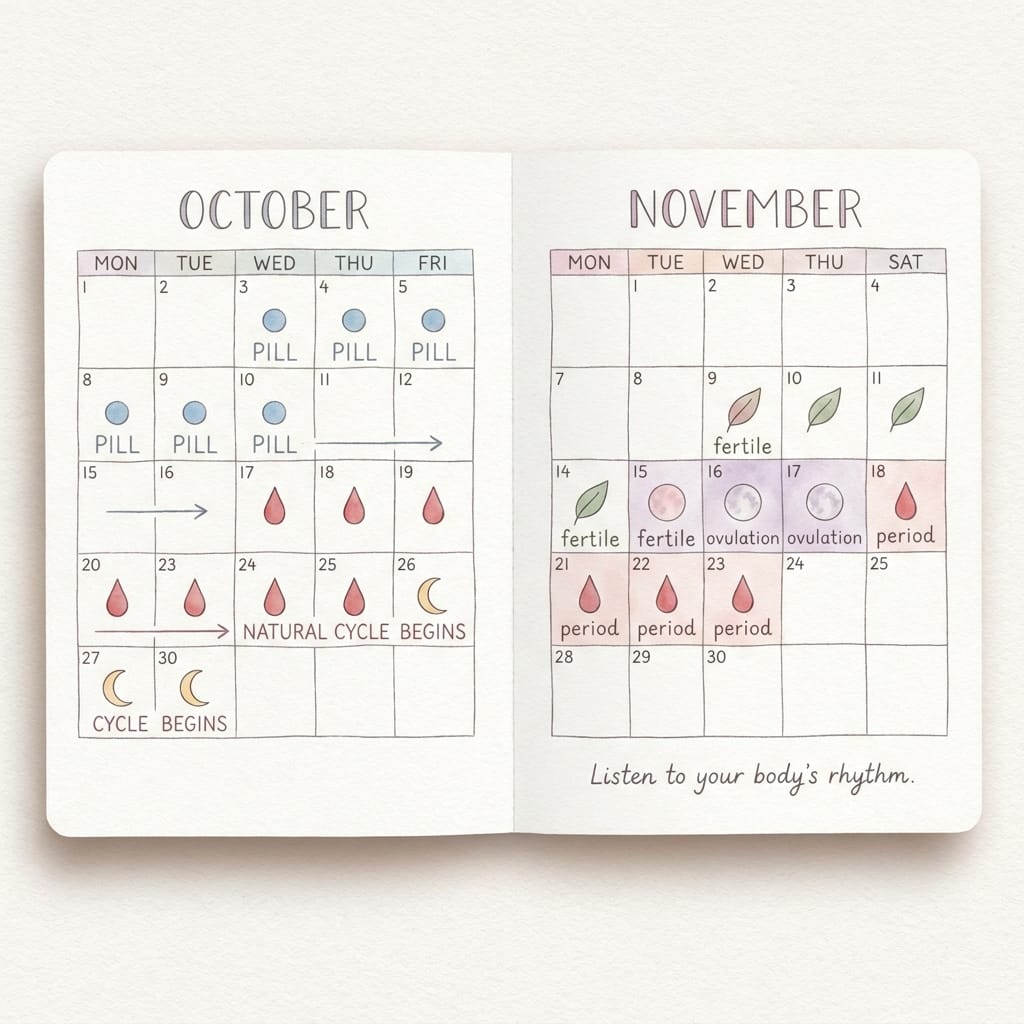
The recovery time varies significantly by contraceptive type:
Combined Pill
Ovulation can return as early as 2 weeks after stopping. Most women have a period within 4 weeks and a regular cycle within 1-3 months. The Mansour et al. (2011) WHO data confirmed that fertility returns promptly after stopping the combined pill.
Mini Pill (Progestogen-Only)
The mini pill doesn't consistently suppress ovulation (it mainly thickens cervical mucus). Fertility can return within days of stopping. Some women ovulate within the first week.
Hormonal IUD (Mirena, Kyleena)
Once removed, the local progestin effect diminishes quickly. Most women ovulate within 2-4 weeks of removal. Fertility returns promptly.
Contraceptive Implant (Nexplanon)
After removal, ovulation typically returns within 1-3 months. Some women ovulate within weeks; others take a few months.
Contraceptive Injection (Depo-Provera)
This is the slowest to wear off. Each injection lasts 12 weeks, and fertility can take 6-12 months to return after the last injection. Some women take up to 18 months. If you're planning to conceive soon, the injection is not the ideal contraceptive to use in the months before.
Can You Get Pregnant Immediately After Stopping?
Yes. You can get pregnant in the very first cycle after stopping the pill. This surprises many women who've been told (or assumed) that the pill "needs to leave your system" before you can conceive. The hormones clear within days. If you ovulate, you're fertile.
Barnhart & Schreiber (2009) reviewed the evidence on return to fertility after oral contraceptives and found:
- There is no delay in return to fertility after stopping the pill compared to stopping barrier methods
- 80% of women conceive within 12 months of stopping the pill — the same rate as women who weren't using hormonal contraception
- Any apparent "delay" is usually within normal variation and not caused by the pill itself
That said, some women experience a temporary adjustment period. If you were on the pill for many years, your body may need 1-3 cycles to re-establish its natural rhythm. This is hormonal recalibration, not damage.
The adjustment period typically shows up as longer or shorter cycles than expected, lighter or heavier bleeding, more cramping, or the return of symptoms the pill was managing — like acne, mood swings, or painful periods. These usually settle within 2-3 cycles. Think of it as your body recalibrating after years of having its hormonal rhythm managed externally. It needs a little time to find its own groove again.
This is actually one of the most common myths I encounter in my work: the idea that being on the pill for years has somehow 'damaged' your fertility or 'used up' your eggs. The pill prevents ovulation — it doesn't destroy eggs. Your egg supply (ovarian reserve) continues to decline at the same rate whether you're on the pill or not. The pill simply pauses the monthly release cycle. Think of it like pressing pause on a video — when you unpause, the video picks up where it left off. Your fertility is where it would have been at your current age regardless of pill use.
A large Danish cohort study (Mikkelsen et al., 2013) followed over 3,700 women who discontinued contraception to attempt pregnancy. They found no difference in time-to-pregnancy between women who had used the pill for less than 5 years versus more than 5 years. The only factor that consistently predicted slower return to fertility was age — not duration of contraceptive use. This aligns with the broader body of evidence showing that the pill has no long-term effect on fertility.
Post-Pill Amenorrhoea: When Your Period Doesn't Come Back
A small number of women experience post-pill amenorrhoea — no period for 3+ months after stopping the pill. This affects roughly 1-2% of women and is more common if:
- You had irregular periods before going on the pill (the pill may have been masking an underlying condition like PCOS)
- You're underweight or exercising excessively
- You're under significant stress
- You have a thyroid condition
If your period hasn't returned within 3 months of stopping the pill, see your GP. Blood tests for FSH, LH, oestrogen, prolactin, and thyroid function can identify the cause.
Irregular Periods After the Pill
Many women notice their first 2-3 cycles after stopping the pill are irregular — shorter or longer than expected, or with unusual bleeding patterns. This is normal and usually resolves within 3 months.
Common post-pill patterns:
- Longer first cycle — your first "natural" cycle might be 35-45 days instead of the 28-day rhythm the pill created
- Heavier periods — the pill thins the uterine lining, so your natural periods may feel heavier by comparison
- Spotting between periods — your hormonal system adjusting to its own rhythm
- Anovulatory cycles — your first cycle or two might not include ovulation. This is normal and doesn't mean you won't ovulate in subsequent cycles.
Preconception Steps to Take While Waiting
Whether your cycle returns immediately or takes a few months, use this time wisely:
When should you actually worry? If your period hasn't returned at all by 3 months, see your GP. If your cycles are consistently shorter than 21 days or longer than 35 days after 3 months, that's also worth investigating. And if you're experiencing other symptoms alongside irregular cycles — significant hair loss, severe acne, unexplained weight gain, or very painful periods — these could point to an underlying condition like PCOS or thyroid dysfunction that was being masked by the pill and now needs its own treatment.
- Start folate (400mcg/day) — ideally 3 months before you start trying. This reduces neural tube defect risk.
- Consider CoQ10 — supports egg quality during the maturation process
- Check your vitamin D — deficiency is common and associated with poorer fertility outcomes
- Begin tracking — start observing cervical mucus and using OPKs from your first cycle off the pill. This helps you learn your natural pattern.
- Eat for fertility — see my fertility diet guide for evidence-based nutrition advice
- Manage stress — coming off the pill can be anxious-making. Practices like fertility meditation can help during this transition
The Bottom Line
Stopping the pill doesn't damage your fertility. For the vast majority of women, ovulation returns within 2-4 weeks and conception rates are the same as the general population within 12 months. Your first few cycles may be irregular as your body recalibrates, but this is normal hormonal adjustment, not a sign of problems. I recommend my clients start preconception supplements now, begin tracking your natural cycle, and give your body a few months to find its rhythm.
I also want to address something that rarely gets said: it's okay if you don't feel ready yet. The pressure to start trying immediately after stopping the pill — especially if your partner is keen, or your friends are all pregnant, or your mum keeps asking — can be overwhelming. But your timeline is yours. If you stopped the pill to give your body time to adjust before you actually start trying, that's a perfectly valid and sensible approach. There's no prize for conceiving in the first cycle, and there's no penalty for taking a few months to get to know your body again.
Frequently Asked Questions
▸How long after stopping the pill will I ovulate?
Most women ovulate within 2-4 weeks of stopping the combined pill. Some ovulate even sooner. The first ovulation might come before your first period, so if you're not ready to conceive, use barrier contraception from the moment you stop.
▸Does being on the pill for years reduce my fertility?
No. Research consistently shows that the duration of pill use does not affect how quickly you conceive after stopping. Women who used the pill for 10+ years conceive at the same rate as those who used it for 1-2 years. The pill suppresses ovulation temporarily but doesn't deplete or damage your egg reserve.
▸Should I wait a few months after stopping the pill before trying?
There's no medical requirement to wait. However, some doctors recommend waiting 1-2 cycles for practical reasons: it makes dating a pregnancy easier (you'll know your actual cycle length), and it gives you time to start folate and establish tracking habits. But if you conceive immediately, that's perfectly fine.
▸What if my period doesn't come back after stopping the pill?
If you haven't had a period within 3 months of stopping the pill, see your GP. Post-pill amenorrhoea can sometimes reveal an underlying condition that the pill was masking (like PCOS or thyroid issues). Blood tests can identify the cause, and treatment is usually straightforward.
▸Does the Depo-Provera injection take longer to wear off?
Significantly longer. While the pill and IUD return fertility within weeks, the injection can take 6-12 months (and sometimes up to 18 months) for full fertility to return. If you're planning to conceive in the near future, consider switching to the pill or an IUD a year before you want to start trying.
References
- Barnhart, K.T., & Schreiber, C.A. (2009). Return to fertility following discontinuation of oral contraceptives. Fertility and Sterility, 91(3), 659–666.
- Mansour, D., et al. (2011). Fertility after discontinuation of contraception: a comprehensive review of the literature. Contraception, 84(5), 465–477.
- NHS. (2024). Contraception guide — after stopping contraception. NHS.uk
Medical Disclaimer: The information in this article is for educational purposes only. If you have concerns about your return to fertility after stopping contraception, please consult your GP or a fertility specialist.
Written by

Subscribe to Fertilitys
All my Free Resources. No spam. Unsubscribe anytime.