Meditation for Fertility: Can It Actually Help You Conceive?
A nutritionist's guide to how meditation affects your hormones, your cycle, and your chances of conceiving


If you're trying to conceive and someone has told you to "just relax," I'm sorry. I know how maddening that feels — as if you're somehow causing your own infertility by worrying about it. That's not what this article is about.
What I am going to show you is the actual science behind how stress affects your reproductive hormones, and why meditation — not as a magic fix, but as a daily practice — might genuinely support your fertility journey. I've seen it make a difference for my clients, and the research backs it up more than most people realise.
🔑 Key Takeaways
- Stress suppresses GnRH — the hormone that triggers ovulation. Chronic stress keeps your reproductive system in survival mode, not baby-making mode.
- Mindfulness-based interventions have been shown in multiple RCTs to improve fertility quality of life and, in some studies, increase pregnancy rates during IVF.
- You don't need hours. Even 10 minutes of daily meditation can meaningfully reduce cortisol levels within 2-4 weeks.
- Meditation complements medical treatment — it doesn't replace it. Think of it as creating the best possible conditions for your body to do its thing.
- The hardest part is starting when you're already overwhelmed by tracking, appointments, and uncertainty. Start small. Start today.
The Science: How Stress Interferes with Your Fertility
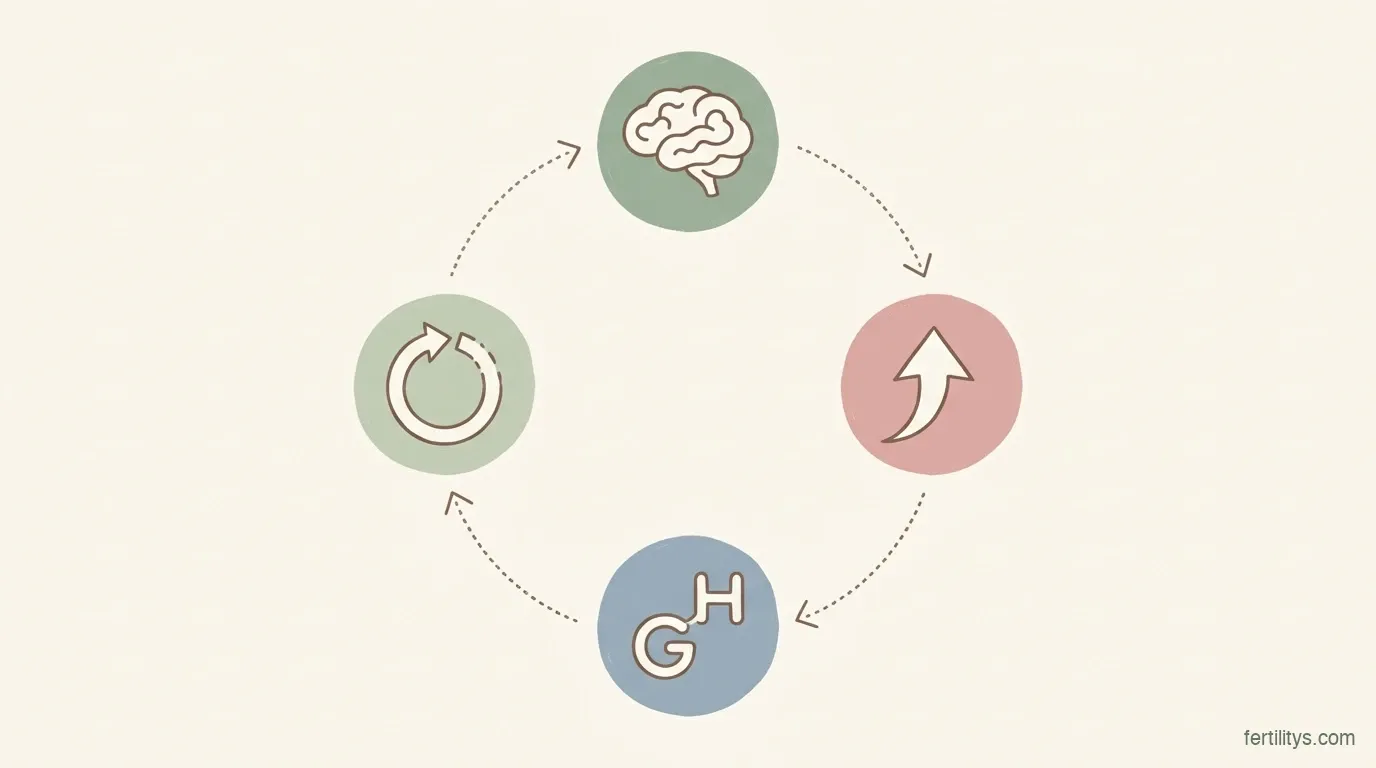
Your body has two major hormonal systems running in parallel. The HPA axis (hypothalamic-pituitary-adrenal) controls your stress response, and the HPG axis (hypothalamic-pituitary-gonadal) controls your reproductive hormones. When everything's working well, they operate independently. When you're chronically stressed, the HPA axis starts muscling in on the HPG axis's territory.
Here's the mechanism: when your brain perceives a threat (real or imagined — your body doesn't distinguish between a tiger and a negative pregnancy test), it releases cortisol. In short bursts, cortisol is helpful — it sharpens your focus, mobilises energy. But when cortisol stays elevated day after day, it can:
- Suppress GnRH pulsatility — GnRH (gonadotropin-releasing hormone) is the signal that tells your pituitary to release LH and FSH, the hormones that drive ovulation. Without regular GnRH pulses, your cycle can become irregular or anovulatory.
- Reduce estradiol production — high cortisol can lower the oestrogen levels needed for egg maturation and thickening of the uterine lining.
- Disrupt progesterone — the corpus luteum may produce less progesterone after ovulation, potentially shortening your luteal phase and making implantation harder.
- Affect implantation — ex vivo studies suggest that cortisol and aldosterone can independently disturb endometrial stromal cell changes needed for a fertilised egg to embed (Lewiński, 2023).
A systematic review by Güder et al. (2023) in Frontiers in Endocrinology examined 16 studies and found that the majority linked chronically elevated cortisol with disrupted reproductive endocrinology, though they noted the complexity of these pathways means we can't draw a single neat conclusion.
The takeaway isn't "stress causes infertility." It's that stress is one factor among many that can push an already-challenging conception journey further from success — and it's one of the few factors you can actually do something about.
What the Research Says About Meditation and Fertility
I want to be honest here: the evidence that meditation directly increases pregnancy rates is promising but not conclusive. What the research does clearly show is that mindfulness-based programmes meaningfully reduce the psychological suffering that comes with infertility — and that matters enormously on its own.
Mindfulness and IVF Outcomes
Li et al. (2016) conducted a study at a fertility centre in China, following 58 women who completed a mindfulness-based intervention before their first IVF cycle, compared with 50 controls. The mindfulness group showed significantly improved fertility quality of life and higher pregnancy rates. The study was published in Behaviour Research and Therapy.
Domar et al. (2011) ran a randomised controlled trial at Boston IVF, putting women through a 10-week mind/body programme before starting their first IVF cycle. The results? 55% of the mind/body group achieved pregnancy compared to 20% of controls. That's a striking difference, though later replications have shown more modest effects.
A 2026 meta-analysis published in Current Psychology pooled data from 13 randomised controlled trials and found that mindfulness-based interventions significantly reduced anxiety and depression in women undergoing IVF, with a positive but less definitive trend toward improved pregnancy rates.
Cortisol Reduction Through Meditation
A 2019 study published in the Journal of Psychosomatic Obstetrics & Gynaecology found that an 8-week mindfulness programme significantly reduced cortisol levels and perceived stress in women with infertility. This is the measurable, biological pathway — meditation actually lowers the stress hormones that can interfere with your cycle.
The mechanism is straightforward: meditation activates your parasympathetic nervous system (the "rest and digest" system), which directly counteracts the HPA axis stress response. Over time, a consistent practice can shift your baseline cortisol levels downward, creating a more hospitable hormonal environment for ovulation and implantation.
The Nuance We Need to Hear
Eugster and Vingerhoets (1999) reviewed the psychological aspects of IVF and identified that the period between embryo transfer and pregnancy notification was the most stressful part of the entire treatment. Their review — published in Social Science & Medicine — found that psychosocial factors like ineffective coping strategies were associated with lower IVF pregnancy rates.
Does this mean meditation guarantees better IVF outcomes? No. But it does mean that how you cope with the stress of fertility treatment genuinely matters — and meditation is one of the most accessible, evidence-supported coping tools we have.
Types of Meditation That Support Fertility
Not all meditation is sitting cross-legged with your eyes closed for an hour. Here are the approaches that work best for fertility specifically — and you can mix and match based on what resonates with you.


Mindfulness Meditation
This is the most-studied form in fertility research. It involves sitting quietly and focusing on your breath, noticing when your mind wanders (it will — constantly), and gently bringing your attention back. The goal isn't to empty your mind. It's to practice not getting carried away by every thought.
How to start: Set a timer for 5 minutes. Sit comfortably. Focus on the sensation of breathing — the rise of your chest, the warmth of your exhale. When you notice thoughts about ovulation dates or beta results, simply acknowledge them ("thinking") and return to your breath. That's it. That's the whole practice.
Body Scan Meditation
Lie down and systematically bring awareness to each part of your body, from your toes to the crown of your head. This is particularly helpful if you hold tension in your pelvis or abdomen (very common when you're TTC — I see it all the time in my clients). The body scan teaches you to release physical tension you might not even know you're carrying.
Guided Visualisation for Fertility
This involves listening to a guided meditation that walks you through visualising your reproductive system, your cycle, or the process of conception. I know it might sound a bit "woo" — I was sceptical too — but there's solid psychological reasoning behind it. Visualisation activates the same neural pathways as actual experience, and it helps shift your relationship with your body from adversarial ("why won't you work?") to collaborative.
Programmes like CALM IVF (tested in a 2023 clinical trial published in F&S Reports) incorporate visualisation alongside other mindfulness techniques and showed significantly improved fertility quality of life scores for both partners.
Loving-Kindness Meditation (Metta)
This one is powerful for the emotional side of TTC. You repeat phrases like "May I be happy. May I be healthy. May I be at peace" — first directing them to yourself, then to loved ones, then to everyone. It sounds simple, but it's remarkably effective at reducing the self-blame and bitterness that can creep in month after month.
Meditation with Movement
If sitting still feels impossible right now (totally valid), try yoga nidra (yogic sleep — you lie down and listen), walking meditation (slow, deliberate walking with full attention on each step), or tai chi. The movement gives your restless body something to do while your mind settles.
For more on gentle movement and fertility, see my guide to fertility and exercise — including why I stopped doing HIIT and never looked back.
How to Build a Fertility Meditation Routine (That Actually Sticks)
The biggest barrier isn't knowing what to do — it's actually doing it, consistently, when your life is already consumed by cycle tracking, supplements, appointments, and emotional ups and downs. Here's what works for my clients.
Start Ridiculously Small
Five minutes. That's it. Not 20. Not 30. Five minutes of guided or unguided meditation per day. If you can't do five, do three. The research on habit formation consistently shows that starting small and building is far more effective than ambitious goals that collapse after a week.
Anchor it to something you already do — right after brushing your teeth in the morning, or right before bed. Don't leave it to "when I feel like it."
Use Guided Meditations (at First)
Silent meditation is hard, especially when your mind is full of fertility-related anxiety. Start with guided meditations — apps like Insight Timer (free), Calm, or fertility-specific programmes like Circle + Bloom. Having someone else's voice to follow takes the pressure off figuring out what to "do."
Track It Like You Track Your Cycle
You're already tracking everything else — add meditation to your daily checklist. Some of my clients put a tiny checkbox on their cycle chart. Others use a simple app. The point is to make it part of your fertility routine, not separate from it.
Vary Your Practice
Some days a body scan is exactly what you need. Other days, a loving-kindness meditation will hit differently. Don't force the same type every day. Listen to what your body and mind need that morning.
Don't Meditate to Get Pregnant
This sounds counterintuitive, but hear me out. If you sit down to meditate thinking "this will help me conceive," you've already turned meditation into another fertility task with an outcome to measure. Instead, meditate because it feels good. Because it gives you 10 minutes where you're not thinking about anything. The fertility benefits are a side effect of genuine relaxation, not a goal to chase.
⚠️ What Meditation Can't Do
Meditation cannot fix blocked fallopian tubes, severe endometriosis, low sperm count, or any other structural or medical fertility issue. It's a complementary practice — it works alongside medical treatment, not instead of it. If your doctor has recommended a specific treatment, meditation doesn't replace that. Think of it as making your body's internal environment as receptive as possible while you pursue treatment.
"Just Relax" — Why That Advice Is Both Wrong and Right
I have strong feelings about this phrase. When someone tells a woman struggling with infertility to "just relax," it's dismissive, it ignores the medical complexity of what she's going through, and it adds guilt to an already painful situation. So let me be clear: your stress did not cause your infertility.
But here's the nuance: while stress alone rarely causes infertility in otherwise healthy individuals, it can be a compounding factor. Eugster and Vingerhoets (1999) found that ineffective coping strategies were associated with lower IVF success. The Domar et al. (2011) trial showed that structured stress reduction improved pregnancy rates. These aren't about "just relaxing" — they're about giving your body the best possible conditions.
Think of it like this: if you're trying to grow a garden, worrying about it won't kill the plants. But watering them properly, giving them good soil, and protecting them from frost — that's not "just relaxing and letting nature take its course." That's actively creating optimal conditions. Meditation is the same thing. You're not sitting back and hoping. You're actively cultivating a hormonal environment that supports conception.
What I Tell My Clients About Meditation
I don't push meditation on every client. But when someone comes to me anxious, exhausted, and running on cortisol and caffeine, it's one of the first things I recommend — alongside the nutritional changes we make.
The truth is, I came to meditation reluctantly myself. I'm a yoga teacher, so you'd think it would come naturally — but sitting still with my own thoughts was harder than any headstand. What I found was that the 10 minutes I spent meditating in the morning made the rest of my day measurably calmer. I was less reactive, slept better, and — this is the bit that surprised me — I started making better decisions about my health because I wasn't operating from a place of panic.
That's what I want for you. Not a perfectly calm zen garden in your mind. Just a slightly quieter space where you can hear what your body actually needs.
The Bottom Line
The research on meditation and fertility is genuinely encouraging. Multiple RCTs show that mindfulness-based interventions reduce anxiety, depression, and cortisol in women trying to conceive — and some show improved pregnancy rates during fertility treatment. A systematic review confirms that chronically elevated cortisol disrupts the hormonal cascade needed for ovulation, and meditation is one of the most effective ways to bring those cortisol levels down.
Is meditation a cure for infertility? Absolutely not. But it's a free, accessible, evidence-supported practice that can reduce the psychological burden of trying to conceive and create better hormonal conditions for your body to do what it's designed to do. In a journey where so much feels out of your control, that matters.
Frequently Asked Questions
▸Can meditation alone help me get pregnant?
No — meditation isn't a standalone treatment for infertility. But research suggests it can support your fertility by reducing cortisol, improving sleep, and helping you cope emotionally. Li et al. (2016) found improved pregnancy rates in women who practised mindfulness before IVF, though the effect likely works best alongside medical treatment rather than instead of it.
▸How long does it take for meditation to affect fertility?
Most studies use 8-week mindfulness programmes (like MBSR — mindfulness-based stress reduction). Cortisol reduction can begin within 2-4 weeks of consistent daily practice. But remember: meditation affects stress levels, which is just one piece of the fertility puzzle. Don't expect it to produce quick conception results on its own.
▸What type of meditation is best for fertility?
Mindfulness meditation has the most research backing it for fertility specifically — it's the basis of most studies on MBSR and IVF outcomes. Body scan meditation is excellent for releasing pelvic tension, and guided visualisation can help shift your relationship with your body. There's no single "best" type — the one you'll actually do consistently is the best one for you.
▸Can meditation help with IVF success?
The research is promising. Domar et al. (2011) found significantly higher pregnancy rates in IVF patients who completed a mind/body programme. A 2026 meta-analysis of 13 RCTs found that mindfulness interventions reduced anxiety and depression during IVF, with a positive trend toward improved pregnancy outcomes. It won't guarantee success, but it can improve your quality of life during treatment — and that matters.
▸How much do I need to meditate each day?
Start with 5-10 minutes daily. Research shows meaningful cortisol reduction with as little as 10 minutes per day over several weeks. Longer sessions aren't necessarily better — consistency matters more than duration. Five minutes every day beats 45 minutes once a week.
▸I can't stop thinking during meditation — does that mean it's not working?
Absolutely not. The goal of meditation isn't to stop thinking — it's to notice when you're thinking and gently redirect your attention. Every time you catch your mind wandering and bring it back, that's a repetition. Like a bicep curl for your attention. The wandering is the practice, not a failure of it.
References
- Li, J., Long, L., Liu, Y., He, W., & Li, M. (2016). Effects of a mindfulness-based intervention on fertility quality of life and pregnancy rates among women subjected to first in vitro fertilization treatment. Behaviour Research and Therapy, 77, 96–104. PubMed
- Domar, A.D., Rooney, K.L., Wiegand, B., Orav, E.J., Alper, M.M., Berger, B.M., & Nikolovski, J. (2011). Impact of a group mind/body intervention on pregnancy rates in IVF patients. Fertility and Sterility, 95(7), 2269–2273. PubMed
- Güder, C., et al. (2023). Infertility and cortisol: a systematic review. Frontiers in Endocrinology, 14, 1147306. PMC
- Eugster, A., & Vingerhoets, A.J.J.M. (1999). Psychological aspects of in vitro fertilization: a review. Social Science & Medicine, 48(5), 575–589. ScienceDirect
- Current Psychology (2026). The effectiveness of mindfulness-based interventions on psychological emotions, quality of life, and pregnancy outcomes in patients undergoing IVF-ET: a meta-analysis of RCTs. Current Psychology. Springer
- Lewiński, A. (2023). Female infertility as a result of stress-related hormonal changes. GREM Journal, 7(3). GREM
- Domar, A.D., et al. (2024). Clinical effectiveness of the Mind/Body Program for Infertility on wellbeing and assisted reproduction outcomes: a randomised controlled trial. Human Reproduction, 39(8), 1735–1745. Oxford Academic
Medical Disclaimer: The information in this article is for educational purposes only and is not a substitute for professional medical advice. Always consult your GP, fertility specialist, or reproductive endocrinologist before making changes to your fertility treatment plan. If you're experiencing symptoms of infertility, please seek guidance from a qualified healthcare professional.
Written by

Subscribe to Fertilitys
All my Free Resources. No spam. Unsubscribe anytime.