Ovulation After Miscarriage: When Your Cycle Returns and When to Try Again
When ovulation returns after miscarriage, how to track your cycle post-loss, and what the research says about trying again


If you've recently had a miscarriage and your mind has already jumped to "when can I try again?" — that's completely normal. I hear this from my clients constantly — and if you feel guilty about thinking about the next pregnancy before you've finished grieving this one — that's normal too. Both things can be true at the same time.
This article covers what happens to your cycle after a miscarriage, when ovulation typically returns, how to track it during an emotionally difficult time, and what the research says about trying again.
🔑 Key Takeaways
- Ovulation typically returns within 2-6 weeks after a miscarriage. Some women ovulate as early as 2 weeks after the loss.
- You can conceive before your first period — if you ovulate, you're fertile, regardless of whether your period has returned yet.
- First cycles may be irregular — it can take 2-3 months for your cycle to regulate fully. This is normal.
- Physical readiness and emotional readiness are different things — and both are valid. There's no "right" time to try again.
- Research shows no increased risk from conceiving soon after miscarriage. Saraswat et al. (2010) found equal or better outcomes for pregnancies conceived within 6 months.
When Does Ovulation Return After a Miscarriage?
In my experience, your body begins the process of resetting almost immediately after the miscarriage. The key marker is when your hCG (pregnancy hormone) levels drop to zero — because as long as hCG is present, your body still thinks it's pregnant and ovulation won't occur.
For most women, hCG returns to baseline within 2-4 weeks after the miscarriage. Once it reaches zero, your hypothalamus can resume its normal GnRH signalling, and your ovaries can begin the process of recruiting follicles for the next ovulation.
A study by Schliep et al. (2016) found that the first ovulation after a first-trimester miscarriage occurred at a median of about 3-4 weeks, but ranged from as early as 2 weeks to as late as 8 weeks. The variation depends on:
Think of hCG as the switch that needs to flip back to zero before your body restarts its normal ovulation cycle. As long as there's hCG in your system — whether from remaining pregnancy tissue or from a very high pre-miscarriage level — your ovaries stay suppressed. It's the same mechanism that prevents ovulation during pregnancy. Once hCG drops below about 5 mIU/mL (the standard "non-pregnant" threshold), your hypothalamus can start sending out GnRH pulses again, and the whole follicle-stimulating process kicks back into gear.
- How far along you were — earlier miscarriages (before 8 weeks) tend to see faster return to ovulation than later losses
- How the miscarriage was managed — natural passage, medical management (misoprostol), or surgical (D&C). D&C may slightly delay the return due to the need for the uterine lining to rebuild.
- Your pre-pregnancy cycle regularity — if your cycles were regular before, they'll likely return to regular more quickly
- Whether hCG drops promptly — in some cases, hCG levels remain elevated for weeks, delaying ovulation
It's worth understanding that the type of miscarriage you had can influence how quickly things return to normal. A very early miscarriage (sometimes called a chemical pregnancy, before 5-6 weeks) often means your cycle barely notices — ovulation can return within 2 weeks, and your next period may arrive right on schedule. A later first-trimester miscarriage (6-12 weeks) typically takes a bit longer, 3-4 weeks for ovulation to return. If you had a D&C (dilation and curettage) procedure, your body may need an extra week or two to recover, though most women ovulate within 4-6 weeks regardless.
When Will My Period Come Back?
The NHS states that your period should return within 4 to 8 weeks of a miscarriage. This means you'll ovulate first (about 2 weeks before your period), then get your period approximately 2 weeks after ovulation.
The first period after miscarriage may be:
- Heavier than usual — your uterine lining may have built up more than normal
- More painful — cramping can be stronger as your uterus contracts
- Irregular in timing — it may come a few days early or late compared to your usual cycle length
- Different in colour — darker blood at the start is common
All of these are normal and usually resolve within 2-3 cycles.
If your period hasn't returned by 8 weeks after the miscarriage, it's worth contacting your GP or fertility clinic. This doesn't necessarily mean anything is wrong — sometimes the body just takes a little longer to reset, especially after a later miscarriage or D&C. But it's worth ruling out retained tissue (which can sometimes be missed even after a procedure) or an underlying hormonal issue. A simple blood test checking your hCG levels and a pelvic ultrasound can usually provide answers quickly and put your mind at ease.
How to Track Ovulation After Miscarriage
Tracking after a loss is emotionally complicated. You may feel like you're obsessing, or that tracking makes the grief worse. Or you may find comfort in having data — something concrete in a situation that feels completely out of your control. Both responses are valid.
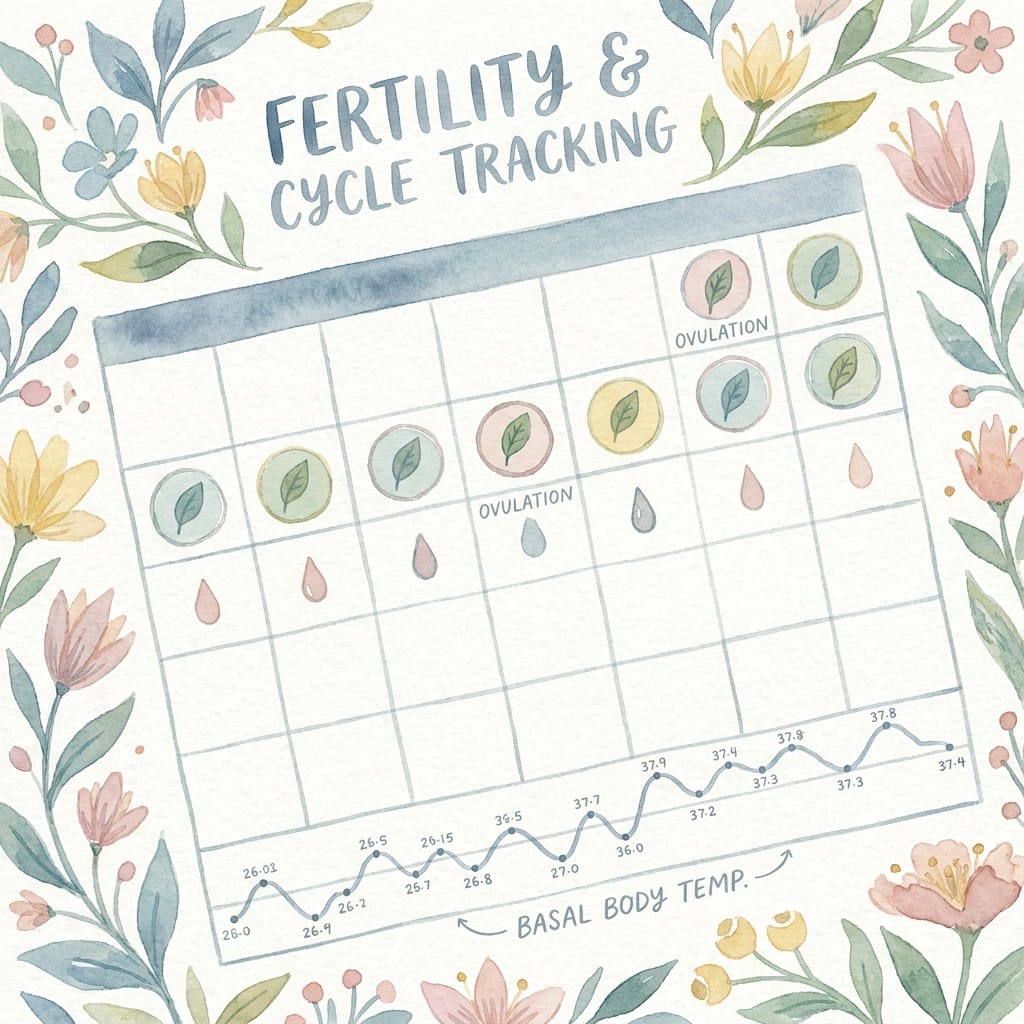
If you choose to track, here are the most useful methods post-miscarriage:
Before you start tracking, give yourself a moment to decide whether it will help or hurt right now. For some women, tracking after a loss provides a sense of control and forward momentum — it turns an anxious wait into a data-gathering exercise, which can feel grounding. For others, it adds pressure and turns every bathroom visit into an analysis session. Both responses are valid. If you're not sure, try tracking for one cycle and see how it feels. You can always stop.
OPKs (Ovulation Predictor Kits)
LH strips are your most reliable tool after a miscarriage, because they detect the LH surge that precedes ovulation regardless of what your cervical mucus or temperature is doing. Start testing about 2 weeks after the miscarriage, or once your bleeding has stopped and hCG is likely near zero.
Important caveat: If you still have residual hCG in your system (from the miscarriage), OPKs can give false positives because hCG and LH are structurally similar. If you're getting positive OPKs that don't lead to a temperature rise or period, this may be residual hCG rather than a true LH surge. A blood test to confirm hCG is at zero can be helpful here.
Cervical Mucus
Check your cervical mucus daily once the bleeding stops. The return of egg white cervical mucus is a strong sign that ovulation is approaching. Some women notice their mucus pattern returns quickly; for others, it takes a cycle or two.
Basal Body Temperature
BBT can confirm ovulation retrospectively (a sustained temperature rise after ovulation). But after a miscarriage, your temperatures may be erratic for a cycle or two. Don't panic about confusing charts — they're normal after a loss.
Emotional Readiness vs Physical Readiness
One thing that catches many women off guard is that their cycle might be different from what they're used to — at least for the first few months. You might ovulate earlier or later than your pre-pregnancy norm. Your luteal phase might be slightly shorter. Your flow might be heavier or lighter than usual. This is completely normal and doesn't indicate a fertility problem. Your body is recalibrating, and it usually settles back into its regular rhythm within 2-3 cycles. If you were tracking before your pregnancy, try to approach post-miscarriage tracking with fresh eyes rather than expecting your body to snap back to the exact same pattern.

Your body may be ready to conceive again within 2-3 weeks. Your heart may need much longer. Or — and this is equally valid — you may feel ready to try again before your body has fully recovered. There's no rulebook for this.
What I tell my clients:
- You don't have to try again immediately just because your body is capable. Grieving fully is not "wasting time."
- You don't have to wait three months if you feel ready. The old advice about waiting has been challenged by newer research.
- Talk to your partner — they may be on a different timeline than you. One of you may want to try immediately; the other may need space. Neither is wrong.
- Consider counselling if the grief feels unmanageable. A miscarriage can trigger depression, anxiety, and PTSD symptoms. Professional support isn't weakness.
What the Research Says About Trying Again
As I covered in detail in my article on miscarriage recovery, the evidence increasingly supports trying sooner rather than later:
Saraswat et al. (2010) — analysed Scottish hospital data and found no worse outcomes for pregnancies conceived within 6 months of miscarriage.
Bangladesh cohort study (2012) — found that pregnancies conceived within 3 months of miscarriage were more likely to result in live birth.
The NHS now says you can try again as soon as you feel physically and emotionally ready. There's no mandatory waiting period.
The Bottom Line
Ovulation typically returns 2-6 weeks after a miscarriage, and your period within 4-8 weeks. You can conceive before your first period arrives — so if you're not ready to try again, use contraception immediately. If you are ready, there's no medical reason to wait. Your first few cycles may be irregular, but they usually settle within 2-3 months. Be patient with your body and gentle with yourself.
In the meantime, this is a good moment to focus on the basics. Make sure you're taking your folic acid (400mcg daily), eating well, and getting enough sleep. If you were taking prenatal vitamins before, there's no reason to stop. Some women find it helpful to have a preconception check-up with their GP — not because anything is wrong, but because it can feel empowering to take a proactive step when so much feels out of your control. Blood tests for iron, vitamin D, and thyroid function can all be done quickly and may reveal issues worth addressing before you try again.
Be gentle with yourself during this time. Grief and hope can coexist — it's completely normal to feel sad about your loss while also feeling eager to try again. There's no right timeline, no correct way to feel, and no deadline for when you should be 'over it.' Your body knows what it's doing, and when you're ready, it will be ready too.
Frequently Asked Questions
▸Can I ovulate before my first period after miscarriage?
Yes — this is common. Ovulation occurs before a period, so if your body ovulates 2-4 weeks after the miscarriage, your first period won't arrive until about 2 weeks after that. You can conceive during this ovulation even though you haven't had a period yet.
▸How do I know if OPKs are picking up hCG or LH after miscarriage?
If you're getting continuous positive OPKs for more than 3-4 days, it's likely residual hCG rather than a true LH surge. A true LH surge lasts 24-48 hours. You can confirm hCG is at zero with a blood test, or wait until pregnancy tests are negative before relying on OPKs.
▸Will my cycles be irregular after miscarriage?
Your first 1-2 cycles may be shorter or longer than usual. Most women find their cycles regulate within 2-3 months. If your cycles remain irregular beyond 3 months, or if you haven't had a period within 8 weeks of the miscarriage, contact your GP.
▸Is it safe to try again before my first period?
Yes. Current evidence shows no increased risk from conceiving in the first cycle after miscarriage. Some doctors recommend waiting for one period for dating purposes — it makes calculating your due date easier. But this is a practical consideration, not a safety requirement.
▸What if I'm not emotionally ready to track my cycle yet?
Then don't. There is absolutely no obligation to start tracking immediately. Use contraception if you're not ready to conceive, and give yourself permission to grieve without the added pressure of cycle tracking. When you're ready — if you're ready — the tracking tools will be there.
References
- Schliep, K.C., et al. (2016). Trying to conceive after an early pregnancy loss: an assessment on how long couples should wait. Obstetrics & Gynecology, 127(2), 204–212.
- Saraswat, L., et al. (2010). Effect of interpregnancy interval on outcomes of pregnancy after miscarriage. BMJ, 341, c3967.
- NHS. (2024). Miscarriage — Afterwards. NHS.uk
Medical Disclaimer: The information in this article is for educational purposes only. If you have had a miscarriage, please consult your GP or early pregnancy unit for personalised guidance on when to try again and any monitoring that may be needed.
Written by

Subscribe to Fertilitys
All my Free Resources. No spam. Unsubscribe anytime.