Cervical Mucus Types: How to Read Your Body's Fertility Signs
A complete guide to every cervical mucus type through your cycle — what each one means for fertility and how to track them


If you've started tracking your cycle, you've probably noticed that what comes out of you changes throughout the month. Some days there's nothing. Some days it's thick and creamy. And then — usually once a cycle — there's a day where it's stretchy, clear, and looks exactly like raw egg white.
That's cervical mucus, and it's one of the most reliable fertility signs your body gives you. Better yet, it's free, requires no gadgets, and once you know what to look for, it takes seconds to check. Let me walk you through every type, what each one means, and how to use this information to time intercourse effectively.
🔑 Key Takeaways
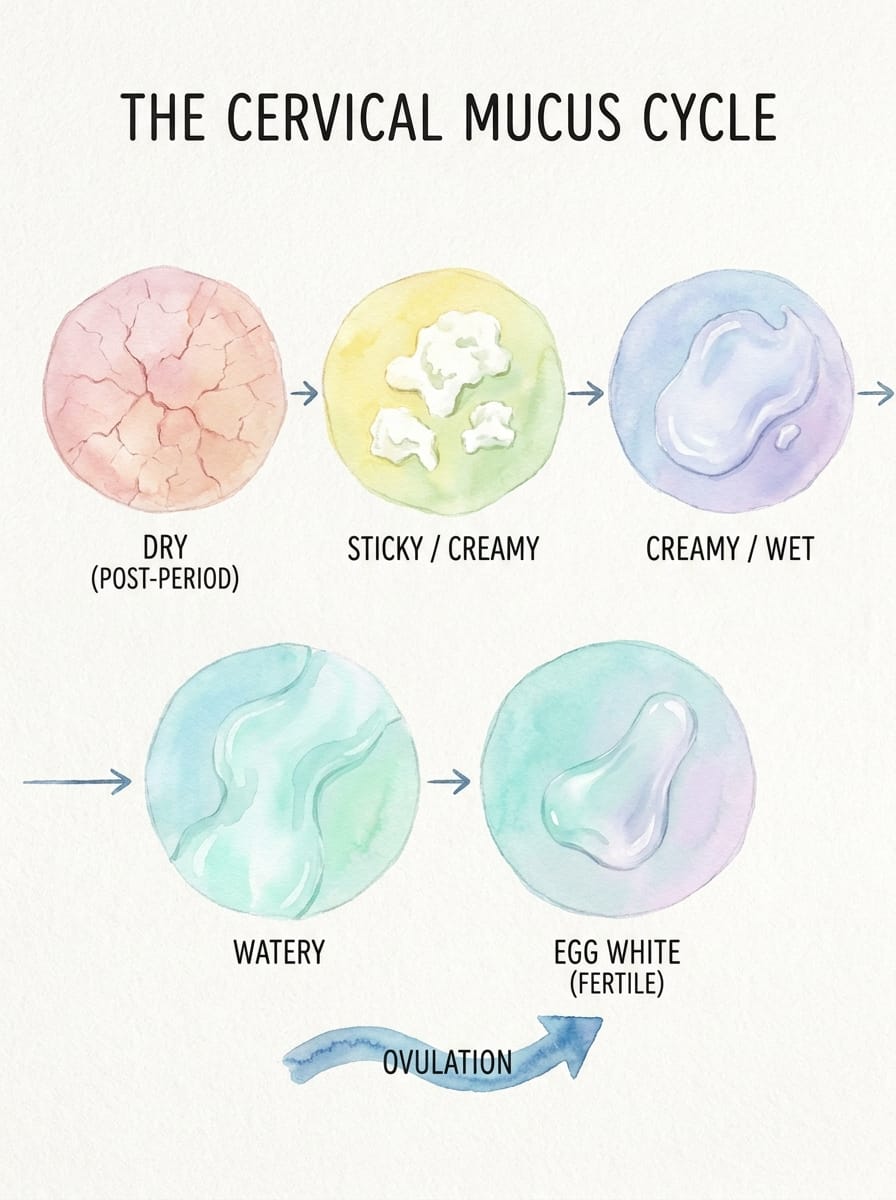
- Cervical mucus is produced by your cervix in response to rising oestrogen as you approach ovulation. It changes predictably from dry → sticky → creamy → egg white → dry again.
- Egg white mucus (EWCM) is your most fertile sign. It creates channels for sperm to swim through and protects them from the acidic vaginal environment.
- Stanford et al. (2002) found that women who reported "watery" or "egg white" mucus had significantly higher daily fecundability (chance of conceiving each cycle).
- Absence of mucus doesn't mean infertility — some women produce less mucus but still ovulate normally. Hydration, medications, and douching can all affect mucus production.
- Check externally, not internally — you can observe mucus on toilet paper or your underwear. You don't need to reach inside your cervix (that's the symptothermal method, which requires training).
What Is Cervical Mucus and Why Does It Matter?
Cervical mucus is a fluid produced by the glands in your cervix (the neck of your womb). Its consistency and quantity change throughout your menstrual cycle in response to the hormones oestrogen and progesterone.
From everything I've learned and experienced, this is one of the most reliable natural signs of ovulation. Think of it as your body's gatekeeper. Most of the cycle, cervical mucus is hostile to sperm — thick, acidic, and impenetrable. But as you approach ovulation and oestrogen rises, the mucus transforms into a sperm-friendly substance that:
- Filters abnormal sperm — only morphologically normal sperm can navigate the channels in fertile mucus
- Nourishes sperm — fertile mucus contains glucose and other nutrients that keep sperm alive for up to 5 days
- Guides sperm — the structure of egg white mucus creates parallel channels that direct sperm toward the egg
- Protects sperm — shields sperm from the acidic pH of the vagina
The WHO developed a classification system for cervical mucus types in the 1980s, and it's still the standard used in fertility awareness methods today.
You might be wondering: do I really need to learn all these categories? Honestly, no. What matters most is recognising the difference between 'dry' and 'wet' — everything else is a gradient. When you notice that shift from sticky or dry to wet and stretchy, that's your body's way of saying ovulation is approaching. The finer classifications are useful if you're using a formal fertility awareness method, but for general cycle tracking, the wet-dry binary gets you most of the way there.
It's also worth knowing that cervical mucus can vary cycle to cycle. Stress, illness, travel, medication, and even hydration levels can all affect what you see. A single dry cycle doesn't necessarily mean something is wrong — it might just mean you were dehydrated, or under more stress than usual, or coming off a course of antihistamines (which dry out all mucous membranes, not just your nose). Look at the pattern over 3-4 cycles rather than drawing conclusions from one.
The 5 Types of Cervical Mucus (Through Your Cycle)
Type 1: Dry (Days After Period → Early Follicular)
Immediately after your period ends, you'll typically feel dry — little or no discharge. Some women notice a slight dampness but nothing visible. This is a non-fertile time. Your oestrogen is at its lowest, and the cervix isn't producing much mucus.

What it looks/feels like: Nothing, or a very slight dry sensation. No visible discharge on your underwear or toilet paper.
Type 2: Sticky (Early-Mid Follicular)
As oestrogen begins to rise, your cervix starts producing a small amount of mucus. It's thick, tacky, and doesn't stretch between your fingers. This is still low fertility, but your body is starting to prepare.
What it looks/feels like: White or cream-coloured, clumpy, breaks when you try to stretch it. Dries quickly on toilet paper.
Type 3: Creamy (Mid Follicular)
I remember the first time I noticed this type — it really is unmistakable once you know what to look for. Oestrogen is rising more noticeably now. The mucus becomes more abundant, smoother, and lotion-like. This is a transitional, moderately fertile time. Sperm can survive in creamy mucus, though not as well as in egg white.
What it looks/feels like: White, yellow, or off-white. Smooth like hand cream or moisturiser. Stretches a little (1-2cm) before breaking. Feels moist on your underwear.
Type 4: Egg White / Watery (Peak Fertility)
This is the money sign. As oestrogen peaks just before ovulation, your mucus becomes thin, clear, stretchy, and slippery. It looks exactly like raw egg white — hence the name. Some women experience a "watery" type instead, which is equally fertile. This is your most fertile time.
Stanford et al. (2002) found that the days with the highest-quality mucus were associated with the highest daily probability of conception. Bigelow et al. (2004) confirmed that the peak mucus day was the single best predictor of the fertile window.
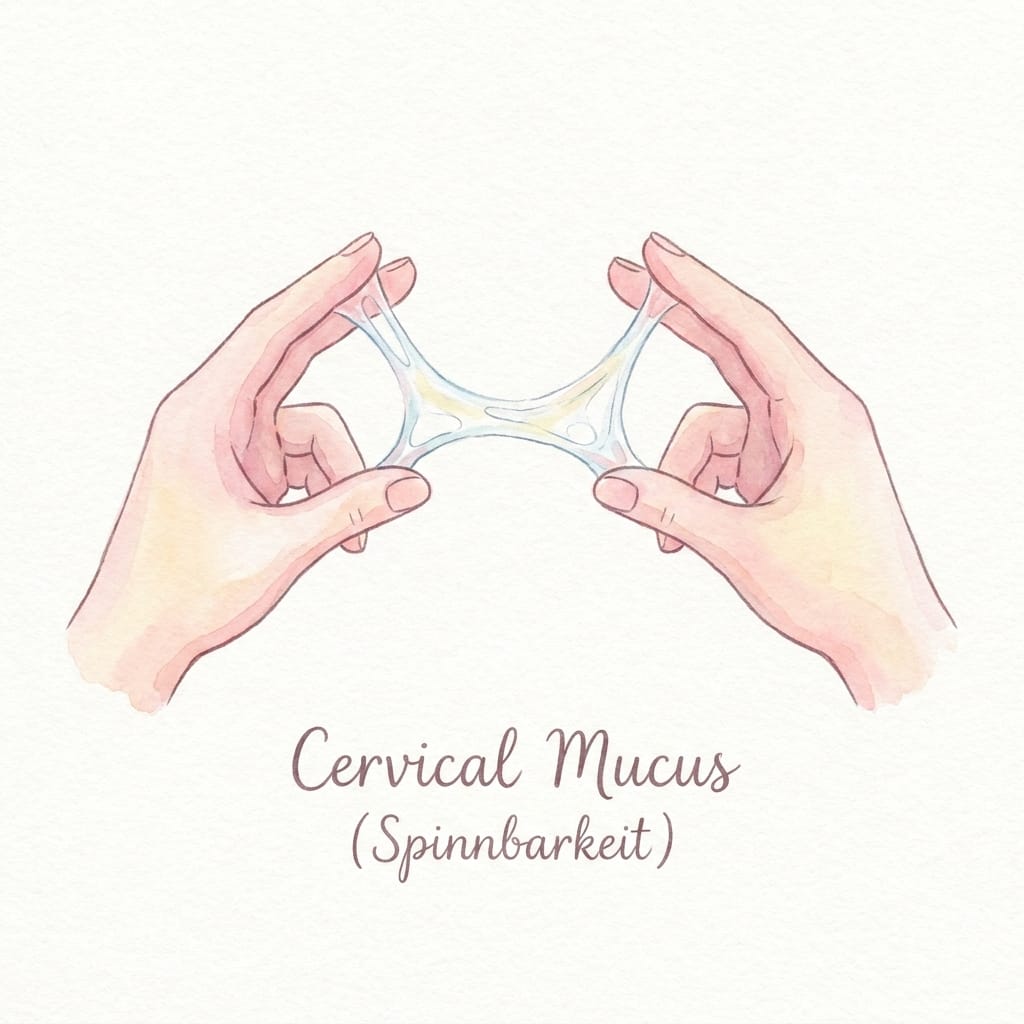
What it looks/feels like: Clear or slightly cloudy. Stretches 5cm+ between your fingers without breaking. Slippery — feels like lubrication. Soaks into underwear rather than sitting on the surface. May be abundant.
When you see this: Have sex today and tomorrow. This is go time.
Type 5: Dry/Sticky Again (Post-Ovulation / Luteal Phase)
From everything I've learned and experienced, this is one of the most reliable natural signs of ovulation. After ovulation, progesterone takes over and the mucus returns to a dry or sticky consistency. The cervix closes its gate again. This is non-fertile until your next cycle begins.
Some women notice a brief drying, then a return of creamy mucus in the luteal phase (driven by progesterone). This is normal and doesn't indicate a second fertile window.
How to Check Your Cervical Mucus
You don't need to do anything invasive. Here's the simple external method:
- Every time you wipe after going to the toilet, notice what's on the toilet paper
- Check your underwear at the end of the day — what does the discharge look like?
- The finger test: wipe your vulva with clean fingers, then press your thumb and finger together and gently pull apart. Does it stretch? How far?
Check at the same time each day (afternoon is often best). Don't check immediately after sex, as arousal fluid and semen can be confused with fertile mucus.
Many women find that checking cervical mucus when they wipe after using the toilet gives the clearest result. You can also check by inserting a clean finger just inside the vaginal opening and noting the sensation and appearance. The key things to record are: colour (clear, white, yellow, or cloudy), consistency (dry, sticky, creamy, or stretchy), and sensation (dry, damp, or wet). Some fertility tracking apps have a specific field for cervical mucus observations — logging it consistently alongside your basal body temperature gives you a much clearer picture of your cycle than either method alone.
One tip from women who have been doing this for years: don't obsess over it in the first couple of cycles. The first month is about learning what your body does, not about timing sex perfectly. By the second or third cycle, you'll start to recognise your own pattern, and it becomes second nature — almost like learning to read a language your body has been speaking all along.
Common Questions About Cervical Mucus
I never see egg white mucus — am I not ovulating?
Not necessarily. Some women produce less mucus than others, and some produce it internally where it's harder to observe externally. Factors that reduce visible mucus include:
- Dehydration — drink more water and you'll often see more mucus
- Antihistamines — dry out all mucous membranes, including cervical
- Douching — destroys the mucus pattern. Stop doing this entirely.
- Certain medications — Clomid (clomiphene citrate) can dry up mucus as a side effect
If you consistently see no mucus and your cycles are irregular, it's worth discussing with your doctor — but many women who don't observe clear EWCM still ovulate and conceive normally.
Can I rely solely on cervical mucus to avoid or achieve pregnancy?
From everything I've learned and experienced, this is one of the most reliable natural signs of ovulation. For avoiding pregnancy, cervical mucus tracking alone (the Billings method) has a typical-use failure rate of about 23% — not reliable as sole contraception. For achieving pregnancy, it's an excellent tool for identifying your fertile window, especially combined with ovulation testing or temperature tracking.
Cervical mucus also matters in the context of assisted reproduction. If you're going through IUI (intrauterine insemination), the quality of your cervical mucus is actually assessed — poor mucus can be one of the reasons IUI is recommended over timed intercourse, since the procedure bypasses the cervix entirely. During IVF, cervical mucus becomes less relevant because fertilisation happens in the lab. But for natural conception and IUI, it's one of the most important factors determining whether sperm can actually reach the egg.
Some medications can significantly affect cervical mucus production. Antihistamines, as I mentioned, dry it out. Clomiphene (Clomid), a common fertility drug, can actually thin cervical mucus as a side effect — your doctor might prescribe oestrogen supplements to counteract this if you're taking Clomid and trying to conceive naturally. Certain antidepressants and decongestants can also reduce mucus production. If you're on any regular medication and struggling to conceive, it's worth asking your doctor whether it could be affecting your cervical mucus.
The Bottom Line
Cervical mucus is one of the most accessible and reliable fertility signs your body offers. Learning to read it gives you a daily window into your hormonal state — for free, with no technology. The progression from dry to egg white to dry again follows a predictable pattern driven by oestrogen, and the peak mucus day is your strongest indicator of imminent ovulation. Take a few cycles to learn your personal pattern, and you'll have a fertility tool that's been used — successfully — for centuries.
Frequently Asked Questions
▸How many days of egg white mucus should I expect?
Most women see 1-4 days of egg white or watery mucus per cycle, with the peak day occurring on or just before ovulation. Some women have a very brief window (one day), while others see it for 3-4 days. Both are normal.
▸Is cervical mucus discharge normal between periods?
Yes — cervical mucus is a normal bodily function throughout your cycle. The amount and type change, but there's almost always some form of discharge. If it's green, grey, has a strong odour, or is accompanied by itching, see your GP as this may indicate an infection.
▸Can I get pregnant without egg white mucus?
Yes. While egg white mucus gives sperm the best chance of survival, sperm can survive in creamy mucus too — just for a shorter time. If you ovulate but don't produce obvious EWCM externally, conception is still very possible. Some women produce fertile mucus internally that they don't observe.
▸Does drinking more water improve cervical mucus?
Being well-hydrated can increase the volume of cervical mucus and make it easier to observe. While there aren't specific studies on water intake and cervical mucus quality, general hydration supports all mucosal secretions. Aim for at least 1.5-2 litres of water per day.
▸Should I use cervical mucus tracking alongside ovulation tests?
They complement each other well. Cervical mucus tells you the fertile window is opening (oestrogen rising), while LH tests tell you ovulation is imminent (within 24-36 hours). Using both gives you the widest possible fertile window for timing intercourse. Mucus starts showing fertile changes 3-5 days before ovulation, while LH surge is detected only 1-2 days before.
References
- Stanford, J.B., White, G.L., & Hatasaka, H. (2002). Timing intercourse to achieve pregnancy: current evidence. Obstetrics & Gynecology, 100(6), 1333–1341.
- Bigelow, J.L., et al. (2004). Mucus observations in the fertile window: a better predictor of conception than timing of intercourse. Human Reproduction, 19(4), 889–892.
- World Health Organization. (1983). A prospective multicentre trial of the ovulation method of natural family planning. Fertility and Sterility, 39(5), 640–647.
Medical Disclaimer: The information in this article is for educational purposes only. Cervical mucus tracking is not a reliable method of contraception on its own. If you have concerns about your cycle or fertility, please consult your GP or fertility specialist.
Written by

Subscribe to Fertilitys
All my Free Resources. No spam. Unsubscribe anytime.