Discharge Before Period: What's Normal, What's Not, and What It Could Mean
A fertility nutritionist's guide to what your pre-period discharge means, how it changes through your cycle, and when it could signal pregnancy or infection.


📌 Key Takeaways
- White or creamy discharge in the days before your period is driven by progesterone and is a normal part of the menstrual cycle
- Discharge typically becomes thicker and less abundant after ovulation, then decreases or disappears just before your period arrives
- Early pregnancy discharge can look very similar to pre-period discharge — the only reliable way to tell the difference is a pregnancy test after a missed period
- Yellow, green, grey, or foul-smelling discharge may signal an infection like bacterial vaginosis or thrush and should be checked by a GP or sexual health clinic
- Tracking your cervical mucus patterns across several cycles helps you learn what's normal for you — and spot anything that isn't
If you've found yourself checking your underwear every time you go to the loo, wondering whether what you're seeing is normal, the start of your period, or — maybe — a sign of pregnancy, you are not alone. I get asked about pre-period discharge constantly, and I completely understand the obsession. When you're trying to conceive, every tiny change feels like it could mean something.
The truth is, vaginal discharge shifts throughout your entire menstrual cycle. It's your body's internal housekeeping system — clearing out dead cells, maintaining the right pH, and protecting against infection. What it looks like in the days before your period is largely controlled by one hormone: progesterone. And once you understand what progesterone does to your cervical mucus, a lot of the anxiety disappears.
So let's go through it properly. What each type of discharge before your period actually looks like, why it changes, what different colours and textures mean, and — because I know this is what you really want to know — how to tell the difference between pre-period discharge and early pregnancy discharge. Any change in vaginal discharge can feel alarming when you're paying close attention, so understanding what's behind it makes all the difference.
What Causes Discharge Before Your Period?
Your cervical mucus changes throughout the menstrual cycle in response to oestrogen and progesterone. In the first half of your cycle (the follicular phase), rising oestrogen makes your discharge wetter, clearer, and more slippery — eventually producing that stretchy, egg white cervical mucus around ovulation that helps sperm travel through the cervix.
After ovulation, everything shifts. Progesterone takes over during the luteal phase, and its job is essentially the opposite of oestrogen's. Where oestrogen said "make things slippery and open," progesterone says "thicken up and close the gates." Najmabadi et al. (2021) found that women experience an average of 6.4 days of fertile-type (estrogenic) mucus per cycle, followed by an abrupt decrease in mucus secretion once progesterone rises after ovulation[1].
This is why the discharge you notice in the week or so before your period tends to be:
- Thicker — more paste-like or lotion-like than the watery, stretchy mucus from earlier in your cycle
- White or cream-coloured — sometimes with a slight yellow tint
- Less abundant — you'll produce less of it compared to earlier in your cycle
- Sticky or tacky — it doesn't stretch between your fingers the way fertile mucus does
Then, in the final 1–2 days before your period, most women notice discharge decreases significantly or stops altogether. That dry feeling right before bleeding starts? That's progesterone dropping and your body preparing to shed the uterine lining.
Vigh-Conrad et al. (2014) confirmed that progesterone makes cervicovaginal fluid more viscous and less permeable — which is one of the mechanisms behind progestin-only contraceptives, but it's also just what happens naturally in every cycle[2].
What Does Normal Discharge Before Your Period Look Like?
I want to be really specific here, because "normal" gets thrown around a lot without anyone actually describing what they mean. Here's what typical pre-period discharge looks like across the luteal phase:
Days 1–5 after ovulation — Discharge transitions from the clear, stretchy egg-white type to something thicker and cloudier. You might notice it becomes white or off-white and feels sticky when you touch it. This is progesterone doing its job.
Days 5–10 after ovulation (mid-luteal phase) — Discharge is at its thickest. It may look like white hand cream or slightly yellowish lotion. The amount of discharge varies — some women have quite a bit, others barely notice any. Both are normal.
Days 10–14 after ovulation (just before your period) — Discharge often decreases sharply. Many women describe a "dry" feeling for a day or two before bleeding begins. Some notice a small amount of very thick, almost crumbly discharge. You might also see a faint brown or pink tinge as spotting begins — that's old blood mixing with mucus as your period starts.
The medical term for normal white vaginal discharge is leukorrhea. It's a mix of cervical mucus, vaginal transudate (fluid that seeps through the vaginal walls), dead cells, and healthy bacteria — primarily Lactobacillus species, which keep the vaginal pH between 3.8 and 4.5[3]. A mild, slightly sour or tangy smell is completely normal and comes from the lactic acid those bacteria produce. It shouldn't smell fishy, foul, or strongly unpleasant.
Discharge Before Period vs Early Pregnancy: Can You Tell the Difference?
This is the question, isn't it? Especially if you're in the two-week wait and analysing every possible symptom.
I'll be honest with you: in most cases, you genuinely cannot tell the difference between pre-period discharge and early pregnancy discharge just by looking at it. I know that's not what you want to hear, but I'd rather be straight with you than give you false certainty.
Here's what we do know. In early pregnancy, rising levels of oestrogen and progesterone can increase the amount of vaginal discharge. This is called leukorrhea of pregnancy, and it tends to be thin, milky-white, and mild-smelling. But here's the problem — that description also matches what plenty of women experience in the days before a normal period.
Some differences people report (though none are reliable enough to diagnose pregnancy):
| Pre-Period Discharge | Early Pregnancy Discharge | |
|---|---|---|
| Texture | Thick, creamy, sticky | May be thinner and more watery |
| Amount | Decreases before period | May stay the same or increase |
| Timing | Stops when period arrives | Continues beyond expected period |
| Colour | White to yellowish-white | Milky white, sometimes clear |
The only reliable way to know if you're pregnant is a pregnancy test after your missed period. If you're tracking your cycle and you're past 12 DPO with no period, that's when testing makes sense. Discharge alone — no matter what it looks like — is not a reliable sign of pregnancy.
I had two chemical pregnancies before my successful one, and I can tell you — I spent hours trying to decode my discharge each time. Looking back, there was no consistent pattern that predicted which cycles would be positive. The only thing that gave me answers was the test itself.
Discharge Colours and What They Mean
Not all discharge is created equal. While white or cream is the standard before your period, other colours can appear — and some of them are worth paying attention to.
White or cream — Normal. This is your standard luteal phase discharge. Thick, sticky, sometimes slightly yellowish. Nothing to worry about unless it's accompanied by itching, burning, or a yeasty smell (which could indicate thrush).
Clear and watery — Can happen at various points in your cycle. If you see it in the days before your period, it may just be vaginal fluid rather than cervical mucus. Perfectly normal.
Yellow — A pale yellow tint to white discharge is normal — it's often just older discharge that's been exposed to air. A bright or dark yellow, especially with an unpleasant smell, could indicate an infection like trichomoniasis or gonorrhoea[4].
Green or grey — This isn't normal. Grey discharge with a fishy smell is the classic sign of bacterial vaginosis (BV), the most common cause of abnormal vaginal discharge in women of childbearing age according to the IUSTI/WHO guidelines (Sherrard et al., 2018)[5]. Green discharge often signals a sexually transmitted infection. See your GP or a sexual health clinic.
Brown or dark red — Usually old blood. Before your period, brown discharge is often just your period beginning slowly. It can also appear after ovulation — ovulation bleeding is more common than people realise. If you're in the two-week wait, brown or pink spotting before your period could be implantation bleeding, though this is far less common than the internet suggests — Harville et al. (2003) estimated that only about 25% of pregnancies involve any implantation bleeding[6].
Thick, white, and lumpy (like cottage cheese) — This is the hallmark of a vaginal yeast infection (thrush). Usually comes with itching, redness, and sometimes a mild yeasty smell. Very common — around 75% of women will have at least one episode in their lifetime — and treatable with over-the-counter antifungals[3].
How Your Discharge Changes Through Each Cycle Phase
It helps to see the full picture. Here's what your cervical mucus typically does across a complete menstrual cycle, based on the patterns described in clinical research:
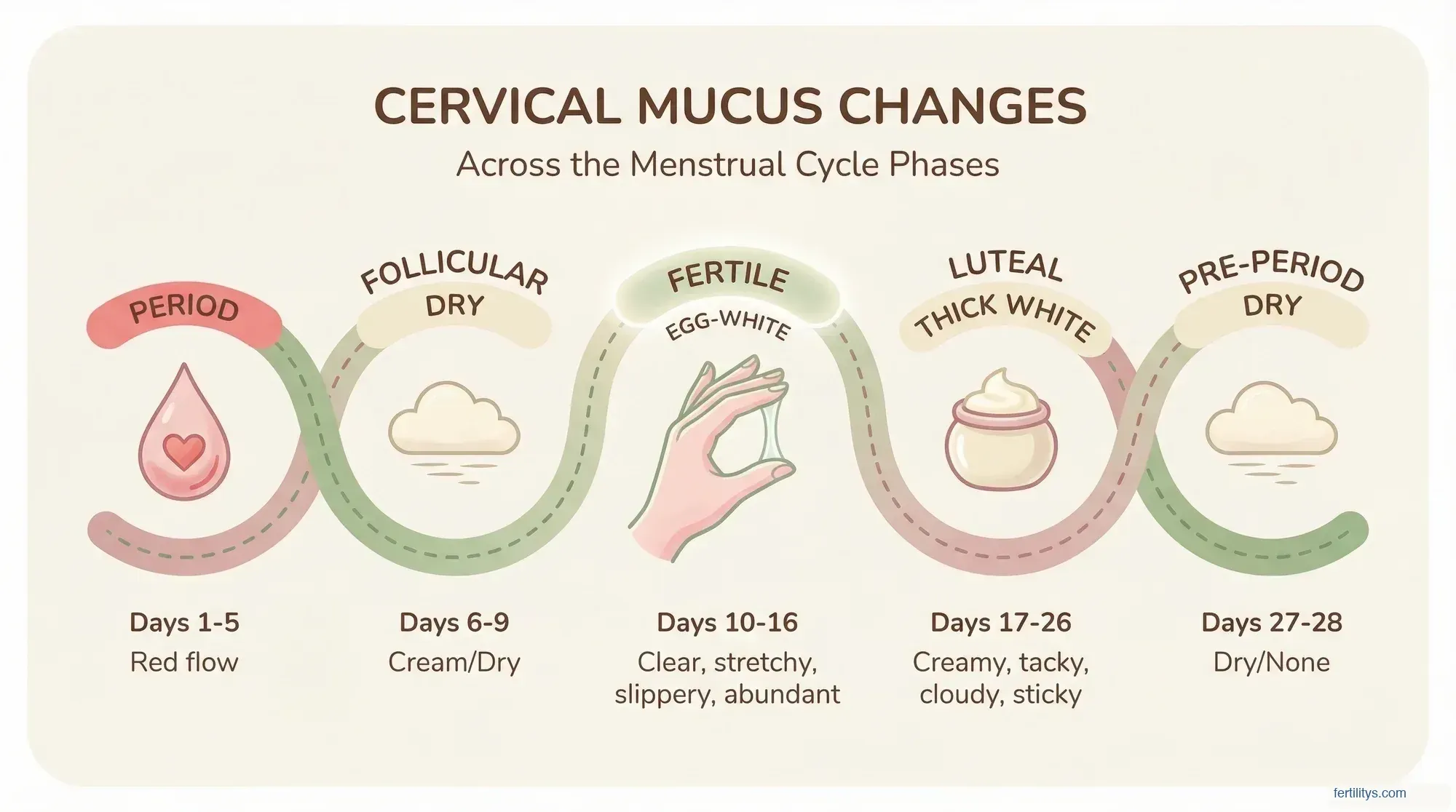
During your period (days 1–5) — Cervical mucus is still being produced, but you won't notice it because it's mixed with menstrual blood. Some women notice a clear or slightly pink discharge in the last day or two of their period as bleeding tapers off.
Early follicular phase (days 6–9) — As oestrogen begins to rise, discharge starts as scant and sticky. Many women describe feeling relatively "dry" during these days.
Late follicular phase (days 10–13) — This is when things get wetter. Discharge becomes creamy, then progressively more clear, stretchy, and slippery as you approach ovulation. The presence of egg-white cervical mucus (EWCM) is a strong indicator of peak fertility. Bigelow et al. (2004) found that mucus observations were a better predictor of conception probability than timing of intercourse alone[7].
Ovulation (around day 14) — Peak mucus: clear, stretchy, wet. Your most fertile days. If you're using an ovulation test, the positive result typically comes 24–36 hours before ovulation, which lines up with when mucus is at its most fertile.
Luteal phase (days 15–28) — Progesterone dominates. Discharge thickens, becomes white or cream, decreases in quantity. In the final days before your period, it may almost disappear entirely.

I always encourage my clients to track their cervical mucus alongside other fertility signs. It's free, it doesn't require any gadgets, and after 2–3 cycles you'll start recognising your own patterns. You can use an app, a simple notebook, or even the notes section of your ovulation calculator.
When to See a Doctor About Discharge
Most changes in discharge before your period are completely normal. But there are a few signs that warrant a GP visit or a trip to a sexual health clinic:
- Discharge that smells strongly fishy, foul, or very unpleasant (BV or an STI)
- Green, grey, or bright yellow discharge
- Thick, cottage cheese-like discharge with intense itching (thrush — you can treat this over-the-counter, but see a GP if it keeps coming back)
- Discharge accompanied by pelvic pain, fever, or pain during sex
- Any significant change from your normal pattern that persists for more than one cycle
- Blood-tinged discharge that isn't related to your period or ovulation, especially if you're post-menopausal
If you're actively trying to conceive, make sure to mention any persistent discharge changes to your fertility specialist or GP. BV in particular can affect fertility — it disrupts the vaginal microbiome and may reduce the chances of implantation, which is something I always flag with clients who are dealing with recurrent BV[5].
The Bottom Line
Discharge before your period is one of those things that feels mysterious until you understand the hormones behind it. Progesterone thickens your cervical mucus after ovulation, making it white, creamy, and sticky — and then it tapers off in the day or two before your period arrives. That's the normal pattern, and it happens every single cycle.
If you're hoping the discharge you're seeing is an early sign of pregnancy, I understand that hope completely. But the honest truth is that pre-period discharge and early pregnancy discharge look almost identical. The only way to know is to wait and test. And I know waiting is the hardest part of all of this.
What I'd encourage you to do is start tracking. Get to know your own patterns. Because once you know what your normal looks like, you'll spend less time googling and more time trusting your body — and that's a much better place to be.
▸Is it normal to have discharge every day before your period?
Yes. Some women produce noticeable discharge throughout their entire luteal phase (the roughly two weeks between ovulation and their period). Others notice it decreasing towards the end. Both patterns are normal. The consistency and amount vary between women, and what matters most is whether it's consistent with your own typical pattern.
▸What does discharge look like before your period starts?
In the days leading up to your period, discharge is usually thick, white or cream-coloured, and sticky or paste-like. It's less abundant than the clear, stretchy mucus you produce around ovulation. In the final 1–2 days before bleeding, many women notice discharge decreasing significantly or stopping altogether.
▸Can white discharge before your period be a sign of pregnancy?
It can be, but it's not a reliable indicator on its own. Both pre-period discharge and early pregnancy discharge can look milky white. In early pregnancy, discharge may be slightly thinner and more abundant, and it continues rather than decreasing before your expected period. A pregnancy test after a missed period is the only reliable way to confirm.
▸Why does my discharge change colour before my period?
Colour changes are usually caused by hormonal shifts, the age of the discharge (older discharge exposed to air can turn slightly yellow), or small amounts of blood mixing in. A brown or pink tinge before your period is typically old blood from your uterine lining beginning to shed. If you see green, grey, or bright yellow discharge with an unpleasant smell, it could indicate an infection — see your GP.
▸Does discharge stop before your period?
For many women, yes. As progesterone drops in the day or two before your period, cervical mucus production decreases and you may feel relatively dry. Some women describe this as the "calm before the storm." However, not everyone experiences this — some continue producing discharge right up until bleeding begins, and that's also perfectly normal.
You might also find helpful:
References
- Najmabadi S, Schliep KC, Simonsen SE, Porucznik CA, Egger MJ, Stanford JB. Cervical mucus patterns and the fertile window in women without known subfertility: a pooled analysis of three cohorts. Human Reproduction. 2021;36(7):1784–1795. doi:10.1093/humrep/deab086
- Vigh-Conrad KA, Yuan LW, Bhatt DK, Hillier SL, Meyn LA, Haggerty CL, Wiesenfeld HC, Cone RA. The effects of reproductive hormones on the physical properties of cervicovaginal fluid. American Journal of Obstetrics and Gynecology. 2014;211(3):226.e1–226.e7. doi:10.1016/j.ajog.2014.03.041
- Sobel JD. Vaginitis. New England Journal of Medicine. 1997;337(26):1896–1903. Updated in StatPearls: Vaginitis [Internet]. Treasure Island (FL): StatPearls Publishing; 2025. NCBI Bookshelf
- Reed BG, Carr BR. The Normal Menstrual Cycle and the Control of Ovulation. In: Feingold KR, et al., editors. Endotext. South Dartmouth (MA): MDText.com; Updated 2024. NCBI Bookshelf
- Sherrard J, Wilson J, Donders G, Mendling W, Jensen JS. 2018 European (IUSTI/WHO) International Union against Sexually Transmitted Infections (IUSTI) World Health Organisation (WHO) guideline on the management of vaginal discharge. International Journal of STD & AIDS. 2018;29(13):1258–1272. doi:10.1177/0956462418785451
- Harville EW, Wilcox AJ, Baird DD, Weinberg CR. Vaginal bleeding in very early pregnancy. Human Reproduction. 2003;18(9):1944–1947. doi:10.1093/humrep/deg379
- Bigelow JL, Dunson DB, Stanford JB, Ecochard R, Gnoth C, Colombo B. Mucus observations in the fertile window: a better predictor of conception than timing of intercourse. Human Reproduction. 2004;19(4):889–892. doi:10.1093/humrep/deh173
Medical Disclaimer
This article is for informational purposes only and is not a substitute for professional medical advice, diagnosis, or treatment. Always consult your GP, midwife, or healthcare provider with any questions about your health or a medical condition. If you're experiencing symptoms that concern you, please seek medical attention. I'm a registered nutritionist (MSc, RNutr), not a medical doctor.
Written by

Subscribe to Fertilitys
All my Free Resources. No spam. Unsubscribe anytime.