Sperm Morphology: What Low Morphology Means and What to Do About It
What sperm morphology actually measures, why low results are less alarming than you think, and evidence-based ways to improve


Your partner's semen analysis results come back, and one number catches your eye: morphology. It's flagged as low, and suddenly you're spiralling. Does this mean he's infertile? Does this mean IVF? Before you go down that rabbit hole, let me tell you what sperm morphology actually means — and more importantly, what it doesn't.
I work with couples dealing with male factor fertility issues regularly, and morphology is consistently the most misunderstood result on a semen analysis. The good news is that it's usually far less alarming than it first appears.
🔑 Key Takeaways
- Sperm morphology is the LEAST predictive individual semen parameter. Low morphology alone doesn't diagnose infertility — the AUA and ASRM guidelines confirm this.
- 4% normal forms is the WHO threshold — meaning 96% of sperm can be "abnormal" and you're still within normal range. That's expected, not alarming.
- Most abnormal sperm never would have fertilised an egg anyway. The body produces millions of imperfect sperm as a byproduct of high-volume production.
- Antioxidants like CoQ10 (200-300mg/day) and omega-3 fatty acids have shown the strongest evidence for improving morphology in RCTs.
- Lifestyle changes take 3-6 months to show results because sperm take about 74 days to mature. Be patient with the process.
What Is Sperm Morphology?
Sperm morphology refers to the shape and structure of sperm cells. Under a microscope, a trained embryologist examines at least 200 sperm and counts how many have a normal shape — oval head, intact midpiece, and a single straight tail. The result is given as a percentage of normal forms.
There are two main assessment methods:
- WHO criteria (World Health Organization) — the global standard. The 6th edition (2021) sets the lower reference limit at 4% normal forms.
- Kruger strict criteria — a more rigorous method developed by Dr. Thinus Kruger in the 1980s. It uses tighter measurements for head width, length, and midpiece dimensions. Many fertility clinics prefer Kruger because it was originally studied in IVF settings and has slightly better predictive value for IVF fertilisation rates.
Both methods are valid. The key thing to know: under either system, having mostly "abnormal" sperm is completely normal. A healthy, fertile man might have only 4-15% morphologically normal sperm. The other 85-96% are imperfect — and that's how sperm production works. It's a volume game, not a precision game.
Sperm abnormalities fall into several categories, and understanding them can take some of the fear out of seeing a low result. Head defects — oversized, tapered, or double heads — are the most common, accounting for roughly 60-70% of abnormal forms. Midpiece defects (thick, bent, or absent midpieces) make up about 20-25%, while tail defects (coiled, doubled, or absent tails) account for the remaining 10-15%. A trained embryologist can distinguish between these during analysis, and the specific type of defect sometimes points to different underlying causes. For example, a predominance of tapered heads has been linked to varicoceles, while high rates of cytoplasmic droplets on the midpiece can suggest testicular stress.
Does Low Morphology Mean Infertility?
Short answer: no, not on its own.
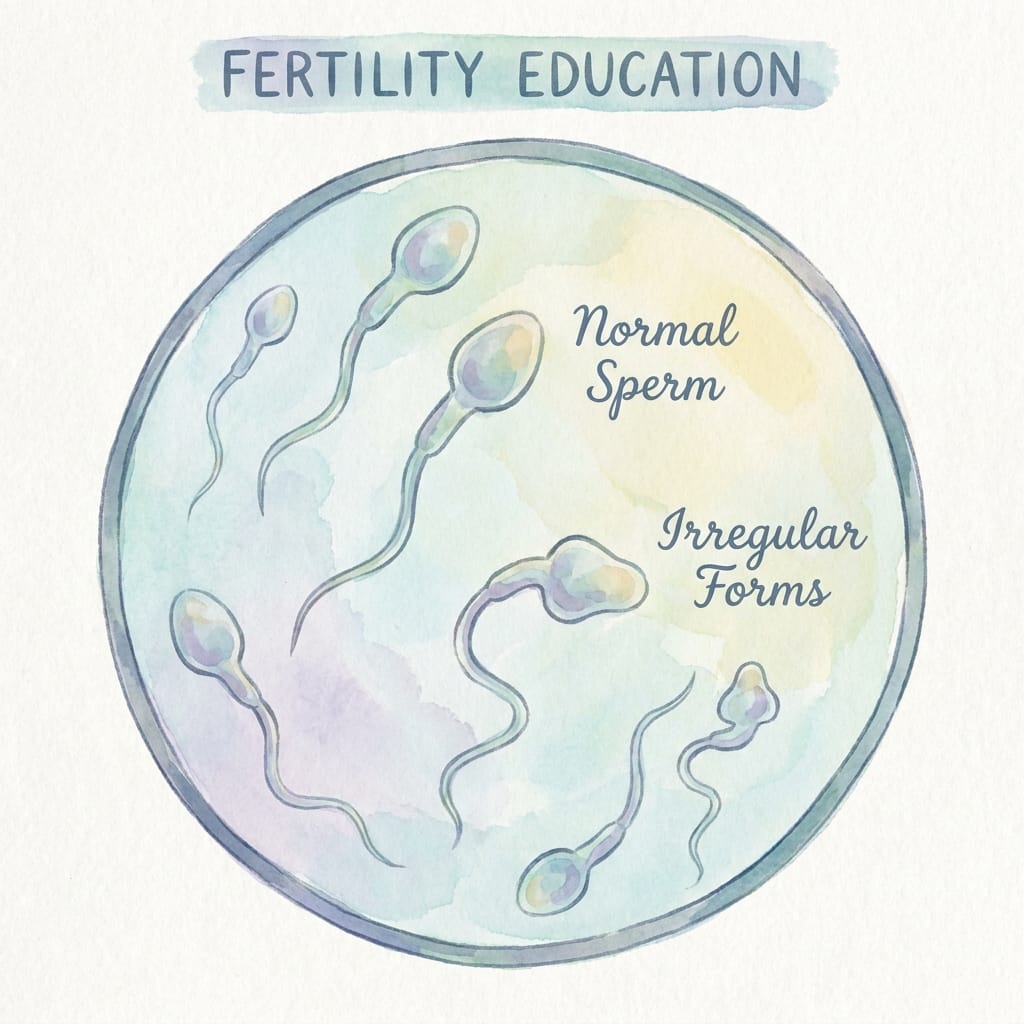
The AUA and ASRM guidelines explicitly state that an individual sperm parameter like morphology is "not highly predictive of fertility nor does it diagnose infertility." A 2024 study in F&S Reports found a high rate of isolated teratospermia (low morphology with normal count and motility) in a population of fertile men — men who had successfully fathered children naturally.
Here's why morphology alone isn't definitive:
- Other parameters matter more. Sperm count (concentration) and motility (movement) are generally better predictors of natural conception than morphology.
- Morphology is subjective. Two embryologists looking at the same sample can score it differently. The inter-observer variability is significant.
- One sample isn't enough. The WHO recommends at least two semen analyses before drawing conclusions, because sperm quality varies naturally from month to month.
That said, very low morphology (less than 4% by Kruger criteria, particularly below 1%) combined with other abnormal parameters can indicate a more significant issue and may warrant ICSI (intracytoplasmic sperm injection) during IVF, where a single sperm is injected directly into the egg.
What Causes Abnormal Sperm Shape?
Sperm morphology can be affected by:
- Heat — tight underwear, frequent hot baths/saunas, laptop on the lap, cycling long distances
- Oxidative stress — smoking, excessive alcohol, poor diet, environmental toxins
- Varicocele — enlarged veins in the scrotum, present in about 15% of all men and up to 40% of men with fertility issues
- Infections — past or current genital tract infections
- Medications — some antibiotics, steroids, and certain other medications
- Age — morphology tends to decline modestly with age
- Genetics — some men have a genetic predisposition to higher rates of abnormal morphology
What's particularly frustrating about morphology is that we don't always know why it's abnormal. Unlike count or motility, where we can often point to a clear cause, morphology can be low even when everything else looks fine. This 'isolated teratozoospermia' is more common than you'd think — a 2019 study in Andrology found that roughly 15-20% of men at fertility clinics had isolated abnormal morphology with no other identifiable issues (Agarwal et al., 2019).
Age also plays a role that's often overlooked. While we tend to focus on maternal age, paternal age over 40 is associated with declining sperm quality across all parameters, including morphology. A large systematic review in Fertility and Sterility (Sharma et al., 2020) found that men over 40 had significantly higher rates of abnormal sperm morphology compared to younger men, with the effect becoming more pronounced after age 45.

How to Improve Sperm Morphology
The encouraging news: sperm quality is one of the most responsive parameters to lifestyle changes. Because sperm regenerates completely every ~74 days, the changes you make today can show up in a semen analysis in 3-6 months.
Antioxidants with Evidence
A network meta-analysis of RCTs published in Advances in Nutrition (2021) examined the effect of various antioxidants on sperm quality. The findings:
- CoQ10 (200-300mg/day) — achieved the highest rank in efficacy for sperm concentration. A 2022 network meta-analysis in Frontiers in Endocrinology confirmed that CoQ10 and omega-3 had a "favorable effect on sperm morphology" compared to placebo.
- Omega-3 fatty acids — improved sperm morphology in multiple RCTs. Fish oil or algae-based supplements.
- Zinc — essential for sperm production. Deficiency is associated with poor morphology.
- Selenium — works synergistically with vitamin E to protect sperm from oxidative damage.
- Folate — important for DNA synthesis during sperm production.
A combination supplement containing carnitine, arginine, zinc, vitamin E, glutathione, selenium, folate, and CoQ10 improved morphology, motility, and count in a 2020 RCT. But you don't need to take all of these separately — a good male fertility supplement covers the bases.
Lifestyle Changes
- Loose, breathable underwear — boxers over briefs. Keep the scrotum cool.
- Quit smoking — one of the most impactful single changes. Smoking significantly increases oxidative stress on sperm.
- Reduce alcohol — moderate consumption (1-2 drinks) is probably fine, but heavy drinking is clearly harmful.
- Maintain healthy weight — obesity is associated with poorer sperm morphology, likely through increased heat and hormonal disruption.
- Limit heat exposure — no hot tubs, saunas, or prolonged laptop use on the lap.
- Manage stress — chronic stress affects male hormones too. See my article on meditation for fertility — this applies to partners as well.
Diet and Nutrition
What you eat directly affects the quality of your sperm. A 2022 systematic review in Nutrients found that diets rich in omega-3 fatty acids, zinc, folate, and antioxidants were consistently associated with better sperm morphology (Salas-Huetos et al., 2022). The Mediterranean diet pattern showed the strongest correlation — men following it had roughly 2.5 times higher odds of normal morphology compared to those on a typical Western diet.
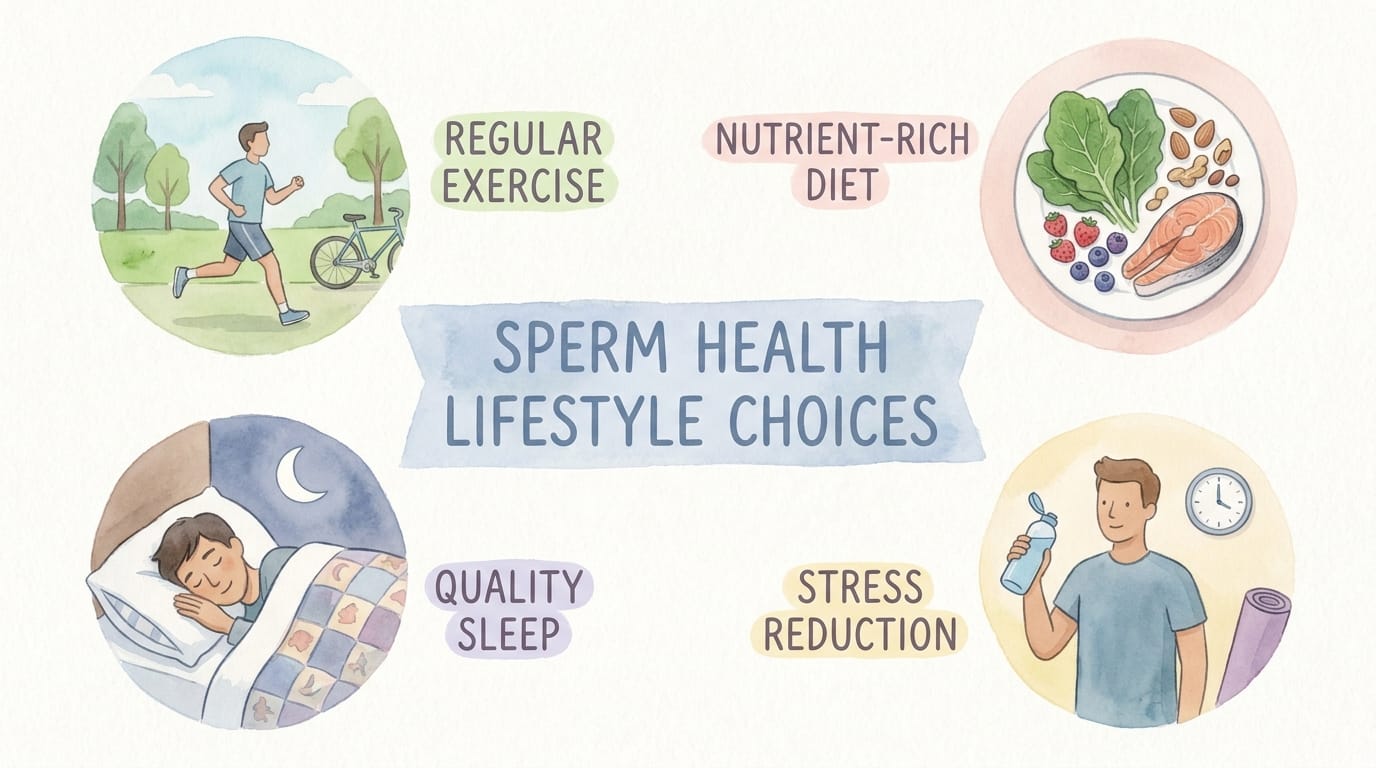
Some specific foods worth adding: walnuts (a randomised trial by Robbins et al., 2012, found 75g daily improved morphology after 12 weeks), dark leafy greens for folate and antioxidants, fatty fish like salmon or sardines for omega-3s, and oysters or pumpkin seeds for zinc. Processed meats, trans fats, and excessive sugar have all been linked to poorer sperm quality. Small, consistent changes make a real difference over the 3-6 month sperm regeneration cycle.
When to See a Specialist
If two semen analyses show morphology below 4% AND other parameters are abnormal (low count or motility), it's worth seeing a urologist or fertility specialist. They may recommend:
It's also worth knowing that morphology interpretation can vary between labs. The Kruger strict criteria are considered the gold standard, but not all labs use them — some use the older WHO 'liberal' criteria, which have a much lower threshold (just 1% normal forms). If your results seem confusing, ask which method was used. A result that looks alarming by one standard might be within normal range by another.
If you're dealing with low morphology, try not to let it consume you. I see so many couples who fixate on that one number and lose sight of the bigger picture. Semen analysis is a screening tool, not a crystal ball. The real question isn't 'what does this number mean?' — it's 'can we achieve a pregnancy?' And that answer involves far more than just morphology.
- Varicocele repair (if a varicocele is present)
- Hormone testing
- Genetic screening
- Discussion of IUI vs IVF/ICSI depending on the full picture
The Bottom Line
Sperm morphology is the most misunderstood parameter on a semen analysis. Having mostly "abnormal" sperm is normal — the body produces sperm in massive numbers, and many are imperfect. What matters is the overall picture: count, motility, and morphology together. Low morphology alone rarely prevents natural conception, and with targeted antioxidant supplementation and lifestyle changes, it often improves within 3-6 months.
Frequently Asked Questions
▸What is a normal sperm morphology percentage?
By WHO 2021 criteria, ≥4% normal forms is the lower reference limit. By Kruger strict criteria, the same 4% threshold applies, though original Kruger studies used ≥14% for predicting IVF fertilisation. Most fertile men have between 4-15% normal forms.
▸Can you still get pregnant with low sperm morphology?
Yes — many couples conceive naturally even when morphology is below normal. If count and motility are good, isolated low morphology is usually not a barrier to natural conception. It may take a bit longer, but it's not a diagnosis of infertility on its own.
▸How can I improve my partner's sperm morphology?
The evidence-based approach: CoQ10 (200-300mg/day), omega-3 fatty acids, zinc, and selenium. Lifestyle: quit smoking, reduce alcohol, wear loose underwear, avoid heat exposure, and maintain a healthy weight. Results take 3-6 months to show because sperm take about 74 days to fully mature.
▸What's the difference between WHO and Kruger morphology?
WHO criteria are the international standard and slightly more lenient. Kruger strict criteria use tighter measurements and were specifically studied in IVF settings. Both use the same 4% threshold. Kruger is more commonly used in fertility clinics because it was originally validated against IVF outcomes.
▸Does low morphology mean we need IVF?
Not necessarily. Low morphology alone — especially if count and motility are normal — doesn't automatically mean IVF is needed. Many couples conceive naturally or with minimal assistance (timed intercourse, IUI). IVF with ICSI is typically considered when multiple semen parameters are severely abnormal. Your fertility specialist will look at the complete picture, not just morphology.
References
- ASRM. (2023). Sperm morphology (shape): Does it affect fertility? Patient Education Fact Sheet. ASRM
- World Health Organization. (2021). WHO Laboratory Manual for the Examination and Processing of Human Semen. 6th edition. WHO Press.
- Ambrosini, G., et al. (2021). Effect of antioxidants on sperm quality parameters in subfertile men: a systematic review and network meta-analysis. Advances in Nutrition, 13(5), 1621–1634. ScienceDirect
- Salas-Huetos, A., et al. (2022). The effect of antioxidants on sperm quality parameters and pregnancy rates for idiopathic male infertility: a network meta-analysis. Frontiers in Endocrinology, 13, 810242. Frontiers
- F&S Reports (2024). High rate of isolated teratospermia in a population of fertile men. F&S Reports
Medical Disclaimer: The information in this article is for educational purposes only and is not a substitute for professional medical advice. If you or your partner have concerns about semen analysis results, please consult a fertility specialist or urologist for personalised assessment.
Written by

Subscribe to Fertilitys
All my Free Resources. No spam. Unsubscribe anytime.