Ovulation Bleeding: What It Looks Like, Why It Happens, and When to Worry
A fertility nutritionist's guide to mid-cycle spotting — what causes it, what it looks like, and whether it affects your fertility.


You're mid-cycle, nowhere near your period, and you notice a streak of pink on the toilet paper. Or maybe a faint smudge on your underwear that definitely isn't your period starting early. Your brain immediately starts scrolling through possibilities — is something wrong? Could I be pregnant? Is this normal?
I see this question constantly, and the short answer is: yes, it's almost always normal. But I know that "almost always" isn't particularly comforting when it's your body doing something unexpected. So let's go through exactly what ovulation bleeding is, why it happens, what it looks like, and — because I know this is what many of you really want to know — whether it means anything for your fertility.
What Is Ovulation Bleeding?
Ovulation bleeding (sometimes called ovulation spotting or mid-cycle spotting) is light vaginal bleeding that occurs around the time your ovary releases an egg. In a typical 28-day cycle, that happens around day 14 — though the exact timing varies from person to person and even cycle to cycle.
It's not a period. Not even close. We're talking about very light spotting, the kind you'd notice when you wipe or as a small mark on your underwear. Most women who experience it describe it as barely there — easy to miss entirely if you're not paying attention.
The BioCycle Study — one of the most thorough investigations of menstrual bleeding patterns in healthy women — found that only 4.8% of cycles included any mid-cycle bleeding at all (Dasharathy et al., 2012). A broader survey of over 3,900 women aged 21–40 found that 13.3% reported mid-cycle spotting over the previous year (Harlow & Ephross, 1995). So while it's definitely not rare, the majority of women never experience ovulation bleeding or spotting at all.
And here's the thing that matters most: it doesn't mean something is wrong. For most women, it's simply your hormones doing their job.
Why Does Ovulation Bleeding Happen?
To understand why you might spot at ovulation, it helps to know what's going on hormonally at this point in your cycle.
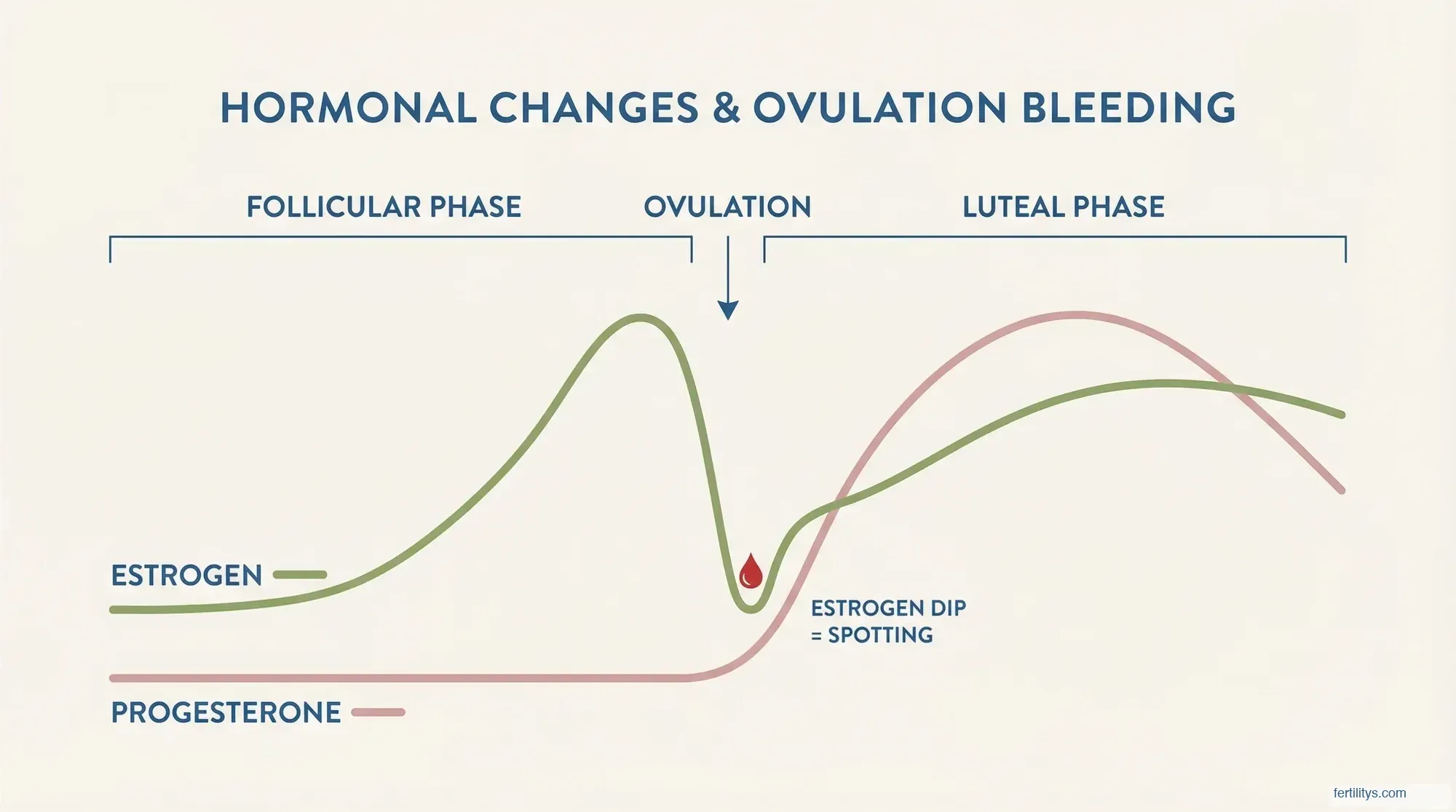
During your follicular phase, oestrogen steadily rises, thickening the lining of your uterus (the endometrium) in preparation for a potential pregnancy. This oestrogen peak triggers a surge in luteinising hormone (LH) — the signal that tells your ovary to release an egg.
Here's where the spotting comes in. Right after that LH surge, oestrogen levels drop quite sharply. Progesterone hasn't fully kicked in yet — there's a brief hormonal gap. Reed and Carr (2018) describe this as a transient withdrawal of oestrogen support from the endometrium, which can cause a small amount of the uterine lining to shed. Think of it as a mini version of what happens at the start of your period, just much lighter.
The follicle rupture itself may also contribute. When the egg breaks through the surface of the ovary, it can cause a tiny amount of bleeding or fluid release — this sometimes irritates the surrounding tissue. Some researchers point to this as an explanation for ovulation pain — that one-sided twinge known as mittelschmerz — and it may occasionally contribute to spotting too (Brott & Le, 2023).
There's also emerging evidence that the ratio of progesterone to oestrogen matters. Women with relatively higher progesterone and lower oestrogen immediately after ovulation may be more likely to experience spotting (Thiyagarajan et al., 2025). It's not about having "abnormal" hormone levels — just that the transition between the two phases is a bit more dramatic in some women than others.
What Does Ovulation Bleeding Look Like?
If you've seen it, you probably already know it looks nothing like a period. But for those who aren't sure what they're seeing, here's a practical breakdown.
Colour: Usually light pink (fresh blood mixed with cervical mucus) or light brown (older blood that took a little longer to leave the body). Bright red is less typical — if you're seeing bright red flow, that's worth investigating further.
Amount: Very light. We're talking about a spot on your underwear, a streak when you wipe, or a slight tinge in your cervical mucus. You wouldn't need a pad or tampon. Many women only notice it because they're actively tracking their cycle.
Duration: One or two days at most. Some women notice it for just a few hours. If bleeding continues for more than three days mid-cycle, it's less likely to be ovulation spotting and worth mentioning to your GP.
Timing: Appears around day 12–16 of your cycle (roughly 12–16 days before your next period is due). If you're using ovulation tests, you'd typically see the spotting on the day of or just after your LH surge.
Other signs it might accompany: Mild one-sided pelvic pain (mittelschmerz), increased cervical mucus that looks like raw egg white, a slight rise in basal body temperature, and — for some — a brief dip in mood or energy. These are all normal ovulation signals.
Ovulation Bleeding vs. Implantation Bleeding vs. Your Period
This is the comparison most of you are here for — especially if you're trying to conceive. The three types of bleeding can look similar, but the timing tells you almost everything you need to know.
Ovulation spotting happens mid-cycle, roughly 12–16 days before your next period. It's light pink or brown, lasts 1–2 days, and coincides with other ovulation signs like egg-white cervical mucus and a positive OPK.
Implantation bleeding happens much later — typically 8–12 days after ovulation, which puts it just a few days before your period is due. It can look similar (light pink or brown), but the timing is completely different. If you're tracking your cycle, that 10-day gap between ovulation spotting and implantation bleeding is the key distinction. Implantation bleeding may also come with very early pregnancy symptoms like mild cramping, breast tenderness, or fatigue.
Your period starts heavier, gets progressively lighter, and lasts 3–7 days. The colour is typically deeper red. If you're producing a flow that needs a pad or tampon, that's not ovulation spotting.
I remember when I first started tracking my cycle properly — every little sign felt like it could mean everything. Is this spotting? Is this implantation? Am I imagining it? If that's where you are right now, know that cycle tracking genuinely does get easier with practice. After a few months, you start recognising your own patterns.
Does Ovulation Bleeding Mean You're More Fertile?
This is a question I get asked a lot, and the honest answer is: not exactly, but it's a good sign.
Ovulation bleeding is caused by the hormonal shifts that occur when you ovulate. So if you're spotting mid-cycle and the timing lines up, it's a reasonable indicator that ovulation has happened — which means you're in your fertile window.
But — and this is an important but — the absence of spotting doesn't mean you haven't ovulated. Most women ovulate perfectly normally without any mid-cycle bleeding at all. The BioCycle Study confirmed that 95% of ovulatory cycles had no mid-cycle spotting whatsoever (Dasharathy et al., 2012). So don't worry if you never see it.
If you're trying to conceive and want to pinpoint ovulation more reliably, I'd suggest using a combination of methods rather than relying on spotting alone. Ovulation tests that detect your LH surge, cervical mucus tracking, and an ovulation calculator based on your cycle length will give you a much clearer picture. Spotting, if it happens, is just one more piece of data to add to the pattern.
When to See Your Doctor
Occasional mid-cycle spotting that fits the pattern I've described above? Totally normal. But there are times when bleeding between periods does need medical attention. Here's when to book an appointment:
Persistent bleeding between periods — if you bleed between periods in most or every cycle, or if the bleeding is getting heavier over time, mention it to your GP. NICE guidelines recommend investigation for persistent intermenstrual bleeding, particularly to rule out cervical or endometrial causes (NICE, 2018).
Heavy mid-cycle bleeding — if you're soaking a pad or tampon mid-cycle, that's not ovulation spotting. Heavy intermenstrual bleeding can indicate polyps, fibroids, hormonal imbalance, or infection.
Bleeding after sex — postcoital bleeding has its own set of causes and should always be investigated, especially if it's happening regularly.
Bleeding with severe pain — mild cramping around ovulation is normal. Sharp, severe, or one-sided pain accompanied by bleeding could indicate an ovarian cyst rupture, ectopic pregnancy, or other conditions that need prompt evaluation.
Irregular cycles with spotting — if your cycles are already irregular and you're also spotting between periods, it's worth getting a full hormone panel done. Conditions like PCOS, thyroid disorders, and luteal phase deficiency can all cause intermenstrual bleeding.
New spotting on hormonal contraception — breakthrough bleeding on the pill or with an IUD is common in the first few months but should settle. If it doesn't, speak to whoever prescribed your contraception.

How to Track Ovulation Bleeding
If you're trying to conceive — or even just trying to understand your cycle better — tracking when you experience bleeding or spotting mid-cycle alongside your other fertility signs can be genuinely useful.
Note the day it starts and stops. Record it in whatever tracking app or journal you use. Over a few months, you'll see whether it's consistent.
Pair it with OPK results. If your spotting consistently appears on the day of or just after a positive ovulation test, that's a reliable pattern telling you ovulation has occurred.
Track your cervical mucus. Ovulation spotting often appears alongside or just after peak-quality egg-white cervical mucus — the stretchy, clear discharge that signals your most fertile days.
Watch for the temperature shift. If you're tracking basal body temperature, the spotting should roughly coincide with the thermal shift that confirms ovulation. Together, these signs create a clear picture of your cycle phases.
Note the colour and amount each time. Consistency cycle-to-cycle is reassuring. Changes — heavier, darker, longer — are worth paying attention to.
The Bottom Line
Ovulation bleeding is one of those things that sounds more alarming than it actually is. For the roughly 5–13% of women who experience it, it's simply a visible side effect of the hormonal shifts that make ovulation happen — the brief oestrogen dip between your follicular and luteal phase.
It doesn't mean your hormones are off. It doesn't mean you're more or less fertile than someone who doesn't spot. And it's not your period arriving early. It's your body doing exactly what it's supposed to do — releasing an egg and transitioning into the second half of your cycle.
If the spotting is light, lasts a day or two, and happens around mid-cycle, there's nothing to worry about. If it's persistent, heavy, or accompanied by pain, get it checked. And if you're actively trying to conceive, think of it as one more piece of your fertility puzzle — useful, but not the whole picture.
▸Is ovulation bleeding a sign of pregnancy?
No — ovulation bleeding happens when the egg is released, which is before conception occurs. It means you've ovulated and are entering your fertile window. Implantation bleeding, which can be a very early sign of pregnancy, happens 8–12 days later. The timing is the key difference.
▸How long does ovulation bleeding last?
Usually 1–2 days, though some women notice it for just a few hours. If mid-cycle spotting lasts more than 3 days or is heavy enough to need a pad, speak to your GP as it may have another cause.
▸Does everyone get ovulation bleeding?
No — most women don't. Research suggests only about 5% of cycles include mid-cycle spotting. Not experiencing it is completely normal and doesn't mean you aren't ovulating.
▸What colour is ovulation bleeding?
Usually light pink (fresh blood mixed with cervical fluid) or light brown (older blood). Bright red or heavy bleeding mid-cycle is less typical and worth discussing with your doctor.
▸Can ovulation bleeding happen every month?
It can, though it's more common to experience it in some cycles and not others. If you're spotting mid-cycle every single month, mention it at your next GP or gynaecologist appointment — it's likely nothing concerning, but persistent intermenstrual bleeding warrants a check.
You might also find helpful:
References
- Dasharathy SS, Mumford SL, Menber AJ, et al. Menstrual bleeding patterns among regularly menstruating women. Am J Epidemiol. 2012;175(6):536-545. doi:10.1093/aje/kwr356
- Reed BG, Carr BR. The normal menstrual cycle and the control of ovulation. In: Feingold KR, et al., eds. Endotext. South Dartmouth, MA: MDText.com; 2018. NCBI Bookshelf
- Harlow SD, Ephross SA. Epidemiology of menstruation and its relevance to women's health. Epidemiol Rev. 1995;17(2):265-286. doi:10.1093/oxfordjournals.epirev.a036193
- Brott NR, Le JK. Mittelschmerz. In: StatPearls. Treasure Island, FL: StatPearls Publishing; 2023. NCBI Bookshelf
- Thiyagarajan DK, Basit H, Jeanmonod R. Physiology, menstrual cycle. In: StatPearls. Treasure Island, FL: StatPearls Publishing; 2025. NCBI Bookshelf
- National Institute for Health and Care Excellence (NICE). Heavy menstrual bleeding: assessment and management (NG88). 2018; updated 2021. nice.org.uk
- Shapley M, Jordan K, Croft PR. The epidemiology of self-reported intermenstrual and postcoital bleeding in the perimenopausal years. BJOG. 2013;120(11):1348-1355. doi:10.1111/1471-0528.12218
Medical Disclaimer
This article is for informational purposes only and is not a substitute for professional medical advice, diagnosis, or treatment. Always consult a qualified healthcare provider with any questions about your health. Fertilitys.com does not provide medical advice. Read our full medical disclaimer.
Written by

Subscribe to Fertilitys
All my Free Resources. No spam. Unsubscribe anytime.