CoQ10 for Egg Quality: Dosage, Evidence, and Best Forms
A fertility nutritionist's guide to CoQ10 supplementation for egg quality — the dosage, evidence, and best form based on clinical trials and personal experience


When I got my AMH results back at 32 and saw the number 3 — a level my clinic expected to be above 20 — the first thing I did was panic. The second thing was research. And CoQ10 was one of the very first supplements that kept appearing in the fertility literature, with a body of evidence that genuinely surprised me.
I started taking CoQ10 at 200 mg per day as part of my own fertility protocol. It became a non-negotiable in my supplement stack alongside vitamin D and omega-3. But I didn't just take it blindly — I wanted to understand why it works at a cellular level, what the clinical evidence actually shows, and which form gives you the best chance of making a difference.
This is what I've learned from the research, from my own experience, and from working with dozens of clients navigating the same questions you're probably asking right now.
What Is CoQ10 and Why Does It Matter for Egg Quality?
Coenzyme Q10 — usually shortened to CoQ10 — is a fat-soluble compound your body produces naturally. It sits inside your mitochondria (the energy factories in every cell) and does two things: it helps produce ATP, the energy currency your cells run on, and it acts as a powerful antioxidant, protecting cells from oxidative damage.
Here's why that matters for your eggs. Human oocytes contain more mitochondria than any other cell in the body — roughly 100,000 per egg compared to about 1,000 in a typical cell. Egg maturation, fertilisation, and early embryo development are incredibly energy-hungry processes. If your mitochondria aren't producing enough ATP, the egg simply can't do what it needs to do. Chromosomes don't separate properly during meiosis. The fertilised egg doesn't divide cleanly. Embryo quality drops.
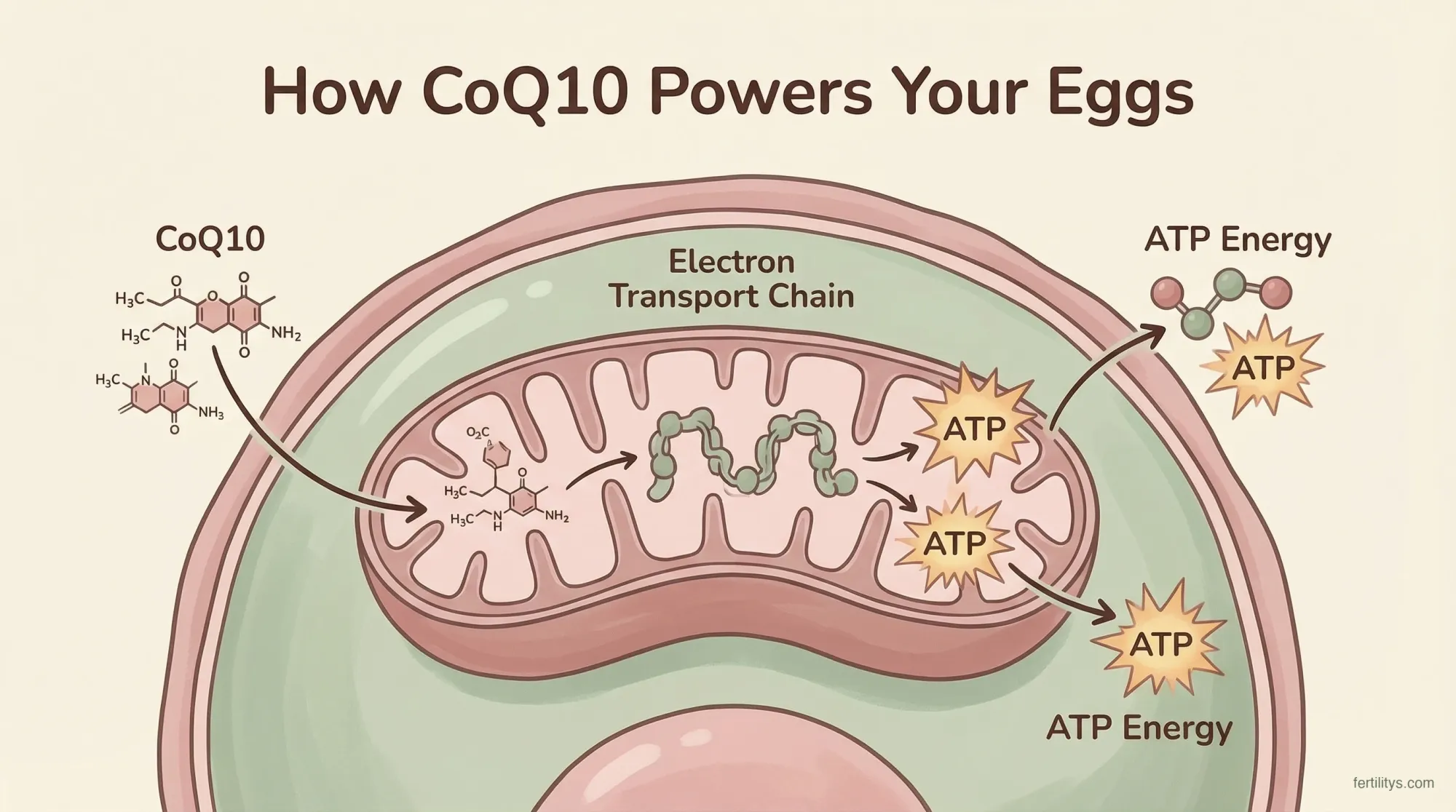
And here's the problem: your body's natural CoQ10 production peaks around age 20 and declines steadily after that. By your mid-thirties, you're producing significantly less than you did a decade earlier — right at the point when egg quality starts becoming a real concern. Ben-Meir et al. (2015) demonstrated in a landmark Aging Cell study that CoQ10 supplementation could reverse age-related decline in oocyte quality by restoring mitochondrial function.
Does CoQ10 Actually Improve Egg Quality? What the Evidence Shows
The short answer: yes, with caveats. The evidence is strongest for women with diminished ovarian reserve (DOR) who are undergoing IVF, and it's growing for natural conception too.
The strongest evidence comes from a 2024 systematic review and meta-analysis by Lin et al. in Annals of Medicine, which pooled six randomised controlled trials covering 1,529 women with diminished ovarian reserve. The results were striking:
- 84% higher clinical pregnancy rate (OR 1.84, 95% CI 1.33–2.53)
- More oocytes retrieved (MD +1.30 eggs per cycle)
- More high-quality embryos
- 40% lower cycle cancellation rate
- 62% lower miscarriage rate (OR 0.38)
- Less gonadotrophin medication needed (330 IU less per cycle)
An earlier meta-analysis by Florou et al. (2020) found that CoQ10 supplementation doubled clinical pregnancy rates in women undergoing ART (28.8% vs 14.1%, OR 2.44).
The landmark RCT from Xu et al. (2018) in Reproductive Biology and Endocrinology looked specifically at young women (under 35) with poor ovarian reserve. After 60 days of CoQ10 pretreatment, they retrieved twice as many eggs (4 vs 2 median), had a higher fertilisation rate (67.5% vs 45.1%), and significantly fewer women had their embryo transfers cancelled due to poor embryo development (8.3% vs 22.9%).
But I want to be honest about the limitations. Most of these studies are in IVF populations, sample sizes are still relatively small, and we don't yet have large-scale trials specifically measuring natural conception rates with CoQ10. The biological mechanism is solid — improving mitochondrial energy production should improve egg quality regardless of how you're conceiving — but the direct clinical proof for natural conception is still catching up.
How Much CoQ10 Should You Take for Egg Quality?
This is the question I get asked most, and the answer varies depending on your situation.
The clinical trials that showed positive results used dosages between 200 mg and 600 mg per day. The most commonly studied dose — and the one I recommend to most of my clients — is 200 mg taken twice daily (400 mg total). That's the dose range supported by the bulk of the fertility research.
| Situation | Suggested Daily Dose | Duration |
|---|---|---|
| General preconception support | 200 mg | At least 3 months before TTC |
| Low AMH / diminished ovarian reserve | 400–600 mg | At least 60 days before IVF or TTC |
| IVF preparation | 400–600 mg | 60–90 days before egg retrieval |
| Male fertility support | 200–400 mg | At least 3 months (full sperm cycle) |
I took 200 mg per day as part of my own protocol — on the lower end, because I was combining it with several other targeted supplements (vitamin D at 10 mcg, omega-3, and a fertility-specific multivitamin). If CoQ10 is the primary supplement you're adding, a higher dose of 400–600 mg may be more appropriate, particularly if you have low AMH or are preparing for IVF.
Timing matters. CoQ10 is fat-soluble, so always take it with a meal that contains some fat — breakfast with avocado, eggs, or even just a drizzle of olive oil. This significantly improves absorption. And split your dose: 200 mg with breakfast and 200 mg with dinner works better than 400 mg in one go.
One thing I emphasise with every client: eggs take roughly 90 days to mature from dormant follicle to ovulation-ready oocyte. That's why the clinical trials use a minimum of 60 days of pretreatment. Ideally, you want at least 3 months of consistent supplementation before you start trying to conceive or begin an IVF cycle. And honestly? I believe in starting fertility preparation at least a year out if you can — that's my signature stance, and CoQ10 is something you can start straight away.
Ubiquinol vs Ubiquinone: Which Form Is Best?
This is where the supplement industry gets confusing — and occasionally misleading. CoQ10 exists in two forms in your body:
- Ubiquinone — the oxidised form (this is what most standard CoQ10 supplements contain)
- Ubiquinol — the reduced, "active" form (typically more expensive)
Your body constantly converts between the two forms as needed. Ubiquinone gets reduced to ubiquinol during energy production, and ubiquinol gets oxidised back during its antioxidant work. They're not two different substances — they're two states of the same molecule.
The marketing around ubiquinol will tell you it's "up to 70% more bioavailable." And there is some truth to that claim — a 4-week study did show higher blood levels with 200 mg/day of ubiquinol compared to the same dose of ubiquinone. But — and this matters — a comprehensive 2025 review in Nutrients noted that once absorbed, your body converts between forms as needed. A 2020 study found no significant difference in long-term bioavailability between the two forms at equivalent doses.
Here's my practical advice: if budget isn't a concern, ubiquinol is a reasonable choice, especially if you're over 35 (since the body's ability to convert ubiquinone to ubiquinol may decrease with age). But if cost is a factor — and let's be realistic, fertility treatment is already expensive — standard ubiquinone at a slightly higher dose is perfectly effective. The fertility RCTs that showed positive outcomes predominantly used ubiquinone, not ubiquinol.
What matters more than the form is the delivery system. Look for supplements using oil-based softgel capsules or enhanced absorption technology (like VESIsorb), which can improve bioavailability of either form by 2–3 times compared to standard powder-filled capsules.
CoQ10 for Male Fertility Too
I always remind my clients that fertility is a two-person project. And the evidence for CoQ10 and male fertility is actually very strong.
A 2024 meta-analysis by Li et al. in Frontiers in Pharmacology found that CoQ10 supplementation significantly improved sperm count, progressive motility, normal morphology, and circulating testosterone levels. Sperm are metabolically active cells packed with mitochondria — they need ATP to swim, and they're vulnerable to the same oxidative damage that affects eggs.
Nadjarzadeh et al. (2019) tested both 200 mg and 400 mg daily doses in men with unexplained infertility and found improvements in sperm concentration and motility at both dose levels, with the higher dose showing slightly better results after 3 months of supplementation.
If your partner is willing, having both of you on CoQ10 for at least 3 months before trying to conceive covers both sides of the equation. Sperm take approximately 74 days to develop, so give it a full cycle.
What to Look for When Choosing a Supplement
Not all CoQ10 supplements are created equal. Here's what I look for — and what I recommend to my clients:
- Form: Ubiquinone in oil-based softgels (best value) or ubiquinol if budget allows
- Dose per capsule: 100–200 mg (so you're not swallowing six pills a day)
- Third-party testing: Look for NSF, USP, or ConsumerLab certification
- No unnecessary fillers: Avoid titanium dioxide, artificial colours, or excessive additives
- Oil-based delivery: Softgel capsules with soybean oil, MCT oil, or similar — dramatically better absorption than dry powder capsules

I personally used Wild Nutrition's fertility supplement which includes CoQ10 alongside other targeted nutrients. But standalone CoQ10 supplements from brands like Pharma Nord (who produce the Bio-Quinon form used in several clinical trials), NatureMade, and Solgar are all solid options in the £15–£30/month range.
A word on timing: don't start CoQ10 two weeks before your egg retrieval and expect miracles. This is a 3-month-minimum commitment. I've worked with clients who started their supplement protocol 6 months before IVF and the difference in their response compared to their previous cycles — where they hadn't been supplementing — was noticeable to their consultants.
Side Effects and Safety
CoQ10 has an excellent safety profile. It's been studied at doses up to 1,200 mg/day in clinical settings with no serious adverse effects. At the fertility-relevant doses of 200–600 mg/day, the most common side effects are mild and rare:
- Mild digestive discomfort (usually resolves within a week)
- Nausea if taken on an empty stomach (always take with food)
- Occasional insomnia at higher doses (take your last dose with dinner, not before bed)
Important interactions: CoQ10 can interact with blood-thinning medications like warfarin (it has a similar chemical structure to vitamin K). If you're on any blood thinners, speak with your doctor before starting supplementation. There's also some evidence it may enhance the effects of blood pressure medications, so monitoring is sensible if you're on those.
During pregnancy, the evidence on continuing CoQ10 is limited, and most fertility specialists recommend stopping once you get a positive pregnancy test unless your doctor advises otherwise. I stopped mine when I found out I was pregnant — it had done its job during the egg maturation phase.
The Bottom Line
CoQ10 is one of the most evidence-supported fertility supplements available. It works at a fundamental level — powering the mitochondria that your eggs (and your partner's sperm) depend on. The 2024 meta-analysis showing an 84% increase in clinical pregnancy rates for women with diminished ovarian reserve is genuinely significant. It's not a magic pill and it won't override everything else, but combined with a solid nutritional foundation, it gives your eggs the energy they need to do their best work.
I took it. I recommend it to nearly every client I work with. And the research keeps getting stronger. Start at least 3 months before you plan to conceive, choose an oil-based softgel at 200–600 mg daily depending on your situation, take it with food, and give it time to work.
Your eggs take 90 days to mature. Give them the fuel they need for the journey.
Frequently Asked Questions
▸How long does it take for CoQ10 to improve egg quality?
Allow a minimum of 60–90 days. Eggs take roughly 90 days to mature from dormant follicle to ovulation-ready oocyte, so you need at least one full maturation cycle of consistent supplementation. The clinical trials showing positive results used 60 days as the minimum pretreatment period. Ideally, start 3–6 months before trying to conceive or beginning IVF.
▸Is CoQ10 safe to take during IVF treatment?
Yes. Multiple randomised controlled trials have safely administered CoQ10 during IVF cycles. The 2024 meta-analysis by Lin et al. found no increase in adverse events. Most fertility specialists recommend starting CoQ10 before stimulation begins and continuing through egg retrieval, then stopping after a positive pregnancy test. Always confirm with your own fertility team.
▸Should I take ubiquinol or ubiquinone for fertility?
Either form works. Your body converts between the two as needed. Ubiquinol may be absorbed slightly faster in the short term, but long-term blood levels are similar. Most fertility clinical trials used ubiquinone. Choose ubiquinol if you're over 35 and budget allows; otherwise, ubiquinone in an oil-based softgel is perfectly effective and more affordable.
▸Can CoQ10 help with low AMH?
CoQ10 won't directly raise your AMH number — AMH reflects the size of your remaining egg pool, not the quality of those eggs. But that's not really the point. What CoQ10 does is support the mitochondrial energy production that determines how well your remaining eggs mature. Even with low AMH, improving egg quality can significantly improve your chances. I had an AMH of 3 at 32 and CoQ10 was central to my protocol.
▸Does CoQ10 help with male fertility?
Yes. A 2024 meta-analysis found CoQ10 significantly improves sperm count, motility, morphology, and testosterone levels. Sperm are energy-dependent cells packed with mitochondria, so the mechanism is the same as for egg quality. A dose of 200–400 mg daily for at least 3 months is the standard recommendation for male fertility support.
▸How much CoQ10 should I take for fertility?
Most fertility studies use 200-600mg of CoQ10 (ubiquinol form) daily. Start with 200mg and work up if tolerated. Take with a fat-containing meal for better absorption. Consult your doctor before starting, especially if on blood thinners.
▸How long does CoQ10 take to improve egg quality?
Egg maturation takes approximately 3-4 months, so most practitioners recommend taking CoQ10 for at least 3 months before conception or IVF. Some studies showing benefits used 12-week supplementation periods.
▸Is ubiquinol better than ubiquinone?
Ubiquinol is the active, reduced form of CoQ10 and is generally better absorbed, especially after age 30 when your body's ability to convert ubiquinone to ubiquinol declines. Most fertility specialists recommend the ubiquinol form.
You might also find helpful:
References
- Ben-Meir, A. et al. (2015). Coenzyme Q10 restores oocyte mitochondrial function and fertility during reproductive aging. Aging Cell, 14(5), 887–895. doi:10.1111/acel.12368
- Lin, G. et al. (2024). Clinical evidence of coenzyme Q10 pretreatment for women with diminished ovarian reserve undergoing IVF/ICSI: a systematic review and meta-analysis. Annals of Medicine, 56(1), 2389469. doi:10.1080/07853890.2024.2389469
- Xu, Y. et al. (2018). Pretreatment with coenzyme Q10 improves ovarian response and embryo quality in low-prognosis young women with decreased ovarian reserve: a randomized controlled trial. Reproductive Biology and Endocrinology, 16(29). doi:10.1186/s12958-018-0343-0
- Florou, P. et al. (2020). Does coenzyme Q10 supplementation improve fertility outcomes in women undergoing assisted reproductive technology procedures? A systematic review and meta-analysis of randomized-controlled trials. Journal of Assisted Reproduction and Genetics, 37, 2377–2387. doi:10.1007/s10815-020-01906-3
- Li, Z. et al. (2024). Does coenzyme Q10 improve semen quality and circulating testosterone level? A systematic review and meta-analysis of randomized controlled trials. Frontiers in Pharmacology, 15, 1497930. doi:10.3389/fphar.2024.1497930
- Nadjarzadeh, A. et al. (2019). The impact of two doses of coenzyme Q10 on semen parameters and antioxidant status in men with idiopathic oligoasthenoteratozoospermia. Andrologia, 51(9), e13357. doi:10.1111/and.13357
- Giannubilo, S.R. et al. (2025). Ubiquinol in Fertility and Reproduction: A Conditionally Essential Nutrient for Critical Early-Life Stages. Nutrients, 17(5), 832. doi:10.3390/nu17050832
- Zhang, M. et al. (2025). Exploring the protective effects of coenzyme Q10 on female fertility. Frontiers in Cell and Developmental Biology, 13, 1633166. doi:10.3389/fcell.2025.1633166
Medical disclaimer: This article is for informational purposes only and is not a substitute for professional medical advice, diagnosis, or treatment. Always consult your healthcare provider before starting any new supplement, particularly if you are pregnant, breastfeeding, or taking medication. Danielle Bowen is a registered nutritionist (MSc, RNutr) — not a doctor. Individual results may vary.
⚕️ Medical Disclaimer
This article is for informational purposes only and does not constitute medical advice. Always consult a qualified healthcare professional before making decisions about your fertility or reproductive health.
Written by

Subscribe to Fertilitys
All my Free Resources. No spam. Unsubscribe anytime.