Yoga for Fertility: A Yoga Teacher and Nutritionist's Complete Guide
As a qualified yoga teacher and registered nutritionist, I've seen yoga transform fertility journeys — including my own. This is everything I teach my clients, from evidence to poses to cycle-specific practice.

I need to tell you something that might surprise you, coming from a nutritionist: the single most impactful change I made for my own fertility wasn't a supplement. It wasn't a diet. It was rolling out a yoga mat.
I'm not just saying this as someone who tried a few YouTube videos. I'm a qualified yoga teacher. I trained in Portugal, I've studied in Bali, and I teach classes on the beach in Poole, Dorset. Yoga isn't a hobby for me — it's a practice I've built my professional life around, alongside nutrition, because I believe the two are inseparable when it comes to fertility.
Before my fertility journey, I was doing HIIT five days a week. I was lean, I was fit, and I thought I was healthy. My acupuncturist took one look at my lifestyle and said: "Stop. Your body is in fight-or-flight. It's not going to prioritise reproduction when it thinks you're running from a tiger." She was right. I swapped HIIT for yoga, and within three months, my cycles became more regular, my stress markers improved, and I felt — for the first time in years — like my body was actually calm enough to conceive.
This guide covers everything: what the research actually says about yoga and fertility, the specific poses I recommend, how to adapt your practice for each phase of your cycle, what to do (and avoid) during the two-week wait and IVF, and how to build a home practice that genuinely supports your reproductive health.
What the Research Says About Yoga and Fertility
Let me be upfront: the evidence base for yoga and fertility is growing but not yet definitive. Most studies are small, and we need more randomised controlled trials. That said, what we do have is consistently promising — and the mechanisms are biologically plausible.
Yoga Reduces Cortisol and Stress Hormones
This is the most well-established pathway. Chronic stress elevates cortisol, which directly suppresses GnRH — the master hormone that triggers your LH and FSH release. Without adequate LH and FSH, ovulation can be delayed, irregular, or absent entirely.
A 2024 narrative review in Cureus (Sharma et al.) found that yoga interventions are consistently associated with decreased cortisol levels, improved parasympathetic nervous system activity, and better regulation of the hypothalamic-pituitary-adrenal (HPA) axis — the exact system that governs your stress response and reproductive hormones.
I see this in my clients constantly. Women who come to me with irregular cycles, high stress, and disrupted sleep. We add yoga (not instead of nutrition — alongside it), and within 2-3 months, their cycles start to regulate. It's not magic. It's biology. When your nervous system shifts from sympathetic (fight-or-flight) to parasympathetic (rest-and-digest), your body gets the signal that it's safe to reproduce.
Yoga May Improve IVF Outcomes
The most striking data comes from a study presented at the American Society for Reproductive Medicine (ASRM), published in Fertility and Sterility (2017). Women who participated in a yoga programme during their IVF cycles had significantly higher pregnancy rates (63.5% vs 43.4%) and clinical pregnancy rates (59.6% vs 37.7%) compared to controls. That's a 20-percentage-point difference.
A systematic review by Darbandi et al. (2018, Alternative Therapies in Health and Medicine) concluded that yoga can improve assisted reproduction outcomes by reducing stress, decreasing anxiety and depression, and improving physiological and psychological states in both men and women undergoing fertility treatment.
Now, I want to be honest: these studies have limitations. Sample sizes are small, and it's difficult to blind a yoga intervention. But the direction of evidence is consistently positive, and the biological mechanisms make sense.
Yoga and PCOS
For women with PCOS specifically, the evidence is even stronger. A 2022 systematic review and meta-analysis (Shukla et al., Advances in Integrative Medicine) found that yoga therapy may have beneficial effects on health outcomes in women with PCOS, including improvements in anxiety, depression, and hormonal markers.
A 2024 pilot study (PubMed: 39888666) found that yoga techniques were associated with significant improvements in insulin resistance in women with PCOS — HOMA-IR decreased from 3.76 to 2.72 (p = 0.0001). Since insulin resistance drives the androgen excess in PCOS, improving insulin sensitivity through yoga could directly address the root cause.
And a 2026 study in the International Journal of Reproduction, Contraception, Obstetrics and Gynecology found that a structured 12-week yoga intervention effectively modulated hormonal balance, reduced inflammatory burden, and improved metabolic health in premenopausal women with PCOS — with enhanced pregnancy rates among participants seeking conception.
I recommend yoga to every single one of my PCOS clients. Not as an alternative to medical treatment, but as a foundational practice alongside nutrition, supplements, and medication. I've written more about PCOS management in my PCOS symptoms guide.
The Mind-Body Connection
Harvard's Domar Center conducted one of the most famous studies on mind-body interventions and fertility. Women who participated in a mind-body programme (which included yoga, meditation, and relaxation techniques) had a 55% pregnancy rate within one year, compared to 20% in the control group (Domar et al., 2000, Fertility and Sterility). While this wasn't yoga alone, yoga was a core component of the intervention.
What I take from this: the combination of gentle movement, breathwork, meditation, and community support creates something more powerful than any single element. That's exactly what a good fertility yoga class provides — and why I structure my own classes the way I do.
Why Yoga Works for Fertility (The Biology)
Understanding why yoga helps makes it easier to commit to the practice. Here's what's happening in your body:
Blood Flow to the Reproductive Organs
Many fertility yoga poses specifically target the pelvic region. Hip-opening poses like Baddha Konasana (butterfly pose) and Supta Baddha Konasana (reclined butterfly) increase blood flow to the uterus and ovaries. Better blood flow means better delivery of oxygen, nutrients, and hormones to the tissues that need them most.
I notice this myself during practice. When I hold pigeon pose or reclined butterfly for a few minutes, I can feel warmth and circulation increasing in my lower abdomen. It's subtle, but it's real — and it's the same principle behind fertility acupuncture, which I also used throughout my preconception journey.
Parasympathetic Activation
The breathwork (pranayama) and meditation components of yoga directly activate your parasympathetic nervous system — the "rest, digest, and reproduce" mode. Deep, slow breathing stimulates the vagus nerve, which reduces heart rate, lowers blood pressure, and shifts your hormonal profile away from cortisol dominance and towards reproductive readiness.
This is why I always tell my clients: it's not just the poses. The breathing is at least half the benefit. Five minutes of slow, diaphragmatic breathing before bed can shift your entire nervous system state.
Reduced Inflammation
Chronic low-grade inflammation impairs fertility through multiple pathways — it disrupts ovulation, impairs implantation, and may contribute to endometriosis and PCOS. Regular yoga practice has been shown to reduce inflammatory markers including C-reactive protein (CRP) and interleukin-6 (IL-6).
Improved Sleep Quality
Sleep is when your body does its repair work, including producing the hormones needed for reproduction. Melatonin — which requires darkness and quality sleep — is a powerful antioxidant that protects eggs in the ovarian follicle. Yoga practitioners consistently report better sleep quality, and the research supports this: a 2020 meta-analysis found that yoga significantly improved sleep quality across 19 randomised controlled trials.
My 10 Favourite Fertility Yoga Poses
These are the poses I teach in my fertility yoga classes on the beach in Poole, and the ones I practised throughout my own preconception journey. I've selected them specifically for their effects on pelvic blood flow, stress reduction, and hormonal balance.
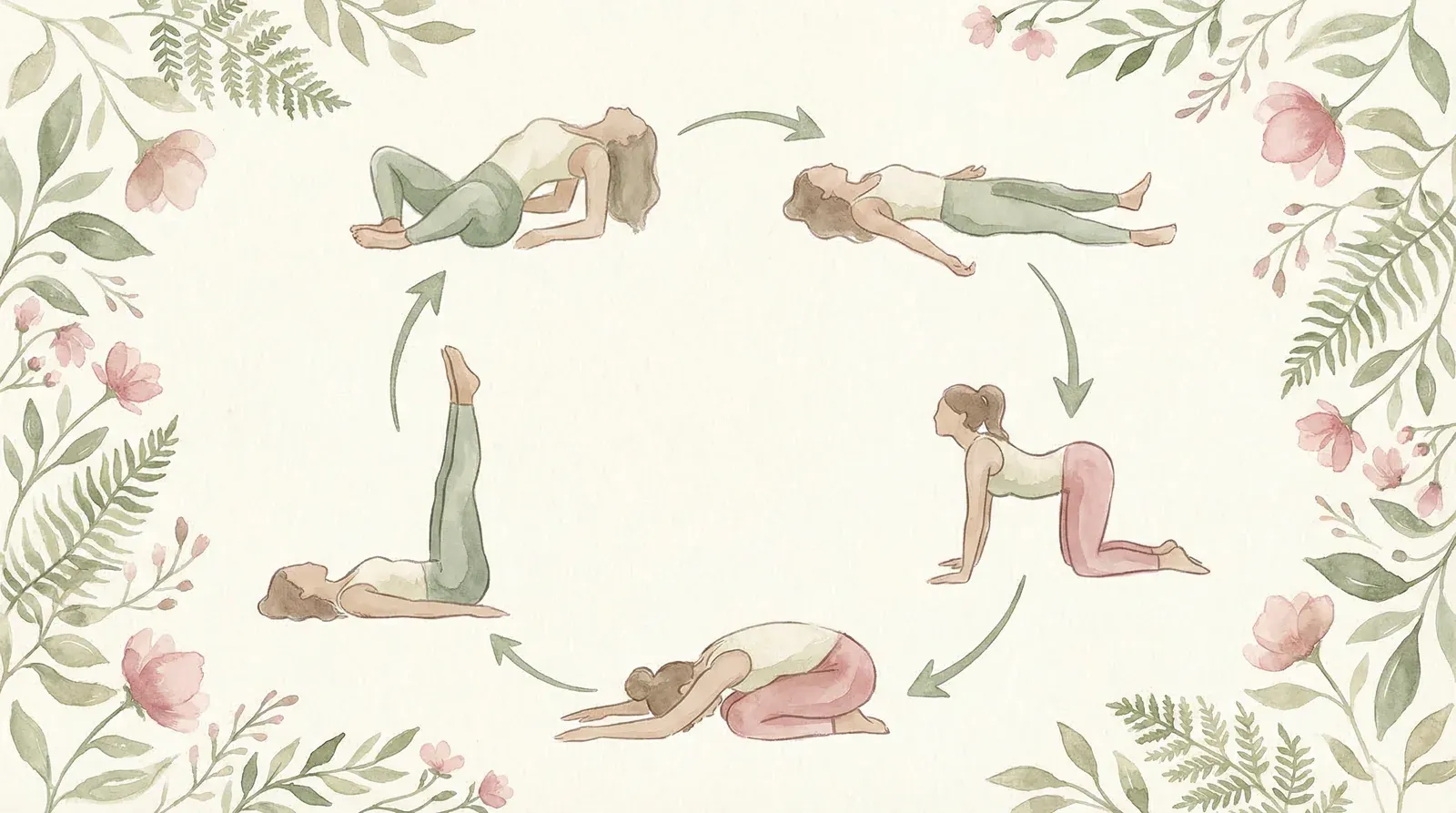
1. Supta Baddha Konasana (Reclined Butterfly Pose)
What it does: Opens the hips and groin, increases blood flow to the pelvic region, deeply relaxing for the nervous system.
How to do it: Lie on your back. Bring the soles of your feet together and let your knees fall open to the sides. Place a bolster or cushion under each knee for support — you should feel a gentle stretch, never strain. Rest your arms by your sides, palms up. Close your eyes. Hold for 3-5 minutes.
My tip: This is my desert-island pose. If I could only do one fertility yoga pose for the rest of my life, it would be this one. I use it at the end of every class and every home practice. Place one hand on your heart and one on your lower belly — it connects you to your body in a way that feels genuinely healing.
2. Viparita Karani (Legs Up the Wall)
What it does: Gentle inversion that promotes venous return from the pelvis, reduces swelling in the legs, deeply calming for the nervous system.
How to do it: Sit sideways next to a wall, then swing your legs up the wall as you lower your back to the floor. Your bottom should be as close to the wall as comfortable. Rest your arms out to the sides. Stay for 5-15 minutes.
My tip: This is the perfect pose for the two-week wait. It's deeply calming, completely passive, and feels nurturing. I practised this every evening during my preconception phase — sometimes with a guided meditation, sometimes just with silence and my thoughts.
3. Baddha Konasana (Butterfly Pose)
What it does: Opens the hips and inner thighs, stimulates the reproductive organs, stretches the groin.
How to do it: Sit tall with the soles of your feet together, knees dropped to the sides. Hold your feet and gently press your knees towards the floor using your elbows. Keep your spine long. For a deeper release, fold forward from the hips. Hold for 1-3 minutes.
My tip: I use this as a warm-up in every class. Gently fluttering the knees (like butterfly wings) is a lovely way to ease into the stretch and increase circulation.
4. Balasana (Child's Pose)
What it does: Gentle compression of the abdomen, deeply restorative, calms the nervous system, releases lower back tension.
How to do it: Kneel on the floor, big toes touching, knees wide apart. Fold forward, extending your arms in front of you, and rest your forehead on the mat. Breathe deeply into your back body. Hold for 2-5 minutes.
My tip: Wide-knee child's pose is best for fertility — the wide stance creates space for the abdomen and avoids compression of the lower belly. It's also a perfect "reset" pose if you feel overwhelmed during practice.
5. Setu Bandhasana (Bridge Pose)
What it does: Opens the chest and hip flexors, strengthens the pelvic floor, increases blood flow to the uterus, stimulates the thyroid gland.
How to do it: Lie on your back, knees bent, feet hip-width apart flat on the floor. Press into your feet and lift your hips towards the ceiling. Interlace your hands beneath you. Hold for 30 seconds to 1 minute, then lower slowly.
My tip: For a more restorative version, place a yoga block under your sacrum (the flat bone at the base of your spine) and just rest there. All the benefits, no effort required. I use this variation more than the active version during the two-week wait.
6. Paschimottanasana (Seated Forward Fold)
What it does: Stimulates the ovaries and uterus, stretches the hamstrings and lower back, calms the mind.
How to do it: Sit with legs extended straight in front of you. Inhale to lengthen your spine, then exhale and fold forward from the hips (not the waist). Reach for your feet, ankles, or shins — wherever feels right. Don't force it. Hold for 1-3 minutes.
My tip: Let gravity do the work. This isn't about touching your toes — it's about creating gentle compression on the reproductive organs and calming your nervous system through the forward fold. Bend your knees if your hamstrings are tight.
7. Marjaryasana-Bitilakasana (Cat-Cow)
What it does: Mobilises the spine, increases circulation to the reproductive organs, gently massages the internal organs through rhythmic movement.
How to do it: Start on all fours. On an inhale, arch your back and lift your head (cow). On an exhale, round your spine and tuck your chin (cat). Move slowly with your breath. Repeat 10-15 times.
My tip: I use this as the opening movement in every fertility class. It wakes up the spine, connects breath to movement, and gets blood flowing to the pelvis. The rhythmic breathing is meditative — it shifts you out of your head and into your body.
8. Malasana (Garland Pose / Deep Squat)
What it does: Opens the hips deeply, strengthens the pelvic floor, increases blood flow to the groin and pelvis.
How to do it: Stand with feet slightly wider than hip-width, toes turned out. Squat down deeply, bringing your elbows inside your knees and pressing your palms together at your heart. Press your elbows against your inner knees to open the hips. Hold for 30 seconds to 2 minutes.
My tip: If your heels lift, place a rolled blanket underneath them. This pose is challenging but incredibly effective for pelvic blood flow. In my beach classes, I pair this with breathing exercises — inhale to lengthen the spine, exhale to sink deeper.
9. Bhujangasana (Cobra Pose)
What it does: Opens the chest and shoulders, stimulates the reproductive organs through gentle back extension, increases circulation to the pelvis.
How to do it: Lie face down, hands under your shoulders. Press gently into your hands and lift your chest off the floor — keep your elbows slightly bent and your lower ribs on the mat. Look forward, not up. Hold for 15-30 seconds.
My tip: Keep this gentle for fertility — baby cobra is better than full cobra. You want a mild back extension, not a deep one. The goal is to open the front body and stimulate the abdominal organs, not to push into a deep backbend.
10. Savasana (Corpse Pose) with Yoga Nidra
What it does: The most important pose in any fertility practice. Deep relaxation, parasympathetic activation, cortisol reduction. This is where the real magic happens.
How to do it: Lie on your back, arms by your sides, palms up, legs slightly apart. Close your eyes. Focus on releasing every muscle in your body, from your toes to your scalp. Stay for at least 10 minutes — 20 is better.
My tip: I always end my classes with an extended savasana, often incorporating yoga nidra (guided deep relaxation). Many of my clients say this is the part that changes everything for them — it's the first time they've truly relaxed in months. If you only have 15 minutes for yoga, spend 5 minutes on gentle poses and 10 minutes in savasana. The relaxation is more important than the movement.
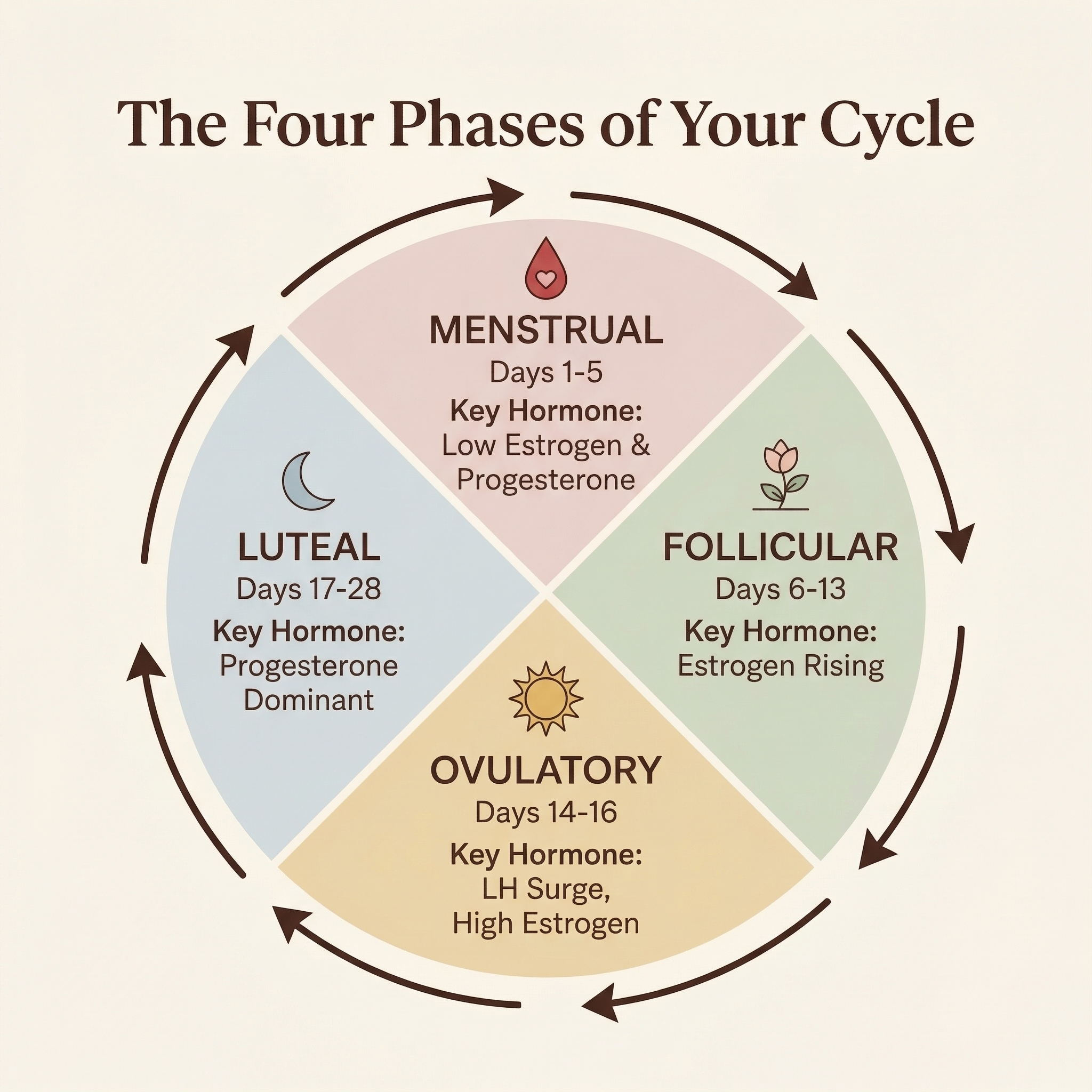
Yoga for Each Phase of Your Cycle
One of the things I teach in my classes is adapting your yoga practice to your menstrual cycle. Your body has different needs at different times, and honouring those rhythms is central to fertility yoga.
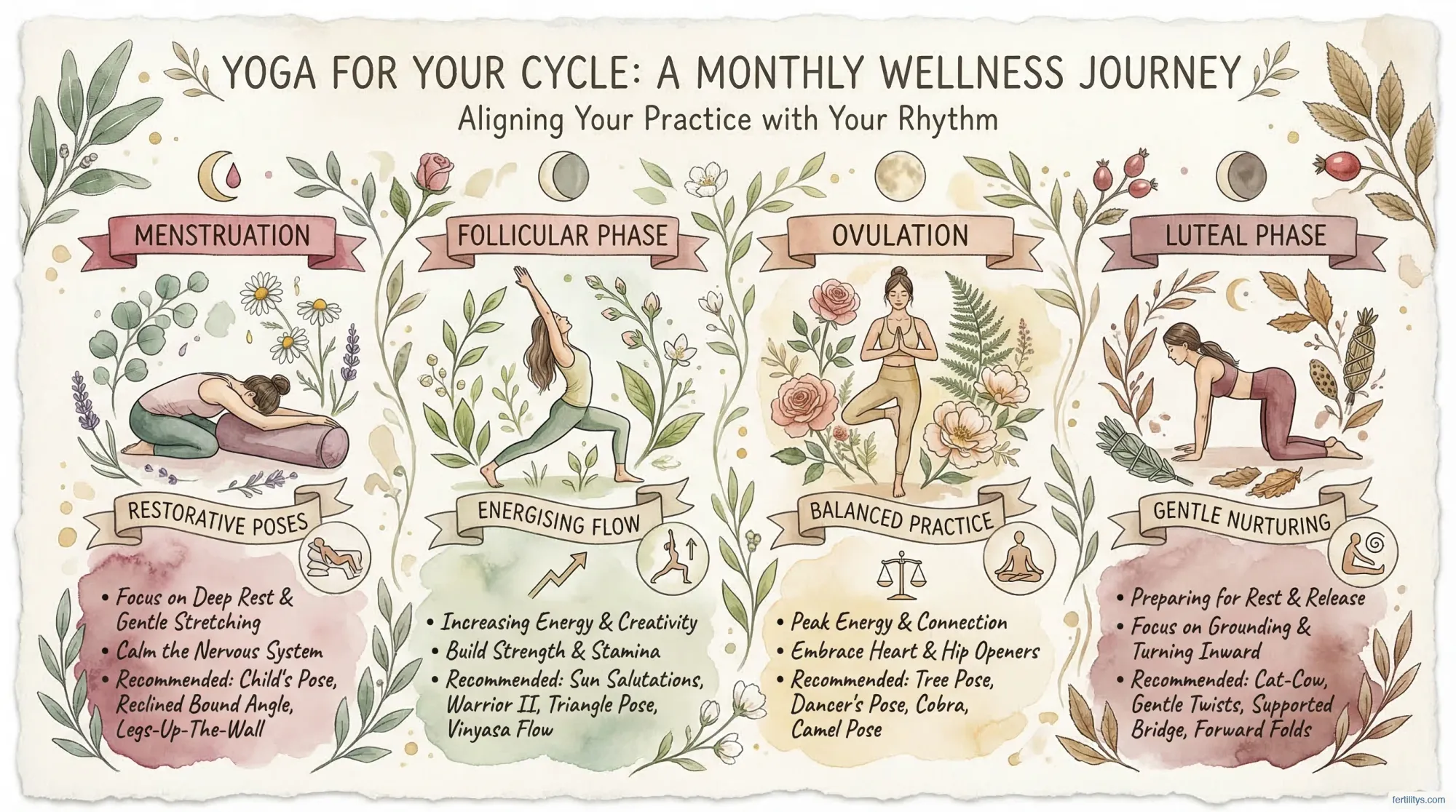
Menstruation (Days 1-5): Rest and Restore
- Focus on: Restorative poses, gentle breathing, complete rest
- Best poses: Supta Baddha Konasana, Child's Pose, Legs Up the Wall, Supported Bridge (with block)
- Avoid: Inversions (shoulder stand, headstand), deep twists, intense core work, hot yoga
- Duration: 15-20 minutes is plenty
Your body is doing important work during menstruation. This isn't the time to push. I keep my own practice entirely restorative during my period — bolsters, blankets, long holds, gentle breathing. Honour the rest.
Follicular Phase (Days 6-12): Build Energy
- Focus on: Energising flows, hip openers, building strength
- Best poses: Cat-Cow, Butterfly, Warrior II, Malasana, Cobra, Sun Salutations (gentle pace)
- Duration: 30-45 minutes
Oestrogen is rising, energy is returning, and your body is preparing to ovulate. This is when you can be slightly more dynamic in your practice — though still keeping it moderate, not intense. I love beach yoga during this phase — the energy of being outdoors matches the rising energy in your body.
Ovulation (Days 12-14): Peak Energy, Stay Grounded
- Focus on: Balanced practice, hip openers to support ovulation, grounding poses
- Best poses: Malasana, Pigeon Pose, Butterfly, Bridge, Seated Forward Fold
- Duration: 30 minutes
You're at peak energy around ovulation. Channel it into your practice — but don't overdo it. The goal is to support your body's release of the egg, not to exhaust it. I like to pair physical practice with a longer meditation during ovulation — connecting intention with biology.
Luteal Phase / Two-Week Wait (Days 15-28): Gentle and Nurturing
- Focus on: Restorative poses, deep relaxation, breathwork, meditation
- Best poses: Legs Up the Wall, Supported Bridge, Reclined Butterfly, Extended Savasana with Yoga Nidra
- Avoid: Intense twists (which compress the abdomen), hot yoga, deep backbends, intense core work
- Duration: 20-30 minutes, mostly restorative
If there's a chance you're pregnant, treat your body as if you are. Gentle, nurturing, restorative. This is the phase where anxiety peaks — the two-week wait is agonising — so the relaxation and breathing components of yoga are even more important than the physical poses. I've written about coping with the 12 DPO wait in detail.
Yoga During IVF and Fertility Treatment
If you're undergoing IVF or other fertility treatment, yoga can be particularly valuable — but you need to adapt your practice.
During Stimulation
- Your ovaries are enlarged and sensitive. Avoid deep twists, intense forward folds, and anything that compresses the abdomen.
- Stick to gentle restorative poses: Legs Up the Wall, Supported Bridge, Reclined Butterfly.
- Focus heavily on breathwork and meditation — managing treatment anxiety is crucial.
After Egg Retrieval
- Rest completely for 48-72 hours. No yoga, no exercise.
- Resume with very gentle restorative poses only when you feel ready — listen to your body.
After Embryo Transfer
- Gentle restorative yoga only: Legs Up the Wall, supported poses, breathing exercises.
- No inversions, no intense core work, no hot yoga.
- Yoga nidra and guided meditation are excellent during this waiting period.
Remember the study I mentioned earlier: women who did yoga during IVF had significantly higher pregnancy rates. But it was gentle, adapted yoga — not a power vinyasa class. More is not better during treatment. Calm, supportive, restorative.
Is Hot Yoga Bad for Fertility?
I get asked this constantly, so let me be clear: I don't recommend hot yoga if you're trying to conceive.
There's no direct study on hot yoga and female fertility, but the logic is sound:
- Elevated core body temperature may impair implantation — studies on fever in early pregnancy show increased miscarriage risk
- Heat stress elevates cortisol — the opposite of what we want
- Dehydration affects cervical mucus quality
- For male partners, heat is a known sperm killer — but women's reproductive organs are also temperature-sensitive
I practised Bikram before my fertility journey and loved it. I stopped completely when we started trying. Regular yoga in a comfortable temperature gives you all the benefits without the risk. If you love hot yoga, switch to a regular practice during your conception window and return to it once you've completed your family.
Building Your Home Fertility Yoga Practice
You don't need a class to start. Here's the routine I recommend to my clients — it takes 25 minutes and covers all the key elements.
The Daily Fertility Flow (25 Minutes)
- Cat-Cow — 2 minutes (10-15 breath cycles)
- Butterfly Pose — 2 minutes
- Malasana (Deep Squat) — 1 minute
- Cobra Pose — 3 rounds of 30 seconds
- Seated Forward Fold — 2 minutes
- Bridge Pose (or Supported Bridge) — 2 minutes
- Reclined Butterfly — 3 minutes
- Legs Up the Wall — 5 minutes
- Savasana — 5-10 minutes (with deep breathing or guided meditation)
During your period or the two-week wait, skip steps 1-5 and do a longer version of steps 6-9 instead. The restorative poses are what matter most.
What You Need
- A yoga mat (any will do — you don't need expensive kit)
- Two cushions or a bolster (for support in restorative poses)
- A yoga block (optional but helpful for supported bridge)
- A blanket (for warmth during savasana — your body temperature drops during deep relaxation)
- A quiet space — even a corner of your bedroom works
Why I Teach Fertility Yoga on the Beach
I teach my classes on the beach in Poole, Dorset, and there's a reason for that. Being outdoors — feeling the sand, hearing the waves, breathing sea air — adds a sensory dimension that amplifies everything yoga does.
Nature exposure reduces cortisol independently of exercise (a 2019 study in Frontiers in Psychology found that just 20 minutes in nature significantly reduced cortisol levels). When you combine nature with yoga, the stress-reduction effect is compounded.
There's also something about practising on a beach that strips away the performance aspect of yoga. No mirrors, no competition, no comparing yourself to the person next to you. Just you, the mat, and the sea. Many of my clients say their beach session is the most peaceful hour of their week.
I trained as a yoga teacher in Portugal, overlooking the Atlantic. I've studied in Bali, surrounded by rice paddies and tropical birdsong. Those environments shaped how I teach: nature isn't a backdrop to yoga. It's part of the practice. The beach in Poole isn't Bali, but on a calm morning with the sun on the water, it comes pretty close.
Yoga for Your Partner
Fertility yoga isn't just for women. Male partners benefit too — and the research supports this.
The 2018 Darbandi review found that yoga improved physiological and psychological states in both men and women undergoing fertility treatment. Specifically, yoga can:
- Reduce oxidative stress, which damages sperm DNA
- Lower cortisol, improving testosterone balance
- Improve sleep quality (which affects sperm production)
- Reduce anxiety and depression associated with fertility struggles
Tim — my partner — started doing yoga with me during our preconception phase. He's not a "yoga person" by nature, but he committed to it because the evidence made sense. We'd do 20-minute sessions together in the evening: some gentle poses, breathwork, and a long savasana. It became our shared ritual, and honestly, it brought us closer during a time that can drive couples apart.
You don't need your partner to attend a class. A simple home practice together — even just 15 minutes — creates shared calm and connection during what can be an isolating, stressful process.
Common Mistakes in Fertility Yoga
Going Too Hard
More yoga is not better yoga. If your practice leaves you exhausted, sore, or depleted, you've gone too far. Fertility yoga should leave you feeling calm, nourished, and restored — not wrung out. I see women jump into 90-minute power vinyasa classes thinking they're "doing yoga for fertility." That's not fertility yoga. That's another form of the high-intensity exercise that may be harming their fertility in the first place.
Treating It as a Quick Fix
Yoga works through sustained, consistent practice over weeks and months — not through a single class. Commit to 20-25 minutes daily (or at least 4-5 times per week) for at least 3 months before assessing its effect. The hormonal shifts that yoga supports take time to manifest.
Ignoring the Breath
If you're holding your breath or breathing shallowly during yoga, you're missing half the benefit. The breathwork (pranayama) is what activates the parasympathetic nervous system. Focus on slow, deep belly breathing throughout your practice — inhale for 4 counts, exhale for 6 counts.
Practising in Extreme Heat
As I covered above: no hot yoga when trying to conceive. Room temperature or outdoors is perfect.
Comparing Yourself to Others
Fertility yoga is not about flexibility, strength, or achieving perfect poses. It's about connecting with your body, reducing stress, and creating the conditions for conception. If you can breathe, you can do fertility yoga. Full stop.
Many women come to fertility yoga as part of a broader strategy for getting pregnant naturally. The practice works on multiple levels: physically, practicing yoga regularly improves blood circulation to the pelvic area, which nourishes the reproductive organs. Poses like supported bridge, reclining bound angle, and legs-up-the-wall specifically target pelvic blood flow. The combination of gentle movement, deep breathing, and mindful awareness makes yoga uniquely suited to the fertility journey.
The Bottom Line
Yoga won't guarantee you get pregnant. Nothing can guarantee that. But the evidence consistently shows it reduces the very things that impair fertility — stress, inflammation, hormonal imbalance, poor sleep — while improving blood flow to the organs that matter most.
As someone who teaches yoga, practises it daily, and credits it as a central part of my own fertility success, I'm biased — and I'm honest about that bias. But the research supports what I've experienced. Yoga is one of the most accessible, affordable, and evidence-supported things you can do for your fertility. All you need is a mat, some cushions, and 25 minutes a day.
Start gentle. Stay consistent. And remember: the most fertile version of you is the calmest version of you.
You might also find helpful:
▸Can yoga really help you get pregnant?
Research suggests yoga can support fertility by reducing cortisol, improving blood flow to reproductive organs, decreasing anxiety and depression, and improving hormonal balance. One IVF study found significantly higher pregnancy rates in yoga participants (63.5% vs 43.4%). While yoga isn't a guarantee, the evidence consistently points to meaningful benefits — especially alongside good nutrition and medical care.
▸What are the best fertility yoga poses?
The most recommended fertility yoga poses are: Supta Baddha Konasana (Reclined Butterfly), Viparita Karani (Legs Up the Wall), Baddha Konasana (Butterfly Pose), Balasana (Child's Pose), Setu Bandhasana (Bridge Pose), and extended Savasana with deep breathing. These poses focus on opening the hips, increasing pelvic blood flow, and activating the parasympathetic nervous system.
▸Is hot yoga bad for fertility?
It's best to avoid hot yoga when trying to conceive. Elevated core body temperature may impair implantation, heat stress raises cortisol, and dehydration can affect cervical mucus quality. Regular yoga at room temperature or outdoors provides all the benefits without the risks. Switch back to hot yoga after you've completed your family if you enjoy it.
▸Can I do yoga during the two-week wait?
Yes, but keep it gentle and restorative. Stick to supported poses like Legs Up the Wall, Reclined Butterfly, and Supported Bridge. Avoid intense twists, deep backbends, hot yoga, and strong core work. Focus on breathing exercises and relaxation — managing two-week wait anxiety is where yoga really shines.
▸Does yoga help with PCOS?
Yes — the evidence for yoga and PCOS is particularly strong. Studies show yoga can improve insulin resistance (a key driver of PCOS), reduce androgen levels, decrease anxiety and depression, and improve metabolic markers. A 2024 pilot study found significant improvements in HOMA-IR (insulin resistance measure) after yoga intervention. I recommend yoga to all my PCOS clients alongside nutrition and medical treatment.
▸How often should I do fertility yoga?
Aim for 20-25 minutes daily, or at least 4-5 times per week. Consistency matters more than duration — a short daily practice is more effective than one long weekly class. Adapt your practice to your cycle phase: more restorative during menstruation and the luteal phase, slightly more dynamic during the follicular phase. Give it at least 3 months of consistent practice before assessing results.
▸Can yoga help during IVF?
Research suggests yes. A study in Fertility and Sterility found that women who did yoga during IVF had pregnancy rates of 63.5% compared to 43.4% in controls. During IVF, keep your practice gentle and restorative — your ovaries are enlarged and sensitive during stimulation. Focus on breathing, meditation, and supported poses. Rest completely for 48-72 hours after egg retrieval before resuming gentle practice.
References
- Sharma R et al. (2024). Yoga and Lifestyle Changes: A Path to Improved Fertility – A Narrative Review. Cureus, 16(6):e61804. doi:10.7759/cureus.61804
- Darbandi S et al. (2018). Yoga Can Improve Assisted Reproduction Technology Outcomes in Couples With Infertility. Alternative Therapies in Health and Medicine, 24(4):50-55. PMID: 29112941
- IVF yoga study. Can yoga affect IVF outcomes? Fertility and Sterility, 108(3):e231, September 2017. doi:10.1016/j.fertnstert.2017.07.691
- Shukla R et al. (2022). Effect of Yoga Therapy on Health Outcomes in Women With Polycystic Ovary Syndrome: A Systematic Review and Meta-Analysis. Advances in Integrative Medicine. PMC9830238
- PCOS insulin resistance pilot study (2024). Yoga Techniques Associated with Improved Insulin Resistance in Women with PCOS. PubMed: 39888666
- Domar AD et al. (2000). Impact of group psychological interventions on pregnancy rates in infertile women. Fertility and Sterility, 73(4):805-811. doi:10.1016/S0015-0282(99)00493-8
- Khalsa SBS (2013). Yoga for psychiatry and mental health: an overview. Indian Journal of Psychiatry, 55(Suppl 3):S291-S292.
- Krishnakumar D et al. (2015). Meditation and Yoga can Modulate Brain Mechanisms that affect Behavior and Anxiety. Ancient Science, 2(1):13-19.
- Hunter MR et al. (2019). Urban Nature Experiences Reduce Stress in the Context of Daily Life. Frontiers in Psychology, 10:722. doi:10.3389/fpsyg.2019.00722
- IJRCOG (2026). Yoga as a therapeutic modality for hormonal and metabolic regulation in premenopausal women with polycystic ovary syndrome. International Journal of Reproduction, Contraception, Obstetrics and Gynecology.
Medical Disclaimer: This article is for informational purposes only and is not a substitute for professional medical advice. Always consult your healthcare provider before starting any new exercise programme, particularly if you're undergoing fertility treatment. Yoga is a complementary practice — it should support, not replace, medical care. If you experience pain during any pose, stop immediately. Danielle Bowen is a registered nutritionist (RNutr) and qualified yoga teacher, not a medical doctor.
Written by

Subscribe to Fertilitys
All my Free Resources. No spam. Unsubscribe anytime.