11 DPO: Symptoms, Testing, and What to Expect
What's really happening at 11 days past ovulation — and whether that pregnancy test will tell you anything yet.


💡 Quick Answer
At 11 DPO (days past ovulation), a pregnancy test can be accurate if positive — but a negative result doesn't rule pregnancy out. HCG levels vary widely at this stage. If negative, wait 2–3 days and retest. Around 60% of pregnancies show a positive by 11 DPO on sensitive tests.
You're 11 days past ovulation and you're here because something feels different. Or maybe nothing feels different at all, and that's scaring you too. Either way — 11 DPO is one of the hardest days in the two-week wait, because you're close enough to test but early enough to doubt every result. If you're trying to conceive, this is the day your patience gets tested almost as much as your body.
Here's what I want you to know before we go any further: whatever you're feeling right now — the hope, the anxiety, the compulsive googling at 2am — it's completely normal. I've been exactly where you are, twice, and both times I drove myself half-mad trying to decode every twinge.
What Is Happening in Your Body at 11 DPO
At 11 days past ovulation, one of two things has happened. Either a fertilised egg has implanted in your uterine lining and your body has started producing hCG — or it hasn't, and your progesterone is beginning to drop as your body prepares for your next period.
The frustrating truth is that both scenarios can feel identical at this point.

Progesterone — the hormone that dominates your luteal phase regardless of pregnancy — causes most of the symptoms you're probably tracking. Sore breasts, fatigue, mild cramping, mood swings. These are progesterone symptoms, not pregnancy-specific symptoms. Your body produces progesterone after every ovulation, whether an embryo implants or not.
If implantation has occurred, hCG (human chorionic gonadotropin) has started rising. But at 11 DPO, levels are typically still very low. A landmark study by Wilcox et al. (1999) in the New England Journal of Medicine tracked 221 pregnancies and found that 84% of viable implantations occurred between days 8 and 10 after ovulation. That means if you implanted on day 9 or 10, you've only had 1-2 days of hCG production by 11 DPO — barely enough for your body to register the change, let alone for a test to pick it up reliably.
The research from Gnoth et al. (2003) in Human Reproduction shows that median hCG levels at 11 DPO in viable pregnancies sit around 10-50 mIU/mL. Most home pregnancy tests need at least 25 mIU/mL to show a positive — some claim 10 mIU/mL sensitivity, but real-world performance at these borderline levels is inconsistent.
11 DPO Symptoms: What You Might Be Feeling
I'm going to be honest with you: there's no single symptom at 11 DPO that reliably distinguishes early pregnancy from an approaching period. The internet is full of lists claiming otherwise, but the biology doesn't support it. What I can tell you is what's common and why.
Cramping — Mild uterine cramping at 11 DPO is one of the most reported symptoms, and it means nothing definitive in either direction. If implantation occurred recently, the embryo burrowing into the endometrium can cause brief, localised cramping. But progesterone also relaxes smooth muscle throughout your body, which can cause the same sensation. Period cramps tend to build gradually and intensify; implantation cramping is more often described as brief twinges that come and go.
Spotting — About 15-25% of women experience implantation bleeding, and 11 DPO is within the typical window for it (Harville et al., 2003). Implantation spotting is usually light pink or brown, lasts 1-2 days maximum, and doesn't fill a pad. If you're seeing bright red flow that's increasing, that's more likely your period starting. But some women have both — a day of spotting followed by nothing, followed by a positive test days later. My second pregnancy started with spotting at 10 DPO that I was convinced was my period arriving early.
Breast tenderness — This is a progesterone symptom. Full stop. It happens in nearly every luteal phase whether you're pregnant or not. Some women report that pregnancy-related breast soreness feels "different" — heavier, more in the sides, with tingling around the nipples. But this is anecdotal, not diagnostic.
Fatigue — Progesterone is a sedative. Literally — it metabolises into allopregnanolone, which acts on GABA receptors in your brain. The same receptors targeted by sleep medications. If you're exhausted at 11 DPO, that's progesterone doing its job. In early pregnancy, fatigue can intensify as hCG and progesterone both rise, but at 11 DPO the difference is imperceptible.
Nausea — Some women search desperately for any sign of pregnancy at this stage, but true pregnancy nausea usually kicks in around weeks 6-8, driven by rapidly rising hCG. At 11 DPO, hCG is too low to cause nausea in most women. If you're feeling queasy, it's more likely progesterone slowing your digestion, stress, or anxiety. That said — some women do report very early nausea. I personally felt slightly off at 12 DPO with my successful pregnancy, but I also felt slightly off during months I wasn't pregnant. Bodies are unhelpful like that.
Mood changes — Irritability, tearfulness, or emotional sensitivity are standard progesterone effects. They're amplified by the psychological pressure of the two-week wait. If you cried at a dog food advert this morning, I promise you that's normal regardless of pregnancy status.
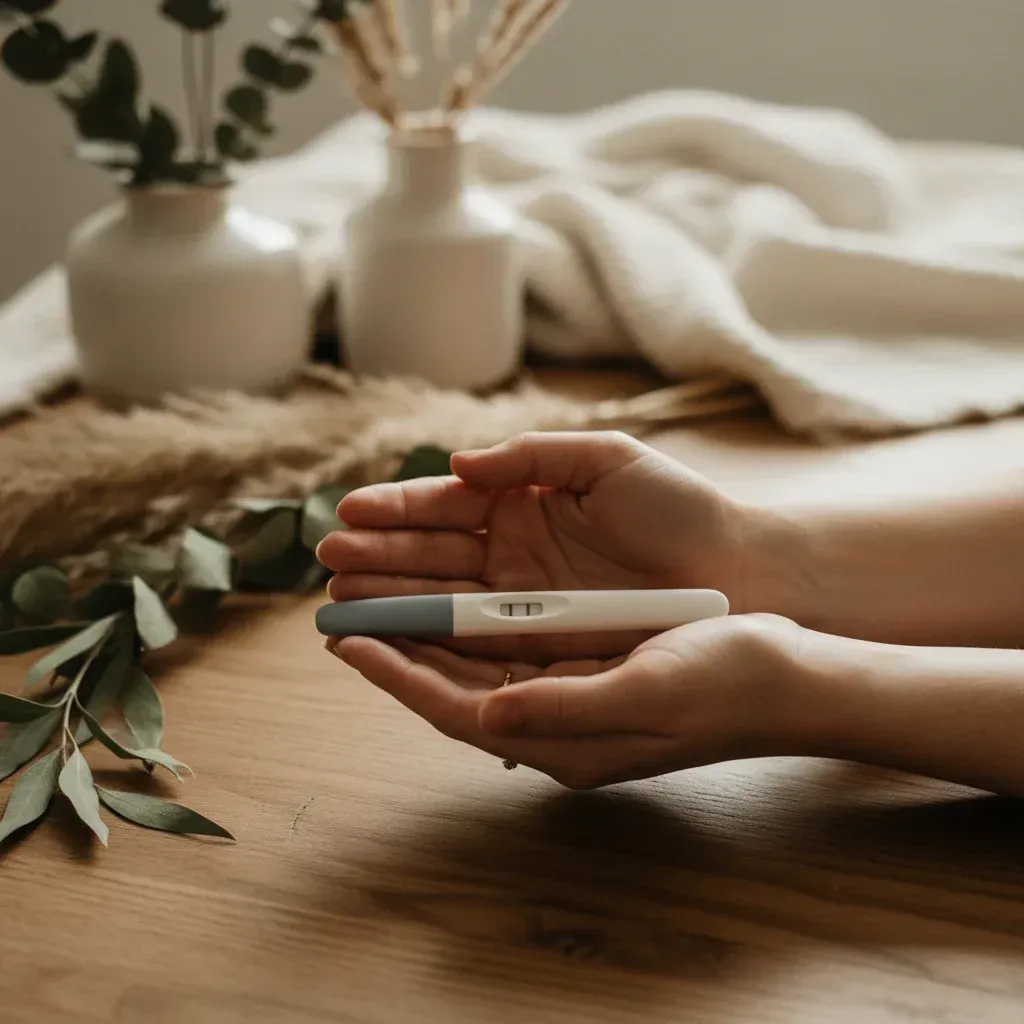
Should You Take a Pregnancy Test at 11 DPO?
You can. But you need to understand what the result actually means.
If it's positive: A positive pregnancy test at 11 DPO is almost certainly a true positive. False positives are extremely rare — the test is detecting hCG that's genuinely there. However, very early positives do carry a higher risk of chemical pregnancy (a pregnancy that ends before it would be visible on ultrasound). Wilcox's NEJM study found that late implantation (after day 10) was associated with a higher risk of early loss. A positive at 11 DPO is real and worth celebrating — just know that confirming with a follow-up test 48 hours later is wise.
If it's negative: A negative at 11 DPO does NOT mean you're not pregnant — a false negative is very common this early. A study by Johnson et al. (2011) in Clinical Chemistry testing the sensitivity of home pregnancy tests found that even the most sensitive tests (claiming 10 mIU/mL detection) missed a significant proportion of pregnancies before 12-13 DPO. The Fertility Friend community data — based on over 93,000 pregnancy charts — shows that approximately 26% of women who eventually got a positive first saw their BFP at 12 DPO or later.
If you can bear it: wait until 12 or 13 DPO. Use a first-morning urine (it's the most concentrated). And use a sensitive test — First Response Early Result consistently outperforms other brands in clinical testing.
I know "wait" is the last thing you want to hear. Both of my pregnancies, I started testing at 9 DPO (I know, I know). The negative tests at 9 and 10 DPO with my son nearly broke me — and then the faintest line appeared at 11 DPO. If I'd stopped testing after that first negative, I'd have missed it.
11 DPO BFP: What Happens Next
If you're holding a positive test right now — congratulations. Take a breath. Here's what to do:
Retest in 48 hours. hCG should roughly double every 48-72 hours in a viable early pregnancy (Barnhart et al., 2004, Obstetrics & Gynecology). A second positive that's equal to or darker than the first is a very good sign.
Start or continue prenatal vitamins. If you haven't already, start taking folic acid immediately (at least 400mcg, though I recommend 800mcg as methylfolate). If you've been following a preconception protocol — keep going. Your CoQ10, vitamin D, and omega-3 are still supporting this early pregnancy.
Contact your GP or midwife. In the UK, your GP will refer you to your local midwifery team, and your booking appointment will be around 8-10 weeks. In the US, call your OB-GYN to schedule your first prenatal visit. There's usually no need for a blood test to "confirm" pregnancy — the home test is diagnostic.
Be cautious with Dr Google. The period between a positive test and your first scan (usually 8-12 weeks) is the longest wait in pregnancy. Resist the urge to compare hCG levels, test line progression, or symptom checklists with strangers online. Every pregnancy is different, and comparison will only fuel anxiety.
11 DPO BFN: Why It's Not Over
A negative test at 11 DPO is disappointing, but it's not conclusive. Here's why.
Implantation can occur as late as day 12 after ovulation (Wilcox et al., 1999). If you ovulated a day later than you think — which is common even with OPK tracking, since ovulation can occur 12-48 hours after an LH surge — then your actual DPO might be 10, not 11. That single day matters enormously when hCG is doubling from near-zero.
Even if implantation happened on day 8, hCG doubles roughly every 48 hours but starts from a baseline of <1 mIU/mL. By 11 DPO, that's potentially only 3 days of doubling — giving you somewhere around 4-16 mIU/mL. Below the reliable detection threshold of most tests.
Wait 48 hours. Test again at 13 DPO with first-morning urine. If that's still negative and your period hasn't arrived, test once more at 15 DPO. After that, if both are negative and your period is late, a blood hCG test through your GP can detect levels as low as 5 mIU/mL.
The Bottom Line
11 DPO is a threshold day. You're past the most common implantation window, hCG is potentially detectable, and your body may — or may not — be giving you signals. The honest truth is that no amount of symptom-spotting will give you a reliable answer. Only time and a test can do that.
What I tell my clients: treat yourself gently during these days. Eat well, sleep enough, move your body gently, and try not to test more than once a day (I appreciate the irony of me saying that, given my own testing history). Whatever the outcome, you're doing everything right by being informed and prepared.
If you're working through DPO symptoms day by day, you might find our 8 DPO, 9 DPO, 10 DPO, and 12 DPO guides helpful for understanding the full timeline.
Frequently Asked Questions
▸Is 11 DPO too early to take a pregnancy test?
It's early but not too early. The most sensitive home tests can detect hCG at 11 DPO if implantation occurred by day 9. However, a negative result at 11 DPO isn't reliable — approximately 26% of pregnancies aren't detectable until 12 DPO or later. If you can wait, 13 DPO gives significantly more accurate results.
▸Can implantation happen at 11 DPO?
Yes, though it's on the later end. Wilcox et al. (1999) found that implantation occurs between days 6 and 12, with 84% happening on days 8-10. Implantation at 11 DPO is possible but associated with a slightly higher risk of early pregnancy loss compared to earlier implantation.
▸How do I tell the difference between period cramps and implantation cramps at 11 DPO?
Honestly, you often can't — they're caused by similar mechanisms. Implantation cramping tends to be milder, more intermittent, and localised to one side. Period cramps typically build progressively and spread across the lower abdomen. But there's significant overlap, and many pregnant women report cramps identical to their usual premenstrual pattern.
▸How dark should a pregnancy test line be at 11 DPO?
A positive at 11 DPO will typically be faint — sometimes barely visible. This is normal because hCG levels are still very low (often 10-50 mIU/mL). The line should darken over the following days as hCG doubles. Don't compare your 11 DPO line to someone else's — hCG levels vary enormously between individuals and have no bearing on pregnancy viability at this stage.
References
- Wilcox AJ, Baird DD, Weinberg CR. (1999). Time of implantation of the conceptus and loss of pregnancy. New England Journal of Medicine, 340(23):1796-1799. doi:10.1056/NEJM199906103402304
- Gnoth C, Johnson S. (2014). Strips of hope: accuracy of home pregnancy tests and new developments. Geburtshilfe und Frauenheilkunde, 74(7):661-669. doi:10.1055/s-0034-1368589
- Barnhart KT et al. (2004). Symptomatic patients with an early viable intrauterine pregnancy: hCG curves redefined. Obstetrics & Gynecology, 104(1):50-55. doi:10.1097/01.AOG.0000128174.48843.12
- Harville EW et al. (2003). Vaginal bleeding in very early pregnancy. Human Reproduction, 18(9):1944-1947. doi:10.1093/humrep/deg379
- Johnson S et al. (2011). Can I be sure? Measuring accuracy of self-assessed pregnancy test results in a cross-sectional study. Clinical Chemistry, 57(S10):A83.
Medical Disclaimer: This article is for informational purposes only and is not a substitute for professional medical advice, diagnosis, or treatment. Always consult your healthcare provider about your individual circumstances. Danielle Bowen is a registered nutritionist (MSc, RNutr), not a medical doctor. Individual experiences vary — the information here reflects current evidence and personal clinical experience, not a guarantee of outcomes.
Written by

Subscribe to Fertilitys
All my Free Resources. No spam. Unsubscribe anytime.