Early Pregnancy Symptoms: Your Complete Week-by-Week Guide
A nutritionist and mum shares every first trimester symptom week by week — what's normal, what's not, and how to cope with the uncertainty of those early weeks.


I remember the exact moment I suspected I was pregnant. It wasn't a missed period. It wasn't nausea. It was a feeling in my breasts that was subtly, unmistakably different from my usual premenstrual tenderness. I was 10 DPO, sitting in a café, and I just knew something had shifted.
Of course, I also "knew" during several cycles that turned out to be nothing. That's the cruel reality of early pregnancy symptoms — they overlap almost perfectly with PMS. And after two chemical pregnancies before my successful one, I'd learned to hold that early hope very gently.
This guide covers every early pregnancy symptom week by week, from the biology of what's actually happening to the practical signs you might notice. I've included what I experienced personally, what the research says, and — perhaps most importantly — how to cope with the uncertainty of those first fragile weeks.
First Trimester Symptoms: The Complete Week-by-Week Timeline
Before we dive in, a reassurance: there is no "right" set of symptoms. Some women feel everything on this list. Some feel almost nothing. Both are normal. The presence or absence of symptoms does not predict the health of your pregnancy (Sapra et al., 2017, Annals of Epidemiology).
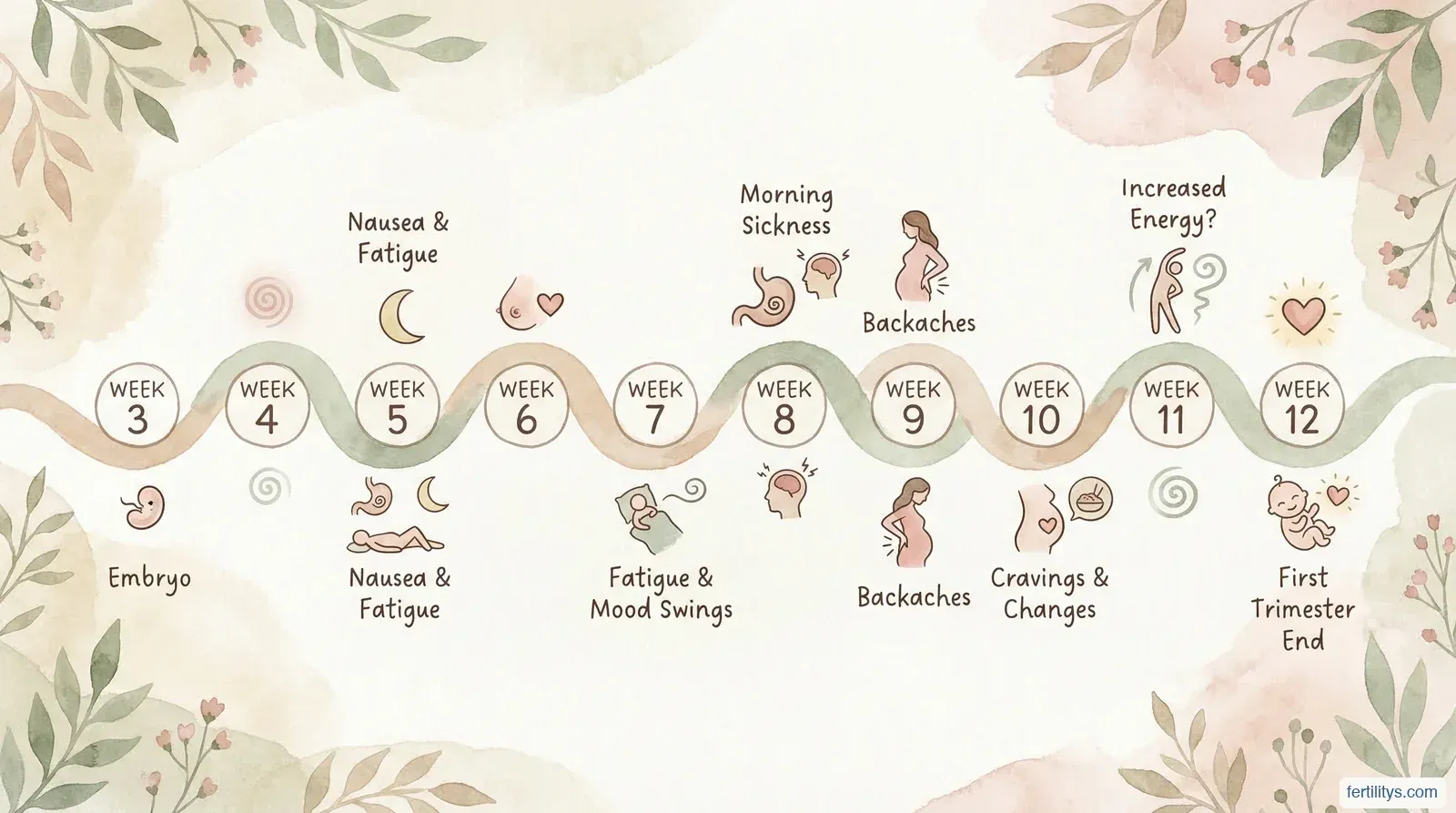
Week 3: Conception and Implantation
What's happening: If conception occurred around ovulation (day 14 of a typical cycle), the fertilised egg is now travelling down the fallopian tube and beginning to divide. By the end of week 3, it may begin implanting in the uterine lining.
What you might feel: Honestly? Probably nothing yet. The embryo hasn't implanted and isn't producing hCG (human chorionic gonadotropin) — the hormone responsible for most pregnancy symptoms. Some women report a vague "feeling" that something is different, but there's no biological basis for symptoms this early.
I tell my clients to try not to symptom-spot during this week. I know that's almost impossible — I certainly couldn't manage it — but the reality is that anything you feel at week 3 is progesterone from ovulation, not pregnancy.
Week 4: Implantation Complete
What's happening: The embryo (now called a blastocyst) has implanted in the uterine wall and is beginning to produce hCG. This is the hormone that a pregnancy test detects, and the one that will soon start causing symptoms. Your period would normally be due around now.
What you might feel:
- Implantation bleeding or spotting — light pink or brown spotting, much lighter than a period. Occurs in about 25% of pregnancies (Harville et al., 2003, Annals of Epidemiology).
- Mild cramping — similar to period cramps, caused by the embryo burrowing into the uterine lining.
- Breast tenderness — often the earliest noticeable symptom. Rising progesterone and hCG increase blood flow to the breasts.
- Fatigue — progesterone is a natural sedative. Many women feel unexplainably exhausted.
I had implantation spotting with my successful pregnancy — a tiny amount of brown discharge at 12 DPO. I nearly dismissed it as my period starting. If you see light spotting around this time, take note but try not to panic — it's one of the most common early pregnancy signs.
Week 5: hCG Rising Fast
What's happening: hCG levels are doubling every 48-72 hours. The embryo is developing rapidly — the neural tube (which becomes the brain and spinal cord) is forming. A home pregnancy test should now show a clear positive.
What you might feel:
- Nausea beginning — the infamous "morning sickness" can start as early as week 5, though weeks 6-8 are more common. Despite the name, it can strike at any time of day.
- Heightened sense of smell — suddenly your partner's cologne is unbearable and the smell of coffee makes you gag. This is thought to be an evolutionary mechanism to protect against potential toxins.
- Frequent urination — hCG increases blood flow to the kidneys, which produce more urine. Your uterus is also starting to press on your bladder.
- Bloating — progesterone slows digestion, causing bloating that can make you feel pregnant before you look it.
- Mood changes — hormonal surges affect neurotransmitters. Crying at adverts? Completely normal.
Week 6: Symptoms Intensify
What's happening: The embryo's heart begins beating (visible on ultrasound from around 6 weeks). hCG levels continue to surge. The placenta is developing.
What you might feel:
- Morning sickness worsening — nausea may become more persistent. About 70-80% of pregnant women experience nausea in the first trimester (Gadsby et al., 1993, BJOG).
- Extreme fatigue — this often peaks in weeks 6-10. Your body is building an entire organ (the placenta) while growing a human. That takes energy.
- Breast changes — nipples may darken (the areolae become larger and darker). Breasts may feel fuller, heavier, or tingling.
- Food aversions — foods you normally love may become revolting. Common aversions include coffee, meat, and strong-flavoured foods.
- Food cravings — often for bland, starchy foods (toast, crackers, potatoes). Your body may be steering you toward easy-to-digest carbohydrates.
Week 6 was when it truly hit me. I woke up one morning and the smell of Tim making coffee — which I normally loved — sent me running to the bathroom. The fatigue was unlike anything I'd experienced. I went from being someone who functioned on 6 hours of sleep to needing 10 hours and still feeling exhausted. The progesterone symptoms I'd been used to from my cycle suddenly amplified tenfold.
Week 7: Nausea at Its Worst
What's happening: The embryo is about the size of a blueberry. Limb buds are forming. The brain is growing rapidly.
What you might feel:
- Peak nausea — this is often the hardest week for morning sickness. Some women experience constant low-grade nausea; others have intense waves.
- Excess saliva (ptyalism) — a less-discussed symptom that can be surprisingly unpleasant.
- Constipation — progesterone slows intestinal motility. Stay hydrated and eat fibre-rich foods.
- Headaches — hormonal changes, increased blood volume, and possible dehydration (from nausea) can all contribute.
- Vivid dreams — many women report unusually intense, strange, or emotional dreams. Changes in sleep patterns and hormones affect REM sleep.
Week 8: Turning a Corner
What's happening: The embryo is now called a fetus. Fingers and toes are forming. All major organs are in place (though still developing). hCG is approaching its peak.
What you might feel:
- Nausea may peak — hCG typically reaches its highest level between weeks 8-11, and nausea often follows the same curve.
- Waistband tightening — not from the baby (which is tiny) but from bloating, water retention, and uterine expansion.
- Dizziness or lightheadedness — blood volume is increasing by up to 50% during pregnancy, and your cardiovascular system is adjusting. Blood pressure often drops in the first trimester.
- Emotional sensitivity — hormonal changes combined with the enormity of what's happening can make you more emotionally reactive than usual.
Weeks 9-10: The Plateau
What's happening: The fetus is about the size of a grape (week 9) to a kumquat (week 10). All vital organs have formed. hCG levels are plateauing.
What you might feel:
- Nausea beginning to ease — for some women, week 9-10 marks the start of improvement. For others, it persists until weeks 12-14.
- Visible veins — increased blood volume can make veins in your breasts, hands, and legs more prominent.
- Slight weight gain or loss — weight loss from nausea is common and usually not a concern unless severe (hyperemesis gravidarum affects 1-3% of pregnancies).
- Round ligament pain — sharp or aching pains in the lower abdomen as the ligaments supporting your uterus begin to stretch.
Weeks 11-12: Light at the End of the Tunnel
What's happening: The fetus is fully formed — the rest of pregnancy is about growth and maturation. The placenta is taking over hormone production from the corpus luteum. The risk of miscarriage drops significantly after a heartbeat is confirmed at the 12-week scan.
What you might feel:
- Nausea fading — most women find morning sickness improves significantly by weeks 12-14 as hCG levels stabilise and the placenta takes over.
- Energy returning — the crushing first-trimester fatigue often lifts around week 12, and many women describe the second trimester as feeling more like themselves.
- Reduced breast tenderness — though breasts may continue to grow throughout pregnancy.
- A small bump appearing — depending on your build, you may notice a slight bump, though many first-time mothers don't show until weeks 16-20.
Week 12 felt like emerging from a fog. I remember waking up one morning and realising I hadn't felt nauseous yet. I made coffee — actual coffee, just a small one — and enjoyed it for the first time in weeks. The exhaustion was lifting. And when we saw Bowie on the 12-week scan, moving and wriggling, the relief was overwhelming. After two chemical pregnancies, seeing a healthy baby at 12 weeks felt like the finish line — even though I know it was really just the beginning.
Early Pregnancy Symptoms vs PMS: How to Tell the Difference
This is the question I get asked most. And the honest answer is: you often can't tell the difference by symptoms alone. Here's why they overlap and the subtle clues that might help.
Why They Feel the Same
Both PMS and early pregnancy are driven by progesterone. After ovulation, your body produces progesterone regardless of whether conception has occurred. It's progesterone that causes breast tenderness, bloating, mood changes, fatigue, and cramping — in both scenarios.
The key difference is what happens next. If you're not pregnant, progesterone drops around day 26-28, triggering your period. If you are pregnant, progesterone continues to rise, and hCG enters the picture.
Subtle Differences to Watch For
- Breast tenderness: PMS breast pain tends to be generalised and improves as your period approaches. Pregnancy breast tenderness often involves the nipples specifically, may include tingling or a "full" feeling, and doesn't go away.
- Cramping: PMS cramps tend to intensify leading up to your period and then ease once bleeding starts. Implantation cramping is usually milder, shorter-lived (1-3 days), and may be one-sided.
- Fatigue: PMS tiredness is mild to moderate. Early pregnancy fatigue is often described as "bone-deep" exhaustion — qualitatively different from normal tiredness.
- Nausea: PMS rarely causes nausea (unless you have severe PMS or PMDD). Nausea is strongly suggestive of early pregnancy, especially if it's persistent or triggered by smells.
- Basal body temperature: If you track BBT, a sustained rise beyond 16 days post-ovulation is a strong pregnancy indicator (your BBT stays elevated rather than dropping before your period).
The only definitive answer is a pregnancy test. I recommend testing at 12-14 DPO for the most reliable result. If you test earlier, a negative doesn't rule pregnancy out — hCG may not yet be high enough to detect.
The Most Common Early Pregnancy Symptoms
Based on a large prospective study by Sapra et al. (2017), the most frequently reported early pregnancy symptoms are:
- Fatigue — reported by up to 95% of women in the first trimester
- Nausea (with or without vomiting) — 70-80% of women
- Breast tenderness — 70-75% of women
- Frequent urination — 60-65% of women
- Food aversions — 50-60% of women
- Bloating — 50-55% of women
- Mood changes — 40-50% of women
- Headaches — 35-40% of women
- Constipation — 30-40% of women
- Dizziness — 20-30% of women
Notice that none of these occurs in 100% of pregnancies. If you're missing one or several, that's completely normal. I had almost no nausea until week 6 — and then it hit me like a wall. Everyone's timeline is different.
Less Common Early Pregnancy Symptoms You Might Not Expect
Beyond the well-known symptoms, there are several that catch women by surprise:
Metallic Taste (Dysgeusia)
A persistent metallic or bitter taste in your mouth, often described as "sucking on coins." It's caused by hormonal changes affecting your taste buds and is more common than you'd think. Sucking on citrus or ice cubes can help.
Nasal Congestion
Pregnancy rhinitis — stuffiness, sneezing, or a runny nose without a cold — affects up to 30% of pregnant women. Increased blood volume causes the nasal membranes to swell.
Increased Vaginal Discharge
A thin, milky white discharge (leukorrhea) is normal in early pregnancy. It's caused by increased oestrogen and blood flow to the vaginal area. If it's thick, lumpy, coloured, or smells strongly, see your GP.
Sensitivity to Temperature
Feeling unusually warm, especially at night. Your metabolic rate increases in early pregnancy, and progesterone raises your basal body temperature. Night sweats are common but rarely discussed.
Vivid or Disturbing Dreams
Many women report unusually intense, vivid, or emotionally charged dreams. Changes in sleep architecture, more frequent waking, and hormonal shifts all contribute. I had bizarre, hyperreal dreams throughout my first trimester — Tim thought I was making them up, they were so strange.
When Symptoms Don't Appear (or Disappear)
This is the section I wish someone had written for me. Because the absence of symptoms can cause just as much anxiety as their presence.
No Symptoms at All?
Some women sail through the first trimester with minimal symptoms. This does NOT mean something is wrong. A 2016 study in JAMA Internal Medicine found that while nausea and vomiting were associated with a lower miscarriage risk, the absence of nausea did not predict miscarriage (Hinkle et al., 2016). Many healthy pregnancies have mild or few symptoms.
Symptoms That Suddenly Stop
This is more anxiety-inducing: you've been nauseous and exhausted for weeks, and then one morning everything feels fine. First, take a breath. Symptoms naturally fluctuate — you might feel terrible tomorrow. Second, a sudden and complete cessation of all symptoms before week 9 can sometimes indicate a missed miscarriage, but it can also be completely normal. If you're worried, contact your midwife or GP for reassurance. An early scan can check for a heartbeat.
After my chemical pregnancies, I was hyper-vigilant about symptom-tracking. Every day I didn't feel nauseous, I panicked. My midwife told me something that helped: "Your body knows what it's doing. Trust it." Easier said than done — but true.
When to See a Doctor
Most early pregnancy symptoms are normal and don't require medical attention. But contact your GP, midwife, or nearest early pregnancy unit if you experience:
- Heavy bleeding (soaking a pad) — especially with severe cramping
- Severe abdominal pain — particularly if one-sided (possible ectopic pregnancy)
- Persistent vomiting — if you can't keep any food or fluid down for 24+ hours (possible hyperemesis gravidarum)
- Fever above 38°C — may indicate infection
- Pain or burning during urination — UTIs are common in pregnancy and need treatment
- Severe headaches with visual disturbances — rarely, can indicate a blood pressure issue
Trust your instincts. If something feels wrong, it's always better to get checked and be reassured than to wait and worry.

How to Cope with First Trimester Symptoms
Managing Nausea
- Eat small, frequent meals — an empty stomach worsens nausea
- Keep plain crackers by your bed for before you get up
- Ginger — fresh ginger tea, ginger biscuits, or ginger supplements. A 2014 meta-analysis confirmed ginger significantly reduces pregnancy nausea (Viljoen et al., Nutrition Journal)
- Vitamin B6 (pyridoxine) — 10-25mg three times daily has good evidence for reducing nausea (ACOG recommendation)
- Acupressure wristbands (Sea-Bands) — may help some women
- Avoid triggers: strong smells, fatty foods, lying down immediately after eating
Managing Fatigue
- Sleep when you can — nap if possible, go to bed early
- Accept it. First-trimester fatigue is biological, not laziness. Your body is doing extraordinary work.
- Gentle movement helps — a short walk or yoga session can paradoxically boost energy
- Iron-rich foods — fatigue can be worsened by the anaemia that develops as blood volume expands. Dark leafy greens, red meat, lentils, fortified cereals.
- Stay hydrated — dehydration worsens fatigue
Managing Emotional Changes
- Talk about it — with your partner, a friend, or a counsellor. Bottling up anxiety makes everything harder.
- Limit Dr. Google — symptom-searching at 2am will not reassure you. Set boundaries with yourself.
- Meditation and breathing exercises — even 5 minutes of slow breathing can reduce anxiety. I practised yoga nidra throughout my first trimester and it was one of my lifelines.
- Be gentle with yourself — growing a human is enormous. You're allowed to feel overwhelmed, scared, excited, and exhausted all at once.
Recognising the symptoms of pregnancy in the first few weeks can be tricky because so many early signs of pregnancy overlap with premenstrual symptoms. The key signs and symptoms of pregnancy — missed period, nausea, breast changes, fatigue — all intensify as each week of pregnancy passes and hCG levels rise.
If you suspect you may be pregnant, the most reliable next step is to take a pregnancy test. Home tests are most accurate from the day of your missed period onwards. The NHS recommends testing with first-morning urine for the most concentrated hCG reading. A healthy pregnancy will show steadily increasing symptoms over the coming weeks — though some women feel very little in the first trimester, and that's normal too.
The Bottom Line
Early pregnancy symptoms are your body's way of telling you something extraordinary is happening. They're driven by hormones — primarily hCG and progesterone — and they vary enormously from woman to woman, and even from pregnancy to pregnancy.
The hardest part isn't the nausea or the fatigue. It's the uncertainty. Especially in those early weeks when it feels too fragile to believe in. I know that feeling intimately. After two chemical pregnancies, I spent most of my first trimester with Bowie in a state of cautious, breathless hope — terrified to celebrate, terrified to worry, terrified in general.
What I'd tell my past self, and what I tell my clients now: your body is wiser than your anxiety. Symptoms come and go. Good days and bad days are both normal. And the overwhelming majority of pregnancies with a confirmed heartbeat at 8 weeks go on to result in a healthy baby.
You're doing brilliantly. Even when it doesn't feel like it.
You might also find helpful:
▸What are the very first signs of pregnancy?
The earliest signs typically appear around 6-12 days after ovulation and include implantation spotting (light pink or brown discharge), mild cramping, breast tenderness (especially nipple sensitivity), and unusual fatigue. These can appear before a missed period, though many women don't notice symptoms until weeks 5-6 when hCG levels are higher.
▸How early can pregnancy symptoms start?
The earliest possible symptoms begin around implantation, which occurs 6-12 days after ovulation (typically 8-10 days). However, most noticeable symptoms begin at weeks 4-6 as hCG rises. Nausea typically starts around week 6 and peaks at weeks 8-10. Anything you feel before implantation is progesterone from ovulation, not pregnancy.
▸Is it possible to be pregnant with no symptoms?
Yes, absolutely. Some women experience very mild symptoms or almost none at all during the first trimester. Research shows that while nausea is associated with lower miscarriage risk, the absence of nausea does not predict miscarriage. If you have a positive pregnancy test but few symptoms, this is likely just your individual hormonal response and is completely normal.
▸How can I tell if it's PMS or early pregnancy?
It's very difficult to distinguish by symptoms alone because both are driven by progesterone. Subtle clues include: nipple-specific breast tenderness (more common in pregnancy), persistent nausea (uncommon in PMS), heightened sense of smell, and a sustained elevated basal body temperature beyond 16 days post-ovulation. The only definitive answer is a pregnancy test at 12-14 DPO.
▸When does morning sickness start and end?
Morning sickness (which can occur at any time of day) typically begins around weeks 5-6, peaks between weeks 8-10 when hCG is highest, and usually improves significantly by weeks 12-14. About 70-80% of pregnant women experience some nausea. For most women, it resolves by the end of the first trimester, though a small percentage experience nausea throughout pregnancy.
▸Should I worry if my pregnancy symptoms suddenly stop?
Not necessarily. Symptoms naturally fluctuate — you may feel terrible one day and fine the next. This is normal. However, a sudden and complete disappearance of all symptoms before week 9 can occasionally indicate a concern. If you're worried, contact your midwife or GP. An early scan can check for a heartbeat and provide reassurance. Trust your instincts — it's always better to get checked.
▸What helps with first trimester nausea?
Evidence-backed strategies include: eating small, frequent meals (never letting your stomach empty), ginger (tea, biscuits, or supplements — confirmed by meta-analysis), vitamin B6 (10-25mg three times daily, per ACOG guidelines), acupressure wristbands, avoiding strong smells, and keeping plain crackers by your bed. If nausea is severe (you can't keep fluids down for 24+ hours), see your doctor — medication is available and safe.
References
- Sapra KJ et al. (2017). Signs and symptoms of early pregnancy loss. Reproductive Toxicology, 68:256-262. doi:10.1016/j.reprotox.2016.10.010
- Harville EW et al. (2003). Vaginal bleeding in very early pregnancy. Human Reproduction, 18(9):1944-1947. doi:10.1093/humrep/deg379
- Gadsby R et al. (1993). A prospective study of nausea and vomiting during pregnancy. British Journal of General Practice, 43(371):245-248.
- Hinkle SN et al. (2016). Association of Nausea and Vomiting During Pregnancy With Pregnancy Loss. JAMA Internal Medicine, 176(11):1621-1627. doi:10.1001/jamainternmed.2016.5641
- Viljoen E et al. (2014). A systematic review and meta-analysis of the effect and safety of ginger in the treatment of pregnancy-associated nausea and vomiting. Nutrition Journal, 13:20. doi:10.1186/1475-2891-13-20
- ACOG Practice Bulletin No. 189 (2018). Nausea and Vomiting of Pregnancy. Obstetrics & Gynecology, 131(1):e15-e30.
- Wilcox AJ et al. (1999). Time of implantation of the conceptus and loss of pregnancy. New England Journal of Medicine, 340(23):1796-1799.
- Gnoth C & Johnson S (2014). Strips of Hope: Accuracy of Home Pregnancy Tests and New Developments. Geburtshilfe und Frauenheilkunde, 74(7):661-669.
Medical Disclaimer: This article is for informational purposes only and does not constitute medical advice. Every pregnancy is different — please consult your midwife, GP, or obstetrician for personalised guidance. If you experience heavy bleeding, severe pain, or persistent vomiting, seek medical attention immediately. Danielle Bowen is a registered nutritionist (RNutr) and qualified yoga teacher, not a medical doctor.
Written by

Subscribe to Fertilitys
All my Free Resources. No spam. Unsubscribe anytime.