At-Home AMH Test: Are They Accurate and Which Is Best?
A fertility nutritionist's honest review of at-home AMH test kits — which are accurate, which are best value, and what to do with your results.


I got my AMH tested the traditional way — a blood draw at a fertility clinic after a referral I waited weeks for. Looking back, I wish I'd known about at-home testing earlier. Not because the clinic was wrong, but because I would have had that information months sooner, and those months matter when your ovarian reserve is low.
At-home AMH testing has come a long way in the last few years. The kits are genuinely accurate, surprisingly easy to use, and increasingly affordable. But they're not all created equal, and there are some important things to understand before you order one.
How At-Home AMH Tests Work
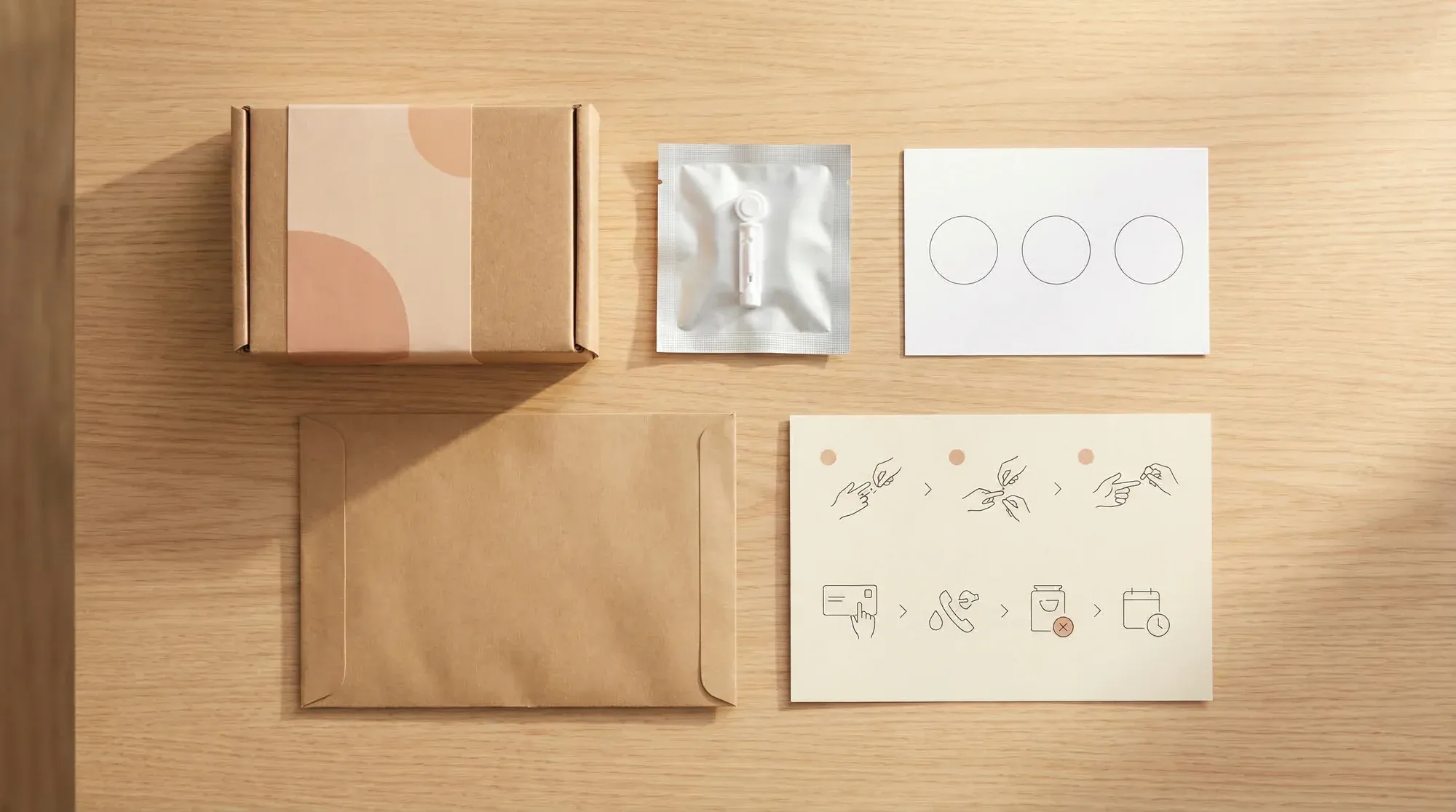
An at-home AMH test kit is a finger-prick blood collection device that you use yourself at home, then post back to an accredited laboratory. The lab runs the same immunoassay (blood analysis) on your sample that a clinic would — the only difference is how the blood is collected.
Most kits use one of two collection methods:
- Dried blood spot (DBS) cards — you prick your finger and drip blood onto an absorbent card, which dries before posting. This is the older, more common method. It's cheap to ship, but slightly less accurate than liquid blood collection.
- Micro-blood collection devices — newer technology like the TAP II device or microvettes that collect a small volume of liquid blood (similar to a clinic sample). These tend to be more accurate because the blood doesn't need to be reconstituted from a dried sample.
Regardless of the method, your sample goes to a UKAS-accredited (UK) or CLIA-certified (US) laboratory — the same accreditations required for hospital labs. The turnaround is typically 5–10 working days.
Are At-Home AMH Tests Accurate?
This is the question everyone asks, and the answer is more reassuring than you might expect.
A 2022 head-to-head clinical trial published in Reproductive Biology and Endocrinology (Kyweluk et al.) compared at-home blood collection with standard clinic venipuncture in 41 women of reproductive age. The TAP II micro-blood device showed an R-squared of 0.99 against the venipuncture gold standard — meaning near-perfect agreement. Sensitivity and specificity were both 100%, with zero clinical disagreements.
The older dried blood spot (DBS/ADx card) method was still good but not as tight: R² of 0.87, with 88% specificity. That means roughly 1 in 8 samples may get a slightly different clinical categorisation compared to a venipuncture test.
The practical takeaway: at-home AMH tests using modern collection devices are clinically comparable to a blood draw at a fertility clinic. The older DBS card method is still reliable enough for screening, but if accuracy matters to you (and it should), look for a kit that uses liquid blood collection rather than dried spots.
What Can Affect Your Results
Even with a perfectly accurate test, a few things can skew your at-home AMH result:
- Insufficient blood volume — the most common issue. Cold fingers, dehydration, or rushing the collection can mean too little blood on the card or in the tube. Run your hands under warm water for 2 minutes before pricking.
- Postal delays — extreme heat during summer shipping can degrade the sample. Most companies include temperature-controlled packaging, but check.
- Hormonal contraception — some hormonal birth control can suppress AMH slightly. Most at-home tests account for this, but mention it when completing your health questionnaire.
- Recent pregnancy or breastfeeding — AMH can be temporarily lower post-pregnancy. Wait at least 3 months after stopping breastfeeding for a reliable baseline.
Best At-Home AMH Tests: UK and US Options
I've looked at the major providers across both markets. Here's what I'd recommend — and what I'd skip.
| Provider | Price | Hormones Tested | Market | Results | Standout Feature |
|---|---|---|---|---|---|
| Hertility | ~£249 | Up to 10 (incl. AMH) | UK | 6–10 days | CQC-regulated, GP follow-up included |
| Modern Fertility | ~$179 | Up to 7 (incl. AMH) | US | 5–7 days | Works on hormonal birth control |
| LetsGetChecked | ~$139 | AMH only (Ovarian Reserve test) | US/UK | 2–5 days | Cheapest AMH-only option, nurse support |
| Forth | ~£79 | AMH only | UK | 2–5 days | Budget UK AMH-only option |
| Everlywell | ~$199 | 5 (incl. AMH) | US | 5–7 days | AMH + thyroid in one panel |
My Take on Each
Hertility is the premium UK option and the one I point most of my UK clients towards. It's CQC-regulated (the same body that inspects NHS hospitals), MHRA-approved, and tests up to 10 hormones — not just AMH. The panel includes FSH, LH, oestradiol, thyroid, and testosterone, which gives a much fuller picture. You also get a personalised report reviewed by a reproductive scientist, with optional follow-up consultations. It's not cheap, but it's the most comprehensive at-home test available in the UK.
Modern Fertility is the go-to in the US market. Acquired by Ro in 2021, it tests up to 7 hormones depending on whether you're on hormonal birth control (one of the few tests that works either way). The dashboard is excellent — it shows you where your results sit on a spectrum rather than just giving you numbers, which is exactly what most people need when they're looking at AMH for the first time.
LetsGetChecked offers a straightforward AMH-only test at the lowest price point. If you've already had your thyroid and other hormones checked and you specifically want an AMH reading, this is the most efficient option. Available in both the UK and US. Includes a nurse consultation to discuss results.
Forth is the budget UK choice for AMH alone — around £79. Less support than Hertility, but the same lab analysis.
At-Home AMH Test vs Clinic Testing
Both are valid. But they serve slightly different purposes, and understanding the difference will help you choose.
| At-Home Test | Clinic Test | |
|---|---|---|
| Collection | Finger prick at home | Venipuncture (arm blood draw) |
| Accuracy | R² = 0.87–0.99 vs gold standard | Gold standard |
| Cost | £79–249 / $139–199 | Free (NHS) or £100–300 (private) |
| Wait time | Delivered in 2–3 days, results in 5–10 | GP referral: weeks to months |
| Other tests | Hormones only (no scan) | AMH + AFC ultrasound + full history |
| Context | Online report, optional consult | Face-to-face discussion with specialist |
The biggest advantage of at-home testing is speed and access. If you're 30 and curious about your ovarian reserve, a GP might not refer you for testing at all — you're "too young" in NHS terms. An at-home test puts the information in your hands within a couple of weeks.
The biggest limitation is that AMH is only one piece of the puzzle. A fertility clinic will combine your AMH with an antral follicle count (AFC) ultrasound, FSH levels, a physical examination, and your full medical history. An at-home test can't do that.
My honest advice: use at-home testing for baseline awareness, but follow up with a clinic if your results are concerning or if you're actively trying to conceive. The at-home test tells you where you stand. The clinic tells you what to do about it.
Who Should Consider an At-Home AMH Test?
Not everyone needs one — but more people could benefit from one than you'd think:
- Women in their late 20s or 30s who want a fertility baseline but aren't actively trying yet
- Anyone considering egg freezing — AMH directly informs the decision and timing
- Women on hormonal birth control — some tests (like Modern Fertility) can measure AMH even on the pill, since AMH isn't affected by most hormonal contraception
- Anyone with a family history of early menopause — early screening gives you more options
- Women with endometriosis or past ovarian surgery — both conditions can reduce ovarian reserve
- Anyone who wants information without waiting — NHS fertility referrals can take months. An at-home test takes days.
⏳ Start Earlier Than You Think
I always tell my clients: test early, not urgently. Getting your AMH checked at 28 or 30 isn't alarmist — it's informed. The earlier you have a baseline, the more time you have to act on it. If your AMH is lower than expected, that's not a crisis at 30 — but it might be at 38. Knowledge is time, and time is what matters most in fertility.
What to Do With Your Results
You've got your AMH number. Now what?
If your AMH is within the normal range for your age — that's reassuring, but don't file it and forget it. Consider retesting in 2–3 years, especially if you're not planning pregnancy in the near future. AMH can drop faster than expected.
If your AMH is lower than expected — don't panic, but do act. Book a follow-up with a fertility specialist (reproductive endocrinologist) for a full assessment including an AFC ultrasound. Start optimising your egg quality now: nutrition, supplements, stress management, sleep. Give yourself at least 12 months of preparation before trying to conceive.
When I got my AMH result of 3 pmol/L at 32, I could have crumbled. Instead, I built a protocol. CoQ10, vitamin D, omega-3, Mediterranean diet, gentle exercise, better sleep. Twelve months later my AMH had roughly doubled to 6.43 pmol/L. And more importantly — I got pregnant naturally. The result isn't the ending. It's the beginning of your plan.
If your AMH is higher than expected (above 5 ng/mL or 35 pmol/L) — this could suggest PCOS, particularly if you have other symptoms like irregular periods, acne, or excess hair growth. A high AMH isn't automatically a problem, but it's worth discussing with your GP or a specialist.

The Bottom Line
At-home AMH tests are accurate, accessible, and increasingly affordable. The best kits now match clinic venipuncture at R² = 0.99 — that's about as close to identical as a finger-prick test can get. Whether you choose Hertility in the UK or Modern Fertility in the US, you'll get a reliable reading of your ovarian reserve without waiting weeks for a referral.
But remember what AMH is — and what it isn't. It estimates your egg quantity, not your egg quality. It doesn't predict whether you can get pregnant. And it doesn't replace a proper fertility assessment with a specialist if you're actively trying.
Think of it as a starting point. A way to know where you stand, so you can plan accordingly. I wish I'd had mine tested earlier than 32. If you're reading this in your late twenties or early thirties and you're even slightly curious — just do it. The test costs less than a pair of trainers. The information it gives you is priceless.
You might also find helpful:
▸How accurate are at-home AMH tests?
Very accurate. A 2022 clinical trial found that modern micro-blood collection devices show R² = 0.99 correlation with clinic venipuncture — meaning near-identical results. Older dried blood spot cards are slightly less precise (R² = 0.87) but still reliable for screening purposes.
▸What is the best at-home AMH test in the UK?
Hertility is the most comprehensive option (up to 10 hormones, ~£249, CQC-regulated with optional GP follow-up). For AMH only, Forth offers a budget alternative at ~£79. Both use accredited laboratories.
▸Can I take an AMH test while on the pill?
Yes. AMH levels aren't significantly affected by most hormonal contraception, unlike FSH or LH which are suppressed by the pill. Modern Fertility specifically designs their test to work on hormonal birth control. However, some studies suggest long-term pill use may slightly lower AMH, so discuss with your provider if your result seems unexpectedly low.
▸How much does an at-home AMH test cost?
Prices range from £79 (Forth, AMH only) to £249 (Hertility, full hormone panel) in the UK. In the US, expect $139 (LetsGetChecked, AMH only) to $199 (Everlywell, hormone panel). Most at-home tests are cheaper than private clinic testing, which typically runs £100–300 or $200–500.
▸Should I get an AMH test if I'm not trying to conceive?
It's worth considering if you're in your late twenties or thirties and want a fertility baseline. AMH gives you information to plan with — whether that's deciding when to try, whether to consider egg freezing, or simply understanding where you stand. It's not about urgency. It's about having the data to make informed choices about your timeline.
References
- Kyweluk MA et al. (2022). Evaluation of at-home serum anti-Müllerian hormone testing: a head-to-head comparison study. Reproductive Biology and Endocrinology, 20:130. doi:10.1186/s12958-022-01004-2
- Steiner AZ et al. (2017). Association Between Biomarkers of Ovarian Reserve and Infertility Among Older Women of Reproductive Age. JAMA, 318(14):1367-1376. doi:10.1001/jama.2017.14588
- Broer SL et al. (2013). AMH: a review of its role in ovarian function. Human Reproduction Update, 19(2):172-183. doi:10.1093/humupd/dms055
- Li HWR et al. (2012). The performance of dried blood spot (DBS) testing for anti-Müllerian hormone (AMH) in the clinical setting. Human Reproduction, 27(11):3321-3324. doi:10.1093/humrep/des264
- Dennis NA et al. (2012). The level of serum anti-Müllerian hormone correlates with vitamin D status. Journal of Clinical Endocrinology & Metabolism, 97(7):2450-2455. doi:10.1210/jc.2012-1106
- Tukiendorf et al. (2025). Age-stratified AMH nomogram: a comprehensive cohort study including 22,920 women. Frontiers in Endocrinology, 16. doi:10.3389/fendo.2025.1612194
- Greenwood EA et al. (2018). Antimüllerian hormone: not a fertility crystal ball. JAMA, 318(14):1328-1330. doi:10.1001/jama.2017.15288
Medical Disclaimer: This article is for informational purposes only and is not a substitute for professional medical advice. Always consult your healthcare provider before making decisions about fertility testing or treatment. Danielle Bowen is a registered nutritionist (RNutr), not a medical doctor.
Written by

Subscribe to Fertilitys
All my Free Resources. No spam. Unsubscribe anytime.