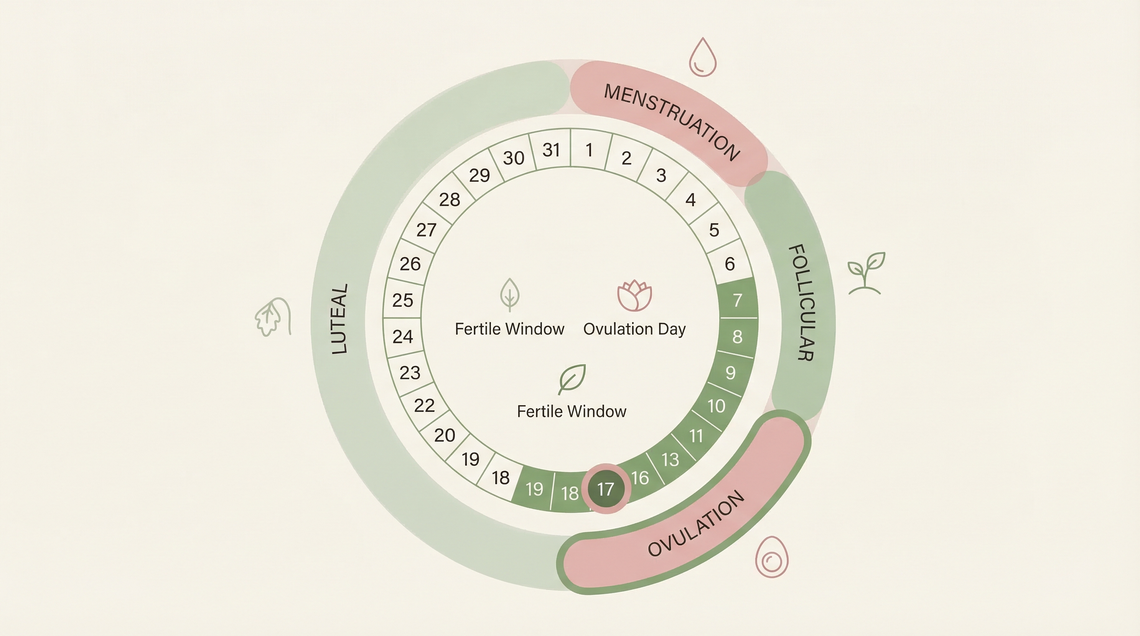
Implantation Cramps: What They Feel Like and When They Happen
What implantation cramps feel like, when they happen, and how to tell them apart from period pain.


💡 Quick Answer
Implantation cramps are mild, brief twinges in the lower abdomen that happen 8–10 days after ovulation in most pregnancies. They're lighter than period cramps, last minutes to hours (not days), and about 30–40% of women notice them. They don't require treatment.
Key Takeaways
- Implantation most commonly occurs 8–10 DPO (84% of pregnancies), with a full range of 6–12 DPO
- Implantation cramps feel like mild twinges or pulling — not like period pain — and last minutes to hours
- About 25% of pregnant women also have light implantation bleeding (pink or brown spotting)
- Progesterone causes identical cramping in non-pregnant cycles — cramps alone can't confirm pregnancy
- Wait until 12–14 DPO for a reliable pregnancy test result
You're somewhere in the second half of your cycle, and there's a strange pulling sensation low in your belly. Not quite like period pain. Not quite like anything you can name. And now you're wondering: is this it?
If you've been trying to conceive — or even just hoping — that question carries enormous weight. Every twinge gets analysed. Every sensation gets Googled. And the internet isn't always helpful, because most articles either tell you implantation cramps are "just like mild period cramps" (not particularly useful) or list 47 symptoms that could mean anything.
So here's what we're actually going to cover: what implantation cramps feel like based on the research we have, exactly when they happen, how they differ from period pain and ovulation cramps, and — honestly — whether you can even tell the difference. Because the answer to that last one is more complicated than most sites admit.
What actually happens during implantation
Before we talk about cramps, it helps to understand what's going on biologically — because "implantation" gets thrown around a lot without much explanation of the process itself. And the question of when does implantation occur only makes sense once you see the full journey from fertilisation to attachment.
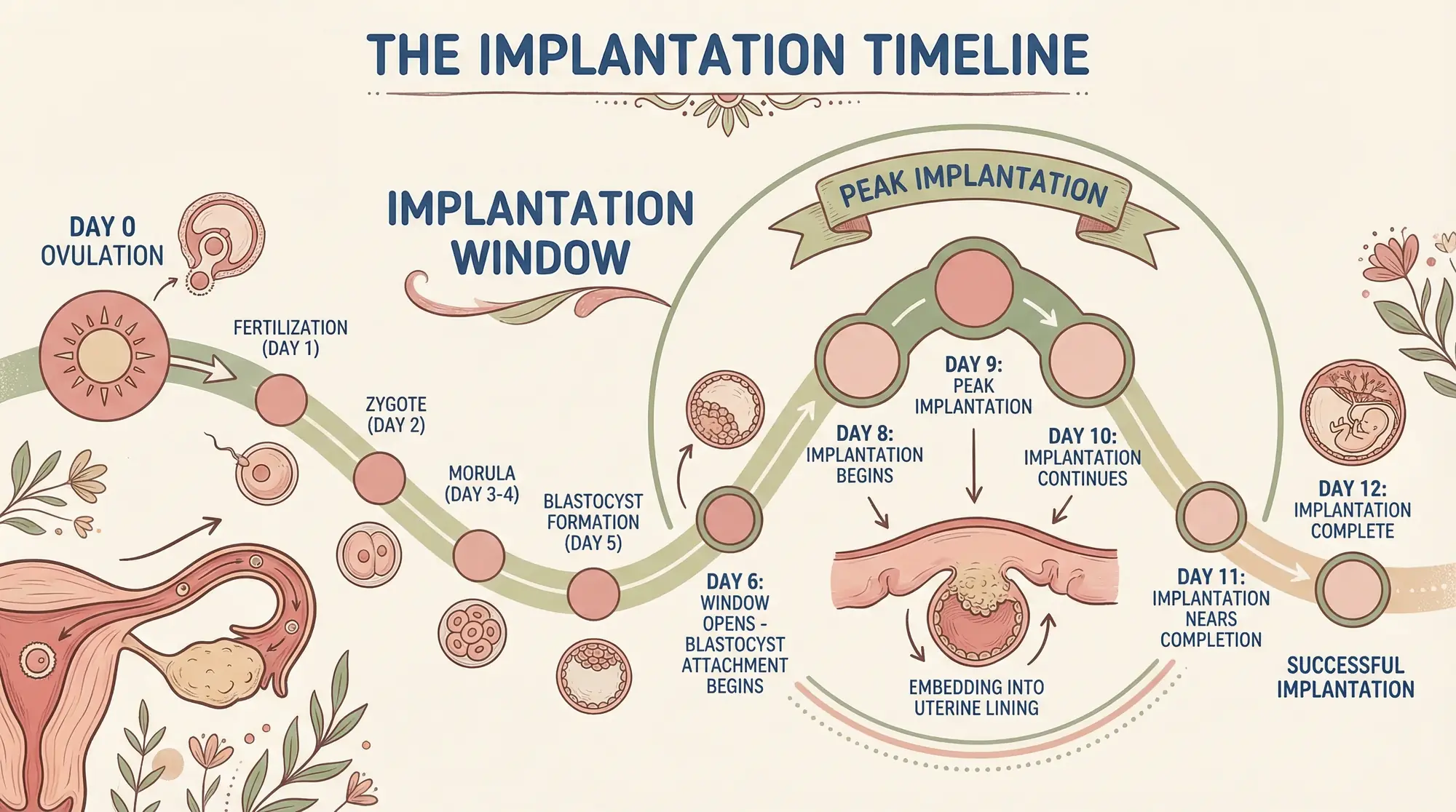
After an egg is fertilised in the fallopian tube, it doesn't immediately attach to anything. The resulting blastocyst (a ball of roughly 70–100 cells by this point) travels down the fallopian tube over 3–4 days, arriving in the uterus around 5–6 days post-ovulation. But it doesn't implant straight away. It floats in the uterine cavity for another day or two, "hatching" from its protective outer shell (the zona pellucida) before making contact with the endometrium.
The actual implantation process happens in three stages:
- Apposition — the blastocyst loosely attaches to the uterine wall
- Adhesion — molecular signalling creates a firmer bond
- Invasion — the trophoblast cells burrow into the endometrium, connecting with maternal blood vessels
That third stage — invasion — is the one that likely causes any cramping you might feel. The blastocyst is literally embedding itself into tissue, and the endometrium remodels in response. Blood vessels form, the tissue changes structure, and localised inflammation occurs as part of a normal immune response (Dey et al., 2004).
When do implantation cramps happen?
The landmark study on implantation timing comes from Wilcox, Baird, and Weinberg, published in the New England Journal of Medicine in 1999. They tracked 221 women attempting pregnancy and used daily urine samples to detect the first appearance of hCG (human chorionic gonadotropin) — the hormone that signals implantation has occurred.
Their findings (Wilcox et al., 1999):
- 84% of successful pregnancies showed first hCG on days 8, 9, or 10 after ovulation
- The earliest implantation detected was 6 days post-ovulation (under 0.5% of cases)
- The latest was 12 days post-ovulation
- The average was 9.1 days after ovulation
So when people say implantation cramps happen "6–12 DPO," that's technically correct — but it's misleading without context. The vast majority cluster tightly around days 8–10. If you're 6 DPO and cramping, implantation is possible but statistically unlikely. If you're 9 DPO and cramping, the timing lines up much better.
There's a catch, though. The Wilcox study measured when hCG first became detectable, not when the physical process of implantation began. The cramping sensation — if it happens — likely occurs during the invasion phase, which could be slightly before hCG appears in urine. But we're talking hours, not days.
What about late implantation?
The same study found something concerning: pregnancies that implanted later had a significantly higher risk of early loss. Implantation after day 11 carried a 26% risk of early pregnancy loss, compared to 13% for day 9 implantation. This doesn't mean late implantation causes miscarriage — but it may signal that something about the embryo or the endometrial environment is suboptimal.
What do implantation cramps feel like?
Here's the honest answer: there's no published clinical study specifically characterising "implantation cramps" as a distinct sensation. What we know comes from a combination of biological plausibility (tissue invasion should produce some sensation) and extensive patient-reported experience.
In my practice, women who later confirmed pregnancies describe implantation cramping remarkably consistently — a light pulling or pinching sensation, almost like a muscle twitch, that comes and goes. It's the kind of thing you'd dismiss if you weren't paying attention.
Based on clinical observation and patient reports, implantation cramps typically feel like:
- Intensity: Mild — significantly lighter than period cramps. More of a twinge, pulling, or prickling sensation than actual pain. If you need paracetamol, it's probably not implantation.
- Duration: Brief. Most women report minutes to a few hours. Some notice intermittent twinges over 1–2 days. Sustained cramping lasting multiple days is more consistent with your period approaching.
- Location: Lower abdomen, usually central (behind the pubic bone area). Some women feel it slightly to one side. Unlike ovulation pain, which is distinctly one-sided, implantation cramps tend to be more central because the uterus sits in the midline.
- Pattern: Intermittent, not constant. Comes in short waves rather than building progressively like menstrual cramps.
Accompanying signs
Around 25% of pregnant women also experience implantation bleeding — light spotting that's typically pink or brown, not red, and much lighter than a period (Cleveland Clinic, 2022). If mild cramps coincide with light spotting around 8–10 DPO, the combination is more suggestive of implantation than either symptom alone.
Other signs some women notice around the same time include:
- Breast tenderness (though this is also a progesterone effect)
- Slight bloating
- Fatigue
- A metallic taste or heightened sense of smell
But — and this matters — every single one of those symptoms is also caused by progesterone, which rises naturally after ovulation whether you're pregnant or not. More on that distinction below.
Implantation cramps vs period cramps vs ovulation pain
This is the comparison most people actually need. Because in the moment, you can't run a blood test to confirm what's causing that twinge. All you have is how it feels, when it happens, and how long it lasts.
Implantation cramps
- When: 8–10 DPO (range 6–12)
- Feels like: Light pulling, pinching, or prickling. Barely-there
- Duration: Minutes to hours; intermittent twinges over 1–2 days maximum
- Location: Lower abdomen, central or slightly to one side
- Intensity: 1–3 out of 10. You'd probably ignore it if you weren't paying attention
- Bleeding: None, or very light spotting (pink/brown)
- Cause: Blastocyst embedding into the endometrium; localised tissue remodelling
Period cramps (dysmenorrhoea)
- When: Day before or first 1–3 days of your period (around 12–16 DPO if not pregnant)
- Feels like: Dull, heavy aching; can be sharp or throbbing. Often radiates to lower back and thighs
- Duration: Hours to days. Typically worst on day 1–2 of bleeding
- Location: Lower abdomen, bilateral. Can spread to back and legs
- Intensity: 3–8 out of 10. Can be debilitating for some women
- Bleeding: Full menstrual flow — red, increasing in volume
- Cause: Prostaglandins triggering uterine muscle contractions and blood vessel constriction to shed the endometrial lining (Dawood, 1981)
Ovulation pain (mittelschmerz)
- When: Mid-cycle, around day 14 (but varies by cycle length)
- Feels like: Sharp twinge or dull ache, distinctly on one side
- Duration: Minutes to 48 hours
- Location: One-sided — left or right lower abdomen, corresponding to whichever ovary released the egg
- Intensity: 2–5 out of 10. Usually noticeable but manageable
- Bleeding: Some women get light mid-cycle spotting
- Cause: Follicle rupture releasing the egg, with associated fluid and slight bleeding irritating the peritoneum
The biggest differentiator? Timing and trajectory. Implantation cramps appear and fade without escalating. Period cramps arrive and intensify, often peaking alongside heavier bleeding. Ovulation pain is mid-cycle and unmistakably one-sided. If you track your cycles, the DPO count alone narrows things down considerably.
Can you actually tell the difference?
Let's be straight about this: for many women, you genuinely can't distinguish implantation cramps from the normal luteal-phase sensations that progesterone causes every single cycle.
Progesterone rises after ovulation regardless of pregnancy. It causes bloating, breast tenderness, mild cramping, fatigue, and mood changes — the same symptoms attributed to implantation. A 2003 study by Harville et al. (2003) found that early pregnancy symptoms overlapped so heavily with premenstrual symptoms that they were essentially indistinguishable before a missed period. We cover this overlap in detail in our guide to luteal phase symptoms.
This is frustrating to hear when you're in the two-week wait. But it's actually useful information, because it means:
- Having cramps at 9 DPO doesn't confirm pregnancy — it's completely normal in non-pregnant cycles too
- Not having cramps doesn't mean implantation hasn't happened — plenty of pregnant women feel nothing at all
- The only reliable confirmation is a pregnancy test, ideally at 12–14 DPO when hCG is high enough for accurate detection (Gnoth & Johnson, 2014)
That's not a dismissal of what you're feeling. Those cramps are real. The question is just whether they're telling you something specific — and the honest answer is: probably not, until a test confirms it.
When to see a doctor about cramping
Most cramping in the luteal phase — whether from implantation, progesterone, or your approaching period — is perfectly normal. But certain patterns warrant medical attention:
- Severe, one-sided pain with spotting or bleeding — could indicate ectopic pregnancy, especially if you've had a positive test
- Cramping that gets progressively worse over days, particularly if accompanied by heavy bleeding
- Cramping with fever or unusual discharge — may signal infection
- Sharp, sudden pain that takes your breath away — at any point in your cycle, this needs evaluation
- You have a history of ectopic pregnancy and are experiencing any abdominal pain with a positive test
The general rule: if the pain is bad enough that you're questioning whether it's normal, talk to your GP or midwife. Nobody will think you're overreacting. Ruling out serious causes is always the right call, and early ectopic detection matters enormously for safety.
What to do if you think you're feeling implantation cramps
You don't need to do anything medical — implantation cramps don't require treatment and aren't a sign of a problem. But if you're tracking your cycle and want to make the most of this information:
- Note the DPO. If you're between 8–10 DPO, the timing is consistent with implantation. Earlier or later is possible but less likely.
- Log the sensation. Write down what it feels like, where, and how long it lasts. If you're tracking cycles month to month, you'll start to notice whether this is your normal luteal-phase pattern or something different.
- Don't test yet. Even if implantation just happened, hCG takes 2–3 days to reach detectable levels. Testing at 8 DPO will almost certainly give you a negative regardless of whether you're pregnant.
- Keep living your life. No foods to avoid, no activities to skip, no positions to hold. The implantation process isn't affected by anything you do or don't do in these few days.
And if you find yourself Googling "implantation cramps" at 3am — which, let's be honest, is when most people find this article — know that you're not the only one. The two-week wait is uniquely maddening, and wanting answers is entirely human.
The bottom line
Implantation cramps are a real phenomenon — the biological process of a blastocyst embedding into your endometrium can reasonably produce mild sensations. They're most likely to occur around 8–10 days after ovulation, feel like light twinges or pulling (not full-blown period pain), and last minutes to hours rather than days.
But here's what the two-week wait forums won't tell you: you can't use cramps alone to determine whether implantation has happened. Progesterone produces identical sensations in every luteal phase. The timing might make you hopeful (especially if you're right in that 8–10 DPO window), and that hope is valid — but a pregnancy test at 12–14 DPO will give you a far more reliable answer than symptom-watching ever can.
In the meantime? What you're feeling is real, it's common, and — either way — it's your body doing exactly what it's designed to do.
Frequently asked questions
How long do implantation cramps last?
Most women report implantation cramps lasting anywhere from a few minutes to a few hours. Some notice intermittent twinges over 1–2 days. If cramping persists for more than 2–3 days or intensifies, it's more likely related to your approaching period or another cause worth discussing with your doctor.
Where is the implantation cramps location — left, right, or centre?
The most common implantation cramps location is the lower abdomen, centrally — in the area behind your pubic bone. Some women notice them slightly to one side. Unlike ovulation pain (mittelschmerz), which is distinctly one-sided, implantation cramps tend to be more central because the uterus sits in the midline of your pelvis. Feeling them on the left or right doesn't indicate a problem — it may simply reflect where the blastocyst has attached.
Can you have implantation cramps without bleeding?
Yes — and this is actually the most common scenario. Only about 25% of pregnant women experience implantation bleeding (Cleveland Clinic, 2022), meaning the majority who have implantation cramping won't have any spotting alongside it.
Is it normal to have no implantation cramps at all?
Completely normal. Many women who go on to have healthy pregnancies feel absolutely nothing around implantation. The absence of cramps doesn't indicate anything about the success or health of implantation — it simply means the process wasn't noticeable to you.
When should I take a pregnancy test after implantation cramps?
If you think you've experienced implantation cramps, wait until at least 12–14 DPO (days past ovulation) before testing. hCG needs time to build to detectable levels after implantation. Testing too early — even if implantation has occurred — often produces a false negative because hCG doubles roughly every 48 hours in early pregnancy and may not have reached your test's sensitivity threshold yet. If you're around 10 DPO, you can read more about whether testing makes sense at that point (Gnoth & Johnson, 2014).
References
- Wilcox AJ, Baird DD, Weinberg CR. Time of implantation of the conceptus and loss of pregnancy. New England Journal of Medicine. 1999;340(23):1796-1799. doi:10.1056/NEJM199906103402304
- Dey SK, Lim H, Das SK, et al. Molecular cues to implantation. Endocrine Reviews. 2004;25(3):341-373. doi:10.1210/er.2003-0020
- Harville EW, Wilcox AJ, Baird DD, Weinberg CR. Vaginal bleeding in very early pregnancy. Human Reproduction. 2003;18(9):1944-1947. doi:10.1093/humrep/deg379
- Gnoth C, Johnson S. Strips of hope: accuracy of home pregnancy tests and new developments. Geburtshilfe und Frauenheilkunde. 2014;74(7):661-669. doi:10.1055/s-0034-1368589
- Dawood MY. Menstrual pain: its origin and pathogenesis. Journal of Reproductive Medicine. 1981;26(suppl):228-236. PubMed
- Cleveland Clinic. Implantation bleeding: causes, symptoms & what to expect. Updated 2022. clevelandclinic.org
Medical Disclaimer: This article is for informational purposes only and does not constitute medical advice. Always consult a qualified healthcare professional for guidance specific to your situation. Fertilitys content is reviewed for accuracy but should not replace professional medical care.
Written by

Subscribe to Fertilitys
All my Free Resources. No spam. Unsubscribe anytime.