Fertility-Friendly Lubricant: Does It Actually Help You Conceive?
Do regular lubricants harm sperm? Which fertility lubricants are actually safe? An evidence-based guide to choosing the right lubricant when trying to conceive.


⚡ Quick Answer
Many conventional lubricants have pH levels and osmolality that can harm sperm motility and survival. Fertility-friendly lubricants are specifically designed to match cervical mucus conditions. But the truth is, most women don't need lubricant at all when trying to conceive — your natural cervical mucus is designed for the job.
🔑 Key Takeaways
- Many popular lubricants have pH and osmolality levels that can damage sperm motility within minutes
- Fertility-friendly lubricants are FDA-cleared as sperm-safe, but they don't actually boost your chances of conceiving
- Your natural cervical mucus is the ideal environment for sperm — lubricant is only needed if you experience dryness
- TTC-related dryness is common and often driven by stress, not a medical problem
- If you need a lubricant, look for one with the FDA 510(k) clearance for fertility use
📑 Table of Contents
I get asked about fertility lubricants almost every week in my clinic. Usually it goes something like this: "Dani, should I be using Pre-Seed? My friend swears by it." And I always give the same answer: maybe, but let's talk about whether you actually need a lubricant first.
The fertility lubricant market has exploded in recent years, and honestly, a lot of the marketing is misleading. Products that call themselves "fertility-friendly" don't necessarily help you conceive — they're just less likely to cause harm. That's a really important distinction that gets lost in most of the content out there.
In this article, I'll walk you through the actual science on lubricants and sperm, explain which products are genuinely safe, and help you figure out if a fertility lubricant makes sense for your situation.
Do Regular Lubricants Really Harm Sperm?
The short answer is yes, many of them do. And this isn't just a theoretical concern — there's solid lab evidence showing that common lubricants can significantly reduce sperm motility (the sperm's ability to swim) within minutes of exposure.
Agarwal et al. (2008) tested several popular lubricant brands and found that most reduced sperm motility by 60-100% within 60 minutes of contact. That's a dramatic effect. Even lubricants marketed as "natural" — including some with aloe vera bases — showed sperm-toxic effects in vitro.
It wasn't just Agarwal's team sounding the alarm. Ellington and Short (2000) ran a separate in vitro study testing three popular lubricants — K-Y Jelly, Replens, and Astroglide — against human sperm. All three significantly reduced sperm motility within 30 minutes of contact, with K-Y Jelly reducing progressive motility by nearly 100%. The researchers concluded that 'routine use of vaginal lubricants should be discouraged in couples attempting conception.' While that conclusion sounds dramatic, it's important to note that in vitro conditions (a petri dish) don't perfectly replicate what happens inside the reproductive tract — but the consistent findings across multiple studies make it hard to dismiss.
More recently, Mendoza et al. (2022) updated this research by testing modern lubricant formulations. Their findings were mixed: some newer lubricants showed less impact on sperm parameters than older formulations, but several still reduced sperm motility below the WHO threshold of 42% progressive motility. The key takeaway? Not all conventional lubricants are equally harmful, but without specific testing, you can't know which ones are safe. This uncertainty is exactly why fertility-specific lubricants exist — they've been tested and cleared for sperm compatibility.
The reason comes down to two factors: pH and osmolality. Let me explain both, because understanding these helps you make better choices.
pH and Osmolality: The Science Behind Sperm-Safe Lubricants
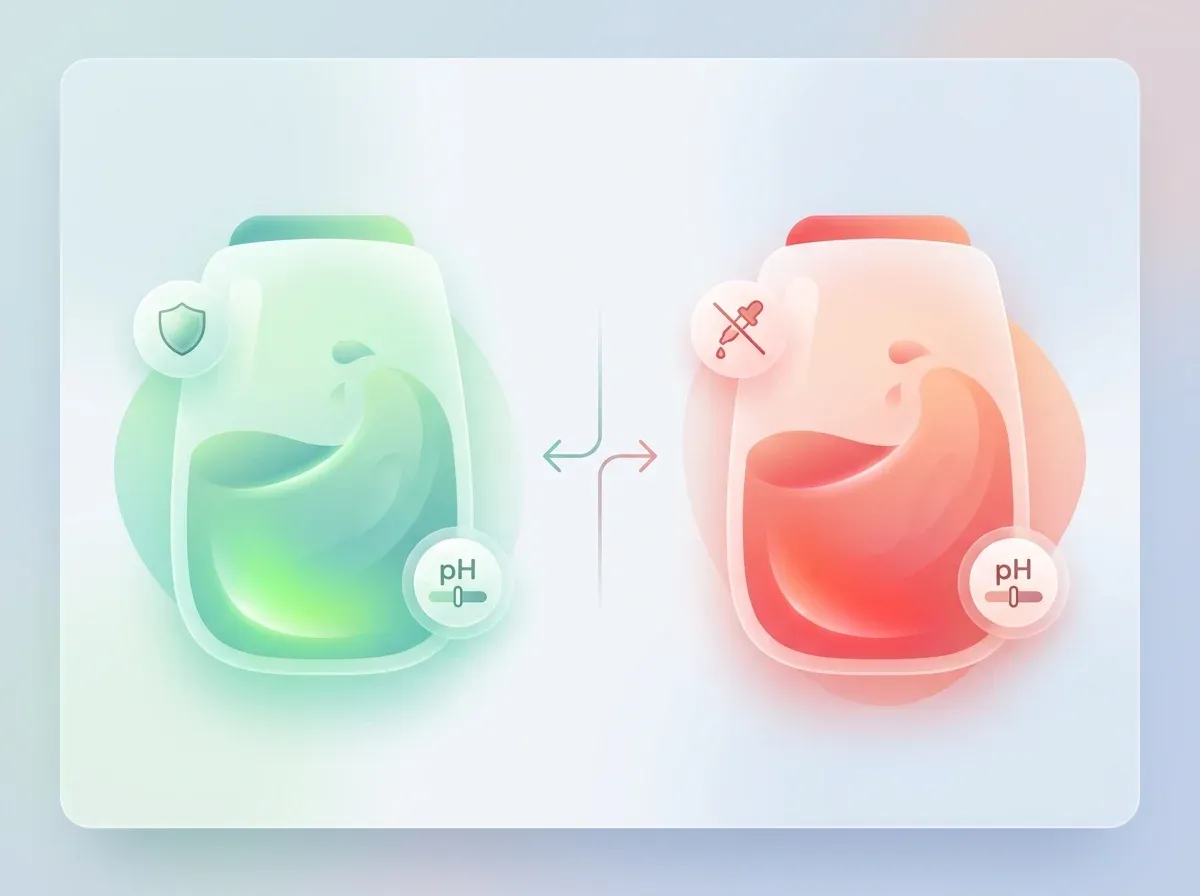
Healthy cervical mucus — the fluid your body produces around ovulation — has a pH of roughly 7.0-8.5. Sperm thrives in this slightly alkaline environment. Most commercial lubricants, on the other hand, are designed to match vaginal pH, which sits around 3.8-4.5. That's significantly more acidic than what sperm can tolerate.
Osmolality is the other key factor. It measures how concentrated a solution is — essentially, how much "stuff" is dissolved in it. Normal cervical mucus has an osmolality of roughly 260-290 mOsm/kg. Many lubricants are hyperosmolar (above 380 mOsm/kg), meaning they draw water out of sperm cells through their membranes. This dehydrates and damages sperm, reducing their ability to reach and fertilise an egg.
In real-world terms, a lubricant with high osmolality essentially draws water out of sperm cells through their outer membrane. This damages the sperm cell structure and can reduce motility even in lubricants that have a sperm-friendly pH. Both conditions — pH and osmolality — need to be right. A lubricant that nails the pH but has extremely high osmolality will still harm sperm. This is why looking for the full range of parameters matters, not just pH.
I tell my clients: think of it like putting a fish in salt water. The fish isn't in an acidic environment, but the osmolality pulls water out of its cells. Same thing happens to sperm in a hyperosmolar lubricant.
This is why the WHO set guidelines in 2013 recommending that lubricants used by couples trying to conceive should have an osmolality below 380 mOsm/kg and a pH between 7.0 and 8.5. Most over-the-counter lubricants don't meet these criteria.
What Makes a Lubricant "Fertility-Friendly"?
In the United States, "fertility-friendly" is actually a regulated term. To earn FDA 510(k) clearance as a personal lubricant for use in fertility, a product must demonstrate through testing that it doesn't harm sperm motility, viability, or DNA integrity.
The FDA 510(k) clearance process for fertility lubricants falls under a specific regulatory category called the 'pH and electrolyte balanced' (PEB) designation. This means the lubricant has been shown to match the pH range and ion concentration of healthy cervical mucus. To get this clearance, manufacturers must submit bench testing data demonstrating that their product does not reduce sperm motility, viability, or DNA integrity compared to a control. It's worth understanding that the FDA doesn't test the product itself — they review the manufacturer's submitted data. But the testing standards are specific, and the clearance can only be obtained if sperm parameters stay within acceptable ranges during exposure.
The products that have earned this clearance are specifically designed to:
- Match the pH of cervical mucus (approximately 7.0-8.5)
- Have osmolality close to cervical mucus (ideally under 380 mOsm/kg, preferably isotonic at ~260-290 mOsm/kg)
- Contain no spermicidal ingredients
- Not damage sperm DNA during exposure
- Not interfere with sperm capacitation (the process sperm need to undergo to fertilise an egg)
This doesn't mean the lubricant helps sperm. It means it doesn't hurt them. That's the baseline, and it's where the marketing often gets carried away.
In practice, this means a fertility-friendly lubricant is sperm-neutral at best. It won't give your sperm a boost, won't increase your chances beyond what unprotected sex without lubricant would achieve, and won't replace good cervical mucus. Some brands market their lubricants as though they actively support conception — language like 'enhances fertility' or 'supports sperm motility.' This is misleading. If you see these claims, look for the FDA 510(k) clearance number. Without it, the marketing is unregulated.
Do You Actually Need a Fertility Lubricant?
This is the question I wish more articles would address. In my experience, the answer for most women is: probably not.
Your body produces cervical mucus around ovulation that is literally designed to nourish, protect, and transport sperm. Fertile cervical mucus (the clear, stretchy, egg-white consistency) has the perfect pH, the perfect osmolality, and contains nutrients that keep sperm alive for up to five days inside your reproductive tract. No manufactured lubricant can replicate that.
However — and this is the important part — many women experience vaginal dryness during the TTC process. This is incredibly common, and here's why:
There's also a psychological component that rarely gets discussed. When you're trying to conceive, sex can start to feel transactional — timed, tracked, obligatory. Adding a lubricant that's specifically labelled 'fertility-friendly' can feel like yet another medical intervention in what should be an intimate experience. If that resonates with you, know that regular water-based lubricant used sparingly has less impact than most people fear. The studies showing 60-100% motility reduction used generous amounts under lab conditions. In real-world use, the volume and duration of contact are typically much less.
That said, if you're already using lubricant regularly, switching to a fertility-friendly option is a low-cost, zero-risk change. It's one of those 'why not?' decisions — there's no downside beyond a slightly higher price point, and there's a reasonable evidence base suggesting it could help. I'd rather my patients spend £15 on Pre-Seed than spend that same money on supplements with far less evidence behind them.
- Performance pressure: sex on a schedule (every other day during your fertile window) can feel mechanical and reduce natural arousal
- Stress and anxiety: TTC stress directly affects arousal response through the same cortisol pathways we discussed in my article on <a href='/stress-and-fertility/'>stress and fertility</a>
- Medications: antihistamines, some antidepressants, and hormonal medications can reduce natural lubrication
- Age: natural lubrication decreases with age, particularly after 35
- Frequent intercourse: trying to hit every fertile day can mean more sex than your body naturally lubricates for
If you're experiencing dryness and it's affecting your comfort or making sex feel like a chore, then yes — a fertility-friendly lubricant is a practical, evidence-based choice. Not because it boosts fertility, but because it removes a barrier to having regular, comfortable intercourse during your <a href='/fertile-window/'>fertile window</a>.
Fertility Lubricant Options: What to Look For
If you've decided a fertility lubricant makes sense for you, here's what I recommend looking for:
Pre-Seed
The most well-known fertility lubricant, and the first to receive FDA clearance for fertility use. Pre-Seed has a pH of 7.0-7.5 and osmolality of approximately 330 mOsm/kg — slightly hyperosmolar but within acceptable range. It's widely available and well-studied. I've had many clients use it successfully.
Conceive Plus
Contains calcium and magnesium ions, which the manufacturer claims support sperm function. pH of approximately 7.4 and osmolality around 300 mOsm/kg. Good option, slightly less research behind it than Pre-Seed but generally well-reviewed.
BabyDance
Newer to the market but specifically formulated for fertility with an isotonic formula (osmolality close to cervical mucus). pH balanced at 7.4. Worth considering if you want something closer to your body's natural conditions.
What I say to all my clients: don't get caught up in brand comparisons. The most important thing is that any lubricant you use has the right pH (7.0-8.5) and osmolality (under 380 mOsm/kg). Check the packaging for FDA 510(k) clearance — if a lubricant doesn't have it, don't assume it's sperm-safe.
🌿 Dani Recommends
10-Minute Pre-Intimacy Body Scan
Before you and your partner have "scheduled" sex during your fertile window, take 10 minutes alone. Lie down, close your eyes, and do a slow body scan from your toes to your head. Notice where you're holding tension — jaw, shoulders, pelvis. Breathe into those areas. This isn't woo. It's nervous system regulation, and it genuinely improves arousal response. I've seen women who had given up on natural lubrication find that this one practice changed everything.
Frequently Asked Questions
Can lubricant prevent pregnancy?
Some conventional lubricants can reduce sperm motility by 60-100% in lab conditions (Agarwal et al., 2008). However, this doesn't mean using a regular lubricant will prevent pregnancy — the in vitro effects may not perfectly translate to in vivo results. That said, if you're trying to conceive, switching to a fertility-friendly lubricant is a simple, sensible precaution.
Is Pre-Seed actually good for fertility?
Pre-Seed is FDA-cleared for use by couples trying to conceive. It has appropriate pH and osmolality levels and doesn't harm sperm in testing. It's not a fertility booster — it simply doesn't interfere with sperm. For women who need lubrication, it's one of the best-studied options available.
Do I really need a fertility lubricant?
Most women don't need one if they produce adequate cervical mucus around ovulation. Your natural mucus is superior to any manufactured product for sperm transport. However, if you experience dryness due to stress, medications, or frequent intercourse, a fertility-friendly lubricant can make sex more comfortable without harming your chances.
Can I use coconut oil as a fertility lubricant?
Coconut oil has not been tested for sperm safety, and there is no evidence it meets WHO guidelines for pH or osmolality. As an oil-based product, it can also trap sperm and may affect vaginal flora. I don't recommend it if you're trying to conceive. Stick with FDA-cleared fertility lubricants.
How much lubricant should I use when trying to conceive?
Use the minimum amount needed for comfort. Even fertility-friendly lubricants are not identical to cervical mucus, and using too much can dilute sperm concentration. A small amount applied externally and at the vaginal opening is sufficient. Don't apply it deep inside where it could create a barrier near the cervix.
A practical tip: most fertility lubricants come with applicators that allow you to apply the lubricant internally, closer to the cervix. This can be particularly helpful if you're using the lubricant primarily for comfort during intercourse. The internal application uses less product and positions it where it's actually needed. Pre-Seed, Conceive Plus, and BabyDance all include applicators in their packaging. If your fertility lubricant doesn't come with one, you can purchase reusable applicators separately — they're inexpensive and worth having on hand.
Does lubricant affect sperm morphology?
Some research suggests that certain lubricant ingredients can affect sperm morphology (shape), but the primary concern is motility. Fertility-friendly lubricants are tested for their effect on morphology and should not cause changes. If morphology is a concern for you or your partner, this is one more reason to choose a sperm-safe lubricant.
What's the difference between fertility lubricant and regular lubricant?
The main difference is pH and osmolality. Regular lubricants are formulated to match vaginal pH (3.8-4.5), which is too acidic for sperm. Fertility lubricants are formulated to match cervical mucus pH (7.0-8.5) and have osmolality closer to what sperm can tolerate. Fertility lubricants also don't contain spermicidal ingredients or glycerin in harmful concentrations.
⚕️ Medical Disclaimer
This article is for informational purposes only and does not constitute medical advice. Always consult with a qualified healthcare professional before making decisions about your fertility. If you are experiencing persistent vaginal dryness or other symptoms, please discuss them with your GP or fertility specialist.
📚 Cite This Page
Dani, Fertilitys. "Fertility-Friendly Lubricant: Does It Actually Help You Conceive?" Fertilitys.com, 8 Jul. 2026, https://fertilitys.com/fertility-lubricant/
References
- Agarwal, A. et al. (2008) 'Effect of vaginal lubricants on sperm motility and chromatin integrity: a prospective comparative study', Fertility and Sterility, 90(3), pp. 795-800.
- American Pregnancy Association (2024) 'Lubricants and Conception'. Available at: https://americanpregnancy.org/getting-pregnant/lubricants-and-conception/
- World Health Organization (2013) 'Use and procurement of additional lubricants for male and female condoms'.
- Ellington, J.E. and Short, S.M. (2000) 'In vitro testing of vaginal lubricants: effects on sperm survival and migration', Contraception, 61(6), pp. 391-396.
- Mendoza, R. et al. (2022) 'Personal lubricants and their impact on sperm parameters: a systematic review', Reproductive BioMedicine Online, 44(5), pp. 890-898.
Written by

Subscribe to Fertilitys
All my Free Resources. No spam. Unsubscribe anytime.