Quick Answer

Trying to figure out exactly when you conceived? I get it - whether you're newly pregnant and trying to work out the timeline, or you're tracking your cycle to optimise your chances, knowing your conception date matters. The tricky part is that it's rarely as straightforward as you'd think.
Key Takeaways
- Conception usually occurs within 24 hours of ovulation, but the fertile window spans 5 to 6 days
- Working backwards from your due date: subtract 266 days (38 weeks) to estimate conception
- LMP-based calculations assume a 28-day cycle with ovulation on day 14 - adjust if your cycle differs
- First-trimester ultrasound is the most accurate method for dating pregnancy
- Sperm can survive up to 5 days, so conception date does not equal intercourse date
- Knowing your conception date helps with prenatal care planning and genetic screening timelines
In This Article
- How Calculators Work
- By LMP
- By Due Date
- Ultrasound Dating
- Why It Matters
- Sperm Survival
- Irregular Cycles
- Dani Recommends
- FAQ
- References
How Conception Date Calculators Work
I have had so many readers write to me asking, "When exactly did I get pregnant?" It is one of the most common questions in early pregnancy, and the honest answer is that we can estimate but rarely pinpoint the exact day with certainty.
Conception date calculators use three primary methods, each with different levels of accuracy and different assumptions. The first is the LMP method, which counts forward from the first day of your last menstrual period, assuming ovulation occurs around day 14. The second works backwards from your estimated due date by subtracting 266 days. The third uses your actual ovulation date if you tracked it through OPKs, BBT charting, or a fertility app.
The American College of Obstetricians and Gynecologists recommends using first-trimester ultrasound as the most reliable dating method, particularly when the LMP date is uncertain or menstrual cycles are irregular. I always recommend asking your doctor about a dating scan between 8 and 12 weeks for the most precise results.
In my experience helping readers navigate this topic, the single biggest source of confusion is the difference between gestational age and embryonic age. Gestational age is counted from your LMP - roughly 2 weeks before actual conception. Embryonic age counts from the actual date of fertilisation. When your doctor says you are 8 weeks pregnant, the embryo is actually about 6 weeks old. This trips people up constantly, and I make sure to explain it clearly every time someone asks me about their dates.
Calculating Conception by Last Menstrual Period
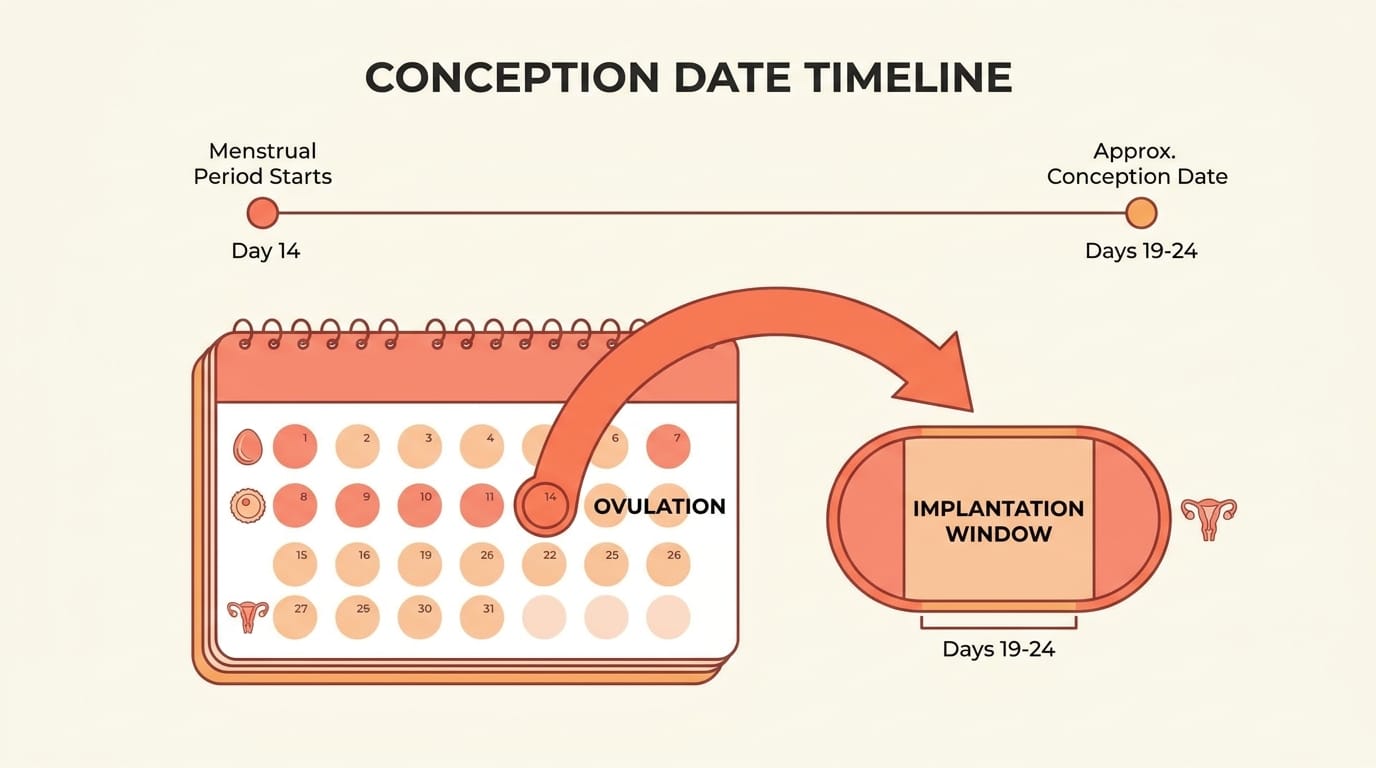
This is the method I see used most frequently, and it works well if your cycles are regular and predictable. The basic assumption is that ovulation occurs approximately 14 days before your next period, which puts it around day 14 of a standard 28-day cycle.
Here is how the calculation adjusts for different cycle lengths:
- 25-day cycle: Conception around day 11
- 28-day cycle: Conception around day 14
- 32-day cycle: Conception around day 18
- 35-day cycle: Conception around day 21
- 40-day cycle: Conception around day 26
The formula I always share with my readers is simple: ovulation day equals your total cycle length minus 14. This works because the luteal phase - the time between ovulation and your next period - is remarkably consistent at 12 to 14 days for most women. Even when overall cycle length varies significantly, the luteal phase tends to stay stable, which is why this formula is so useful.
According to Geirsson and Busby-Earle (2014), Naegele rule, which adds 280 days to the LMP, remains the standard clinical method for estimating due dates. However, it assumes regular 28-day cycles. I always tell my readers to adjust for their personal cycle length rather than relying blindly on the default assumption.
I have seen cases where women were given incorrect due dates because their doctor used the standard 28-day calculation despite the patient having 35-day cycles. That 7-day difference may seem small, but it can lead to unnecessary concern about the baby measuring small or being overdue when the dates were simply wrong from the start.
Calculating Conception by Due Date
If your doctor has already provided a due date from an early ultrasound, working backwards is straightforward. Simply subtract 266 days, which equals 38 weeks, from your estimated due date. This gives you the date the egg was fertilised.
I find this method most useful when my readers have had a dating scan and want to cross-reference with their own LMP-based calculations. If the two dates match within a few days, you can be fairly confident in the estimate. If they differ by a week or more, always trust the ultrasound date - it is based on actual fetal measurements rather than cycle assumptions.
Remember that pregnancy is officially counted as 40 weeks from your LMP, or 38 weeks from actual conception. This two-week difference is a perpetual source of confusion, and I explain it to almost every reader who contacts me in early pregnancy wondering why their dates do not add up.
Ultrasound Dating: The Gold Standard
When I first started writing about pregnancy dating, I was genuinely surprised by how much more accurate ultrasound is compared to LMP-based calculations. The difference is not subtle - LMP dating can be off by a week or more, especially for women with irregular cycles.
During the first trimester, between 6 and 13 weeks of gestation, crown-rump length measurement is accurate to within plus or minus 5 to 7 days. This is the most precise window for dating because embryonic growth is remarkably consistent during this period. Every embryo grows at virtually the same rate in the first trimester, which is what makes the measurement so reliable.
By the second trimester, accuracy drops to plus or minus 7 to 14 days because fetal growth begins to vary more between individuals based on genetics, nutrition, and other factors. Third-trimester ultrasound is the least reliable, with accuracy of plus or minus 21 days or more, making it essentially useless for dating purposes.
Butt and Lim (2014) published guidelines from the American Institute of Ultrasound in Medicine confirming that first-trimester CRL measurements should be used as the primary dating method whenever available. If your LMP-based due date and your ultrasound-based due date differ by more than 7 days in the first trimester, your doctor will typically adjust to the ultrasound date. This is standard practice and the correct approach.
Why Your Conception Date Matters
You might wonder whether it really matters if your date estimate is off by a few days. In most normal pregnancies, the practical difference is minimal. But there are several specific situations where accuracy genuinely matters.
Genetic screening tests like NIPT have optimal testing windows based on gestational age. If your dates are off, you might be tested too early, leading to inconclusive results, or miss the ideal window entirely. Multiple pregnancies also benefit from accurate dating, as it helps determine whether twins developed from one egg or two, which has implications for their health monitoring.
For women who have had intercourse with different partners during the same cycle, the conception window can be critical for establishing paternity, though I always clarify that only a DNA test provides definitive answers. Accurate dating also affects decisions about labour induction timing, growth monitoring protocols, and premature birth risk assessment.
I have worked with readers who were told their baby was measuring large or small for gestational age, causing significant worry. In many cases, the initial conception date estimate was simply off by one or two weeks, and recalculating with proper dates resolved the concern entirely.
The Sperm Survival Factor
One thing I always clarify with my readers is that the date you had intercourse is not necessarily the date of conception. This distinction catches many people off guard and is a frequent source of confusion.
Sperm can survive inside the female reproductive tract for up to 5 days when fertile cervical mucus is present. The egg, by contrast, survives only 12 to 24 hours after ovulation. Fertilisation - the actual moment sperm meets egg - usually occurs in the fallopian tube within 12 to 24 hours of ovulation. Then implantation, when the fertilised egg attaches to the uterine wall, happens 6 to 12 days later.
So if you had sex on Monday and ovulated on Thursday, the conception date is Thursday, not Monday. The sperm were simply waiting in the fallopian tubes, sustained by fertile cervical mucus. Wilcox et al. (2001) confirmed that the probability of conception is highest when intercourse occurs in the 2 days leading up to ovulation, precisely because this timing allows sperm to be in position when the egg arrives.
What If Your Cycles Are Irregular?
This is where standard online calculators fall short, and I hear this frustration constantly from my readers. If your cycles vary by more than 7 days from month to month, the LMP method becomes unreliable.
My recommendation for irregular cycles: track ovulation directly using OPKs, BBT charting, or a fertility monitor like Mira. Then use your earliest ultrasound date as the primary dating method. Women with PCOS, thyroid conditions, or those approaching perimenopause are especially likely to have irregular ovulation and should not rely on LMP-based calculators alone.
Dani Recommends
🌟 My Tips for Getting the Most Accurate Conception Date
- Track from the start: If you are trying to conceive, begin tracking ovulation immediately
- Combine methods: LMP plus OPK results plus cervical mucus gives the clearest picture
- Get a dating scan: Book a first-trimester ultrasound between 8 and 12 weeks
- Use Fertility Friend: The best date calculation tools among free apps
- Note your cycle length: Tracking for 3 or more months gives a reliable baseline
Real-World Examples of Conception Dating
I want to walk you through a few real scenarios that come up constantly in my reader emails, because the theory is one thing but applying it to your actual life is another matter entirely.
Scenario one: Sarah has regular 28-day cycles and her last period started on March 1st. Using the LMP method, her estimated ovulation date is March 14th, and her estimated due date is December 6th. If she had unprotected sex on March 12th and 14th, conception most likely occurred on March 14th when the egg was released and fertilised.
Scenario two: Emma has 33-day cycles. Her last period started on March 1st, but her ovulation day is approximately March 19th (33 minus 14 equals 19). Her due date based on LMP would need to be adjusted because the standard 28-day assumption would put her dates off by 5 days. This is exactly the kind of situation where a dating scan provides clarity.

Scenario three: Jess has very irregular cycles ranging from 26 to 38 days. She used an OPK and detected her LH surge on March 15th, so ovulation likely occurred on March 16th. Without the OPK data, she would have had no reliable way to estimate her conception date. This is why I always recommend active tracking for women with irregular cycles.
I share these examples because I find that concrete scenarios help my readers understand abstract concepts much better than clinical explanations alone. Your situation might not fit neatly into any calculator, and that is completely normal.
The Emotional Side of Conception Dating
I also want to acknowledge something that rarely gets discussed in medical articles: the emotional weight of trying to pin down your conception date. For many women, knowing when conception happened makes the pregnancy feel more real and tangible. It helps you imagine those early days when your baby was just a cluster of dividing cells.
For others, particularly those who have experienced loss or infertility, the conception date carries heavy emotional significance. If you have been trying for months or years, finally having a date to point to can be profoundly meaningful. I always tell my readers to give themselves permission to feel whatever comes up around this milestone.
On the other hand, I have spoken with women who felt anxious about their conception date because it coincided with a time of stress, illness, or alcohol consumption. If this describes you, please know that occasional exposures in the very early days before implantation are rarely harmful. Talk to your doctor about your specific concerns rather than spiralling through online forums.
Frequently Asked Questions
Can you calculate the exact day of conception?
Not precisely. We can narrow it to a 2 to 3 day window using ovulation tracking, and first-trimester ultrasound confirms gestational age within about 5 to 7 days.
Is the conception date the same as the ovulation date?
Almost. Fertilisation occurs within 12 to 24 hours of ovulation, so the dates are the same or one day apart.
How accurate are online conception calculators?
Reasonably accurate for regular 28-day cycles. The more your cycle deviates from that standard, the less reliable they become.
Can an ultrasound tell me exactly when I conceived?
First-trimester ultrasound estimates gestational age within plus or minus 5 to 7 days, giving a highly reliable conception window.
What if I had sex with two different people in the same cycle?
Conception date alone cannot determine paternity if intercourse with different partners occurred within the same fertile window. A DNA test is the only reliable method.
Does the conception date affect my due date?
Yes. Your due date is 266 days from conception or 280 days from your LMP. A more accurate conception date leads to a more precise due date.
Medical Disclaimer
The information in this article is for educational purposes only and should not be considered medical advice. Every fertility journey is unique. Always consult with a qualified healthcare professional before making decisions about your reproductive health.
References
- Butt, K., & Lim, K. (2014). Determination of gestational age by ultrasound. J Obstet Gynaecol Can, 36(2), 171-181.
- Geirsson, R. T., & Busby-Earle, R. M. C. (2014). Certain dates may not provide accurate estimates. Ultrasound Obstet Gynecol, 44(6), 721-722.
- Wilcox, A. J., Dunson, D., & Baird, D. D. (2001). The timing of the fertile window. BMJ, 321(7271), 1259-1262.
- ACOG. (2017). Methods for estimating the due date. Committee Opinion 700. Obstet Gynecol, 129(5), e150-e154.
Cite This Article
Bowen, D. (2026). Conception Date Calculator: When Did You Conceive?. Fertilitys. https://fertilitys.com/conception-date-calculator/
Written by

Subscribe to Fertilitys
All my Free Resources. No spam. Unsubscribe anytime.