First IVF Cycle: What to Actually Expect
A step-by-step guide to your first IVF cycle — from daily injections to embryo transfer. Honest, practical, and emotionally real. Written by a nutritionist who has walked dozens of women through it.


Quick Answer
Your first IVF cycle typically takes 4-6 weeks from the start of stimulation to embryo transfer. The process involves daily hormone injections, regular monitoring appointments, egg collection under sedation, fertilisation in the lab, and embryo transfer. Emotionally, it is one of the hardest things you will go through — but preparation and support make a real difference.
Key Takeaways
- A first IVF cycle takes approximately 4-6 weeks from stimulation start to pregnancy test
- Daily injections are the biggest fear for most first-timers — but they become routine very quickly
- Egg collection is done under sedation and takes about 20-30 minutes; recovery is usually 1-2 days
- Not all collected eggs will fertilise, and not all fertilised eggs become viable embryos — this attrition is normal
- The emotional load of IVF is as real as the physical — plan for it, don't just endure it
Table of Contents
I have walked dozens of women through their first IVF cycle, and there is one thing they all have in common: nothing quite prepares you for it. You can read every guide, attend every appointment, ask every question — and it will still be harder, stranger, and more emotional than you expected. That is not a reason to be afraid. It is a reason to be informed.
This article is not a clinical protocol. It is what I tell my clients before they start: the honest, practical, human version of what happens during a first IVF cycle. What the timeline looks like. What the injections feel like. What nobody warns you about. And how to take care of yourself through it.
If you are considering <a href="/ivf-guide/">IVF</a>, or if your doctor has recommended it, I want you to know: you are not weak for being scared. You are not dramatic for being emotional. You are about to do something incredibly brave, and you deserve to know what you are walking into.
IVF Timeline: What Happens and When
A standard first IVF cycle follows this general timeline. Every clinic varies slightly, but the core steps are the same:
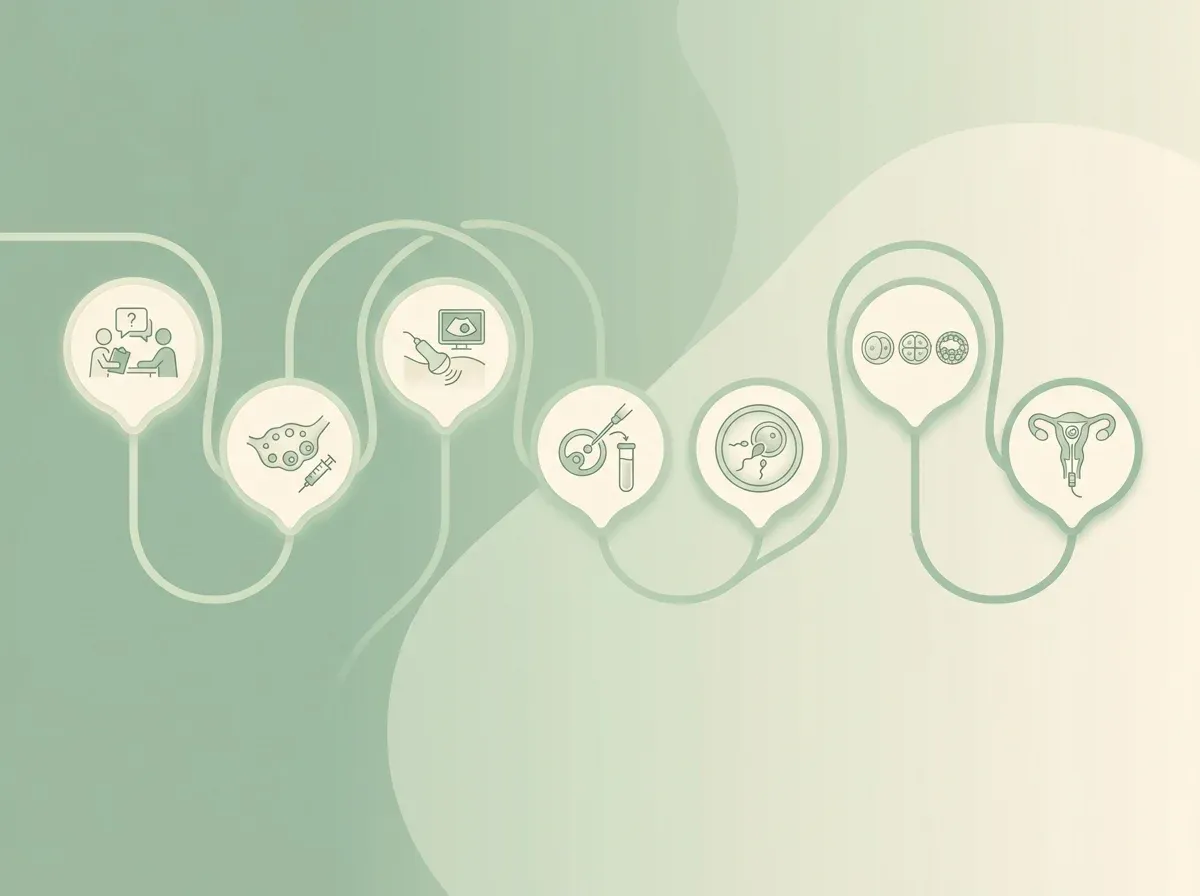
- Pre-treatment preparation (1-2 weeks before): baseline blood tests, ultrasound, suppression medication if needed
- Ovarian stimulation (10-14 days): daily hormone injections to encourage multiple eggs to develop
- Monitoring appointments (every 2-3 days during stimulation): blood tests and ultrasounds to track follicle growth
- Trigger injection (36 hours before collection): a final hormone shot to mature the eggs
- Egg collection (day procedure under sedation, 20-30 minutes)
- Fertilisation in the lab (same day or next day): eggs are combined with sperm or injected via ICSI
- Embryo development (3-5 days): the lab monitors embryo growth
- Embryo transfer (5-10 days after collection): one embryo is placed into your uterus
- Two-week wait (14 days): the agonising wait before a pregnancy blood test
From start to finish, your first cycle will take approximately 4-6 weeks. Some women need a longer suppression phase, or their clinic may freeze all embryos and do a frozen transfer in a subsequent cycle. Your consultant will explain your specific plan.
The Stimulation Phase
This is the part most women dread, and I understand why. Daily injections sound terrifying. But here is what I tell every client: it gets easier faster than you think. By day three, most women are doing their injections on autopilot.
The stimulation drugs — usually FSH (follicle-stimulating hormone) and sometimes LH — are given as subcutaneous injections into the stomach. The needles are tiny — much smaller than you are imagining. You will use a pen-like device similar to an insulin pen.
During stimulation, you will have monitoring appointments every 2-3 days. These involve a blood test (to check hormone levels) and a transvaginal ultrasound (to count and measure your follicles). The team is tracking how your ovaries are responding and adjusting your dose accordingly.
Common side effects during stimulation:
- Bloating and abdominal discomfort as your ovaries grow multiple follicles
- Mood swings — your hormones are being deliberately manipulated, and it shows
- Headaches, fatigue, and breast tenderness
- Feeling full quickly when eating (your enlarged ovaries press on your stomach)
- Mild bruising at injection sites
I see this pattern constantly with my clients: the first few days of injections are emotionally hard, but by the middle of stimulation, they have found a rhythm. The physical side effects build gradually and are usually manageable. If anything feels severe or unusual, call your clinic immediately.
Egg Collection
Egg collection is the moment of truth, and I know it causes a lot of anxiety. Here is what actually happens:
- You will be given light sedation or general anaesthesia — you will not be awake for the procedure
- A needle is guided through the vaginal wall into each ovary under ultrasound guidance
- The fluid in each follicle is aspirated, and the embryologist checks it under a microscope for eggs
- The whole procedure takes about 20-30 minutes
- You will be in recovery for 1-2 hours before going home
After collection, you may experience cramping (similar to period pain), light bleeding, and bloating. Most women take the rest of the day off and return to normal activities the next day.
Now, the part nobody prepares you for: the number of eggs retrieved may not match the number of follicles they saw on ultrasound. Some follicles are empty. Some eggs are immature. This is normal, but it can feel devastating if you were counting follicles and expecting a certain number. I tell my clients: trust the process and let the embryologist do their job. The number of eggs is not the whole story.
What Happens in the Lab
While you recover, the embryologist is working with your eggs and your partner's sperm (or donor material). Here is the attrition funnel — and this is the part that surprises most first-timers:
- Not all eggs will be mature — typically 80% of retrieved eggs are mature enough to fertilise
- Not all mature eggs will fertilise — fertilisation rates are approximately 60-70%
- Not all fertilised eggs will develop into good embryos — expect about 50% to reach Day 5 (blastocyst)
- Not all blastocysts will be chromosomally normal — this varies hugely by age
If you started with 10 eggs, you might end up with 3-4 usable embryos. This is completely normal and does not mean your cycle has failed. Quality matters far more than quantity. Your embryologist will update you on Day 1, Day 3, and Day 5.
Embryo Transfer
Embryo transfer is the simplest part of IVF physically, but one of the hardest emotionally. A catheter is passed through your cervix and the embryo is gently deposited in your uterus. No sedation is needed, and it feels similar to a smear test. You will be able to watch on the ultrasound screen if you want to.
After transfer, you can resume normal activities. There is no evidence that bed rest improves success rates — though many women prefer to take it easy for the rest of the day as a psychological comfort. That is completely fine.
Your clinic will give you a date for a blood pregnancy test, usually 14 days after egg collection. Those 14 days are their own special kind of difficulty. More on that below.
The Emotional Reality Nobody Prepares You For
This is the section I care most about, because it is the one that clinical guides almost always skip. Domar et al. (2015) found that the psychological burden of IVF is comparable to that of serious illness. Boivin et al. (2007) confirmed that anxiety and depression rates are significantly elevated in women undergoing fertility treatment.
Here is what I see in my clients during their first cycle:
- The injections are emotionally harder than physically — the act of injecting yourself with hormones is a daily confrontation with the reality of your situation
- The monitoring appointments create a rollercoaster — good scan results bring hope, disappointing ones bring despair, and the cycle repeats every few days
- The waiting is the hardest part — the two-week wait between transfer and test is when anxiety peaks
- Relationships are strained — partners process IVF differently, and communication gaps emerge
- Isolation grows — it is hard to explain what you are going through to people who have not been there
- Grief appears in unexpected places — hearing a pregnancy announcement, passing a baby shop, attending a family gathering
I tell my clients: plan for the emotional impact. Do not just endure it. Build a support team before your cycle starts — a therapist, a trusted friend, a support group. Organisations like <a href="https://www.bica.net">BICA</a> and <a href="https://fertilitynetworkuk.org">Fertility Network UK</a> offer counselling and peer support specifically for people going through treatment.

Practical Tips from Women Who Have Been Through It
These come from my clients, not from textbooks. They are the small, real things that made a difference:
- Ice the injection site for 30 seconds before you inject — it numbs the area and reduces bruising
- Rotate injection sites: left side of stomach Monday, right side Tuesday, and so on
- Take the day of egg collection and the day after off work — even if you feel fine, the emotional weight catches up
- Bring a comfort item to your transfer appointment — a photo, a lucky charm, anything that grounds you
- Tell at least one person outside your relationship what you are going through — isolation makes everything harder
- Plan something nice for the two-week wait — not to distract yourself, but because you deserve kindness during the hardest part
- Do not test early at home — the trigger injection can give a false positive, and seeing a false positive is devastating
- Know that a failed first cycle is not the end — many women need 2-3 cycles, and clinics learn from each one
Dani Recommends
Pre-Injection Breathing Ritual
Before every single injection, take three slow breaths. Breathe in for four counts, hold for four, out for six. Do this while you prepare your injection pen. By pairing the breathing with the routine, you create a small ritual that takes the edge off the anxiety. I recommend this to every client, and almost all of them keep doing it beyond IVF. It costs nothing, takes 20 seconds, and genuinely shifts your nervous system out of fight-or-flight mode.
Frequently Asked Questions
How painful are IVF injections?
Most women describe the subcutaneous injections as a brief sting or pinch. The needles are very small (similar to those used by diabetics for insulin). The emotional discomfort often outweighs the physical pain. Icing the area beforehand and rotating injection sites helps minimise soreness. By day 3-4, most women report the injections have become routine.
How many eggs will I get?
This varies enormously based on age, AMH, and individual response. The average number of eggs retrieved is 8-15, but anywhere from 1 to 30+ is possible. I tell my clients not to fixate on the number. Quality matters more than quantity, and the attrition funnel means that even a modest egg number can result in good embryos.
What is the success rate for a first IVF cycle?
According to HFEA (Human Fertilisation and Embryology Authority) data, the average live birth rate per IVF cycle in the UK is approximately 25-30% for women under 35, declining with age. These are population averages — your personal chances depend on your specific diagnosis, your partner's sperm quality, and your clinic's expertise.
Can I work during IVF?
Most women continue working during the stimulation phase, though you may need flexible hours for monitoring appointments. You will need the day of egg collection off (sedation), and many women also take the day of transfer and the day after off for emotional reasons. There is no medical reason to stop working unless your job involves heavy physical labour.
What should I eat during IVF?
There is no specific IVF diet, but a <a href='/fertility-diet-plan/'>Mediterranean-style fertility diet</a> supports hormonal health. Focus on whole foods, healthy fats, lean protein, and plenty of vegetables. Stay hydrated, particularly during stimulation when your ovaries are enlarged. Avoid alcohol and minimise caffeine. Your nutritionist can give you personalised guidance.
How do I cope with the two-week wait?
The two-week wait is notoriously difficult. Do not test early — the trigger injection can cause false positives. Instead, plan gentle activities: light walks, a new book, a comfort series on TV, time with supportive friends. Acknowledge the anxiety rather than fighting it. Some women find it helpful to plan something meaningful for after the result, regardless of the outcome.
What happens if my first cycle fails?
A failed first cycle is not the end. Your clinic will review the cycle with you — what went well, what could be adjusted. Many women need 2-3 cycles, and each one provides valuable information. Domar et al. (2015) showed that psychological support improved success rates in subsequent cycles. Take time to grieve, then decide your next step when you feel ready.
Medical Disclaimer
This article is for informational purposes only and does not constitute medical advice. IVF protocols vary between clinics and individuals. Please follow the specific guidance of your fertility specialist and clinic team. If you are experiencing significant emotional distress during treatment, please speak to your clinic about counselling services or contact your GP.
Cite This Page
Dani, Fertilitys. "First IVF Cycle: What to Actually Expect." Fertilitys.com, 23 Jul. 2026, https://fertilitys.com/first-ivf-cycle/
References
- HFEA (2024) 'IVF and ICSI success rates'. Available at: https://www.hfea.gov.uk/treatments/ivf/
- Domar, A.D. et al. (2015) 'Impact of a group mind/body intervention on pregnancy rates in IVF patients', Fertility and Sterility, 103(1), pp. 226-231.
- Boivin, J. et al. (2007) 'National survey of infertility and counselling', Human Reproduction, 22(6), pp. 1570-1577.
- National Institute for Health and Care Excellence (2017) 'Fertility problems: assessment and treatment', NICE Guideline CG156.
- ASRM (2021) 'In vitro fertilization (IVF): what you need to know', Patient Fact Sheet.
Written by

Subscribe to Fertilitys
All my Free Resources. No spam. Unsubscribe anytime.