7 Signs of Ovulation: How to Know When You're Most Fertile
Your body signals ovulation every cycle — here's how to read the signs. Cervical mucus, OPKs, BBT, ovulation pain, and more, ranked by reliability with practical tips for each.


Your body is already telling you
One of the most empowering things about fertility awareness is realising that your body signals ovulation every single cycle — you just need to know what to look for. These aren't subtle or mysterious signs. Once you start paying attention, most women can identify their fertile window within 2–3 cycles of tracking.
I remember the first time I tracked my cervical mucus through a full cycle. I was in my late twenties and had been on the pill for years — I genuinely had no idea what my natural cycle was doing. The first time I saw egg-white cervical mucus, I felt like I'd discovered a secret superpower. My body had been communicating with me all along, and I'd been ignoring it.
Some signs predict ovulation before it happens (cervical mucus, OPKs). Others confirm it after the fact (BBT rise). The combination of both gives you the most complete picture — and the best chance of timing intercourse effectively. Let's break down each sign so you know what to look for.
1. Cervical mucus changes
Reliability: ★★★★★ — The single most useful body sign for predicting ovulation.
As oestrogen rises in the days before ovulation, your cervical mucus transforms. It progresses from dry or sticky → creamy → wet and watery → clear, stretchy, and slippery (like raw egg white). This egg-white cervical mucus (EWCM) is your body's peak fertility signal.
EWCM serves a biological purpose: it creates channels that guide sperm through the cervix, nourishes them, and filters out abnormal sperm. Without fertile mucus, sperm struggle to reach the egg — even if your timing is perfect. Your body is essentially building a highway for sperm, complete with fuel stations and traffic management.
What to look for:
- Clear, transparent mucus that stretches between your fingers without breaking (2–3cm or more)
- A slippery, lubricative sensation — you may notice it when wiping or in your underwear
- Typically appears 1–3 days before ovulation and stops within a day after
- The last day of EWCM is usually ovulation day or the day before (called the "peak day")
Not everyone produces abundant EWCM, and that's normal. Some women notice only slight wetness. What matters is the change from your baseline — the shift from dry/creamy to wet/stretchy. Our discharge guide covers how mucus changes throughout the entire cycle.
2. Positive OPK (LH surge)
Reliability: ★★★★★ — Predicts ovulation 12–36 hours before it happens.
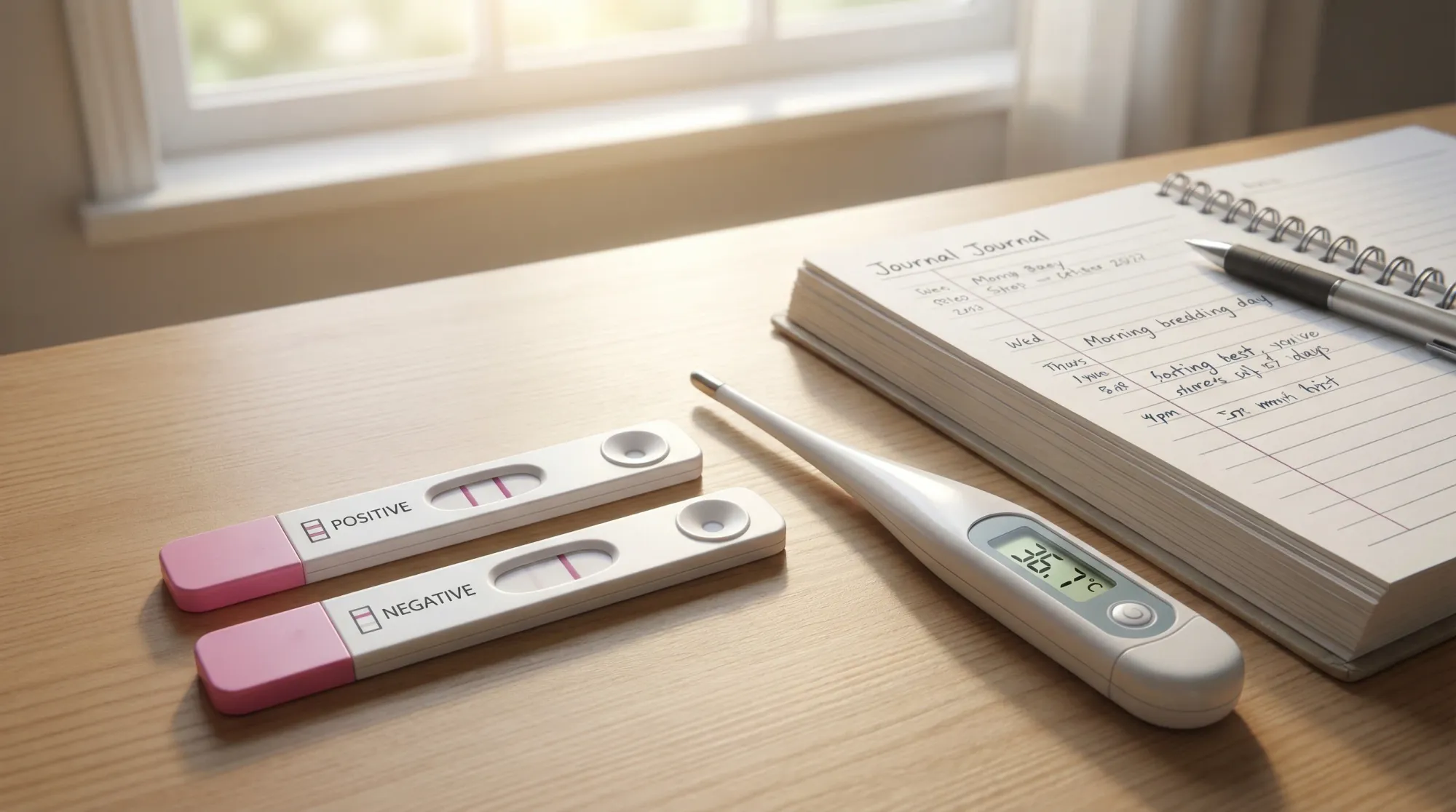
Ovulation predictor kits detect the surge in luteinising hormone (LH) that triggers egg release. When you get a positive result (test line as dark or darker than the control line), ovulation is likely within the next 12–36 hours. The egg is being prepared for release.
Practical tips:
- Start testing 2–3 days before you expect ovulation (around cycle day 10 for a 28-day cycle)
- Test in the afternoon — LH surges typically start in the early morning and may not show in first morning urine
- Don't restrict fluids before testing, but avoid drinking large amounts in the 2 hours before
- A positive OPK means ovulation is coming — have sex that day and the next 2 days for best coverage
- OPKs can be less reliable with PCOS, as elevated baseline LH can produce false positives
I recommend OPKs as a starting point for most women beginning fertility tracking. They're affordable, easy to interpret, and give you concrete data. Our ovulation calculator can help estimate your testing window.
3. Basal body temperature rise
Reliability: ★★★★☆ — Confirms ovulation happened (retrospectively).
After ovulation, progesterone causes your resting temperature to rise by 0.2–0.5°C. This shift stays elevated throughout the luteal phase and drops just before your period (or stays high if you're pregnant). On a BBT chart, it looks like a step up — a clear shift from a lower range to a higher range.
BBT is the only non-invasive method that confirms ovulation actually occurred — OPKs and cervical mucus predict it, but only temperature confirms it. The catch: by the time you see the shift, ovulation has already happened. That's why BBT is best used alongside other signs, not alone.
BBT tracking requires consistency: same time every morning, before getting out of bed, after at least 3 hours of sleep. It's a commitment, but the data is invaluable if you have irregular cycles or suspect anovulation. Our complete BBT charting guide covers equipment, technique, and how to read your chart.
4. Ovulation pain (mittelschmerz)
Reliability: ★★★☆☆ — Helpful if you get it, but not everyone does.
About 20% of women feel a distinct twinge, cramp, or ache on one side of the lower abdomen around ovulation. The name is German for "middle pain" — and it can range from a brief sharp pinch to a dull ache lasting several hours. Some women describe it as a "pop" sensation.
The cause isn't fully understood. It may be the follicle stretching before rupture, the release of fluid or blood when the egg breaks through, or mild irritation of the peritoneum. Whatever the mechanism, if you consistently feel it on one side mid-cycle, it's a useful additional marker.
Important: Ovulation pain is typically mild and brief. Severe, debilitating mid-cycle pain is not normal — if you experience this, it could indicate endometriosis, ovarian cysts, or other conditions worth investigating.
5. Breast tenderness
Reliability: ★★☆☆☆ — Common but variable.
Many women notice breast sensitivity or tenderness around ovulation, driven by the oestrogen surge. It's often more subtle than the breast tenderness before your period (which is progesterone-driven). Some women feel it only for a day, others for several days.
On its own, breast tenderness isn't reliable enough to pinpoint ovulation. But if you notice it consistently at the same point in your cycle alongside other signs, it adds to the picture.
6. Increased libido
Reliability: ★★★☆☆ — Biologically logical, individually variable.
It makes evolutionary sense: your body wants you to have sex when you're most fertile. Many women report heightened desire in the 2–3 days before ovulation, driven by the oestrogen and testosterone peaks that precede egg release.
Research supports this — studies have shown increased sexual desire and initiation in the fertile window. It's not universal, but if you notice a consistent mid-cycle increase in libido, trust it as a signal.
This is actually one of nature's kindnesses: when you're most fertile, you often feel most interested in sex. The problem is that many couples trying to conceive turn sex into a chore, which can suppress this natural desire. Try to maintain some spontaneity and pleasure in the process.
7. Other signs
These are less commonly discussed but real for some women:
- Heightened sense of smell — some women report increased sensitivity to odours around ovulation. Small studies suggest oestrogen may enhance olfactory sensitivity
- Light spotting — a tiny amount of pink or brown spotting mid-cycle happens for about 5% of women. It may result from the follicle rupture or the brief dip in oestrogen around ovulation
- Bloating or water retention — oestrogen promotes fluid retention. Some women notice mild bloating in the days before ovulation
- Cervical position changes — the cervix rises, softens, and opens slightly around ovulation. Checking cervical position is a learnable skill but takes practice and isn't necessary for most women
- Mood changes — some women feel more confident, sociable, or energetic around ovulation, linked to the oestrogen peak
How to combine signs for best results
No single sign is perfect on its own. The most effective approach is combining 2–3 methods:
| Method | What It Tells You | When to Act |
|---|---|---|
| Cervical mucus | Fertile window is open | Start having sex when you see wet/egg-white mucus |
| OPK | Ovulation in 12–36 hours | Have sex the day of positive and next 2 days |
| BBT | Ovulation confirmed | Retrospective — confirms your timing was right |
| Ovulation pain | Ovulation happening now | Additional confirmation alongside other signs |
The most fertile days are the 2–3 days before ovulation. Don't wait for confirmation — act on the predictive signs.
The golden rule: have sex before you ovulate, not after. Sperm survive 3–5 days in the reproductive tract; the egg only lasts 12–24 hours. By the time BBT confirms ovulation, the window has closed. Use cervical mucus and OPKs to time intercourse, and BBT to confirm the pattern over multiple cycles.
What I tell my clients: aim for sex every 1–2 days during the fertile window (roughly 5 days before ovulation through ovulation day). This gives you the best coverage without making the process feel mechanical. Daily sex is fine too if you're both up for it, but it's not necessary — sperm quality is actually slightly better with a day between ejaculations.
What if you don't see any signs?
This is important to address. Some women track for a cycle or two and see no clear patterns — no EWCM, no positive OPK, no BBT shift. This can mean several things:
- Anovulation — you're not ovulating. This is more common than people realise and has many causes (stress, PCOS, thyroid issues, recent coming off hormonal contraception)
- Weak ovulation — you're ovulating, but not strongly. Signs may be subtle
- Late ovulation — you're looking too early in your cycle. Some women ovulate day 18, 20, or even later
- Not checking correctly — you might be missing the signs
If you don't see clear ovulation signs after 2–3 cycles of careful tracking, see your GP. A progesterone blood test (day 21 of a 28-day cycle, or 7 days before expected period) can confirm whether you're ovulating.
🌿 Dani Recommends
Start simple and build up
When clients ask me where to start with ovulation tracking, I always say: start with one method, master it, then add others. Begin with OPKs — they're concrete, affordable, and give you a clear yes/no. Once you're comfortable reading those, add cervical mucus observation. Once you've got those two, add BBT if you want the confirmation. Trying to track everything from day one is overwhelming and often leads to giving up entirely. Fertility awareness is a skill that builds over time. Your first cycle tracking might feel confusing. By your third cycle, you'll likely know your body's patterns better than you ever have. Be patient with the learning process.

The bottom line
Ovulation isn't invisible. Your body produces clear, trackable signals every cycle — from cervical mucus changes and LH surges to temperature shifts and physical sensations. Learning to read these signs takes 2–3 cycles of consistent observation, and the investment pays off enormously: better timing, more confidence, and a deeper understanding of your own fertility.
Start with cervical mucus awareness and an OPK. Add BBT charting when you're ready. Within a few months, you'll know your body's pattern well enough to predict your fertile window with genuine accuracy — and that knowledge is yours for life, not just for this chapter.
What is the most reliable sign of ovulation?
Cervical mucus changes are the most useful predictive sign — clear, stretchy egg-white mucus indicates your most fertile days. For confirming ovulation occurred, a sustained BBT rise (0.2–0.5°C for 3+ days) is the gold standard. The most reliable approach combines both with OPKs for a complete picture.
Can you ovulate without any symptoms?
Yes — some women don't notice obvious physical symptoms. However, cervical mucus changes occur in virtually all ovulatory cycles, even if subtle. If you genuinely see no mucus changes or temperature shift across multiple tracked cycles, it may indicate anovulation and is worth discussing with your GP.
How many days before ovulation should I have sex?
The most fertile days are the 2–3 days before ovulation. Sperm survive up to 5 days in the reproductive tract, while the egg only lives 12–24 hours. Having sex every 1–2 days during the 5 days before ovulation through ovulation day gives you the best chance. Don't wait for confirmation that ovulation has happened.
What does ovulation pain feel like?
Ovulation pain (mittelschmerz) is typically a brief twinge, cramp, or dull ache on one side of the lower abdomen. It can last from a few minutes to several hours. About 20% of women experience it. The side may alternate between cycles depending on which ovary releases the egg. Mild discomfort is normal — severe pain is not and should be investigated.
Do OPKs work if you have PCOS?
OPKs can be less reliable with PCOS because baseline LH levels are often elevated, which can produce false positive results. If you have PCOS, combine OPKs with cervical mucus tracking and BBT for a more accurate picture. Some women with PCOS find that monitoring cervical mucus alone is more reliable than OPKs.
References
- Bigelow, J.L. et al. (2004). Mucus observations in the fertile window: a better predictor of conception than timing of intercourse. Human Reproduction, 19(4), 889–892.
- Su, H.W. et al. (2017). Detection of ovulation, a review of currently available methods. Bioengineering & Translational Medicine, 2(3), 238–246. PMC
- Wilcox, A.J. et al. (1995). Timing of sexual intercourse in relation to ovulation. New England Journal of Medicine, 333(23), 1517–1521.
- Roney, J.R. & Simmons, Z.L. (2013). Hormonal predictors of sexual motivation in natural menstrual cycles. Hormones and Behavior, 63(4), 636–645.
- NICE. (2013, updated 2017). Fertility problems: assessment and treatment (CG156). NICE
Medical disclaimer: This article is for informational purposes only and does not constitute medical advice. If you're not seeing signs of ovulation after several months of tracking, or if you experience severe mid-cycle pain, consult your GP for investigation.
Written by

Subscribe to Fertilitys
All my Free Resources. No spam. Unsubscribe anytime.