Ovulation Calculator: Find Your Most Fertile Days
Free calculator plus everything you need to know about your fertile window.

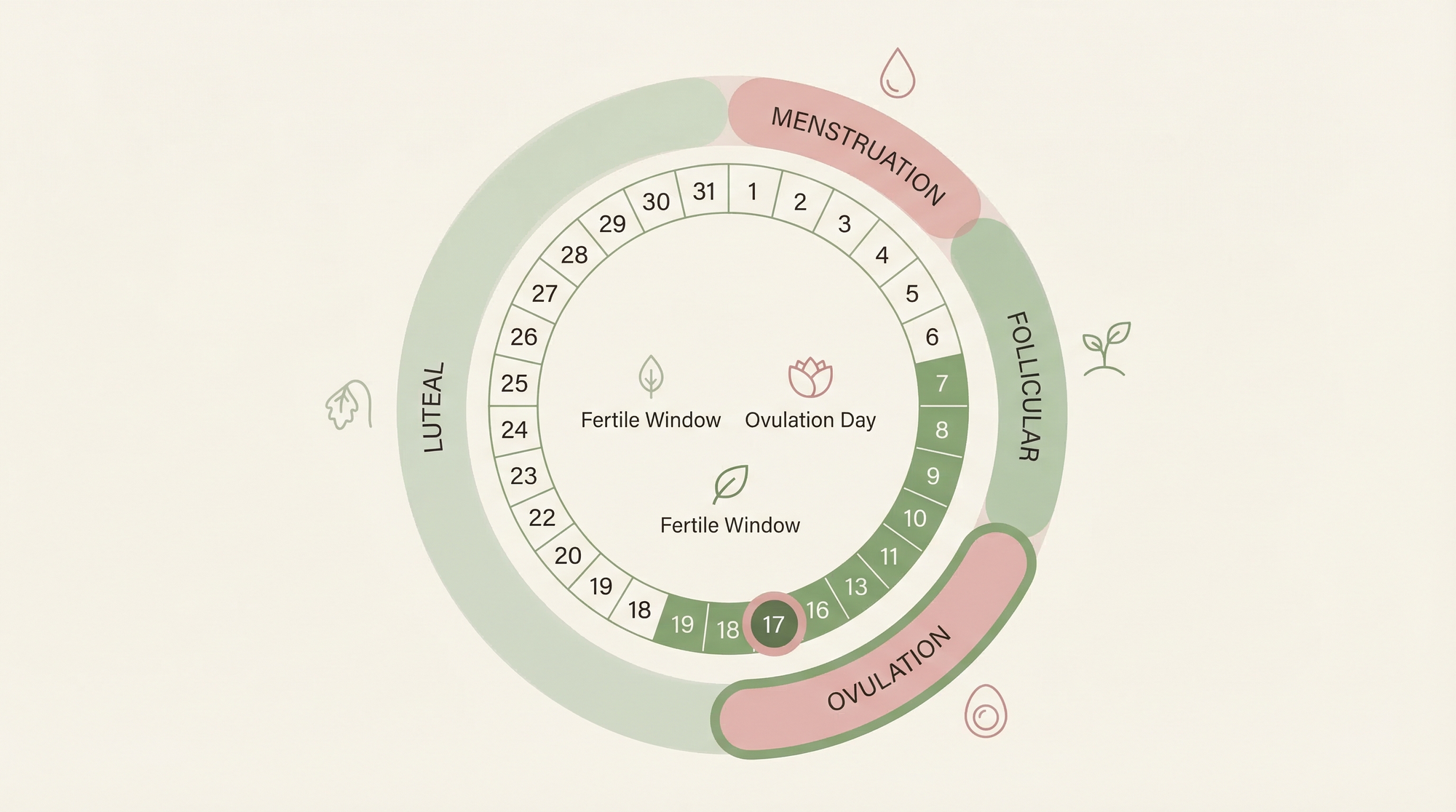
Ovulation Calculator
Enter the first day of your last period and your average cycle length to estimate your fertile window.
First day of last period:Average cycle length (days):Calculate
Estimated ovulation date:
Fertile window:
Best days to try:
This is an estimate based on a standard luteal phase of 14 days. Your actual ovulation may vary. Use OPKs or a fertility monitor for greater accuracy.
This free ovulation calculator does the same maths as every other one on the internet: take your cycle length, subtract 14 days, and call it your ovulation date. Including the one above.
The problem is, your body doesn't do maths. Ovulation isn't a formula — it's a biological event influenced by stress, sleep, illness, travel, and a dozen other factors that no calculator can account for. I use this calculator with clients as a starting point, never an endpoint. It narrows the window. It doesn't define it.
So use the tool, but keep reading. Understanding how ovulation actually works — and why calculators get it wrong sometimes — is worth more than any app.
When Do I Ovulate?
Before we get into the mechanics of calculators, let's answer the basic question. Most women ovulate once per cycle, roughly midway through — but "midway" depends on your cycle length. If you're asking "when do I ovulate?" the honest answer is: it depends on you.
Ovulation is triggered by a surge of luteinising hormone (LH) from your pituitary gland. This surge happens when your oestrogen levels, driven by a maturing follicle in your ovary, reach a threshold. The LH surge typically triggers egg release within 24-36 hours. The whole process is influenced by your hypothalamic-pituitary-ovarian axis — a feedback loop between your brain and ovaries that's sensitive to stress, nutrition, sleep, and overall health.
The key thing to understand: ovulation doesn't happen on a fixed schedule. It happens when your body is ready. Calculators estimate when that might be based on your recent patterns. But your body can override any estimate.
How Ovulation Calculators Work
The formula is simple. Take the length of your menstrual cycle and subtract 14. That gives you your estimated ovulation day, counted from the first day of your last period.
Why 14? Because the luteal phase — the stretch between ovulation and your next period — averages 14 days and is relatively consistent for most women. It's the follicular phase (the first half of your cycle) that varies. A woman with a 28-day cycle probably ovulates around day 14. A woman with a 32-day cycle probably ovulates around day 18. A woman with a 24-day cycle, around day 10.
Your fertile window extends from about 5 days before ovulation through to 1 day after. That's because sperm can survive in the reproductive tract for up to 5 days (Wilcox et al., 1995), while the egg only lives for 12-24 hours after release. So the days leading up to ovulation matter more than the day itself — which is counterintuitive and catches a lot of people off guard.
When Can't You Trust a Calculator?
Calculators fail in predictable ways, and knowing when to distrust yours is arguably more important than knowing how to use it.
Irregular cycles. If your cycle length varies by more than 7 days month to month, a calculator is guessing. You might ovulate on day 12 one month and day 20 the next. The calculator has no way of knowing which month you're having. For irregular cycles, OPK strips or a fertility monitor like Inito will give you real-time data instead of estimates.
PCOS. Polycystic ovary syndrome can cause delayed or absent ovulation, and the timing shifts unpredictably. A calculator that says "you'll ovulate on day 14" when you actually ovulate on day 22 — or don't ovulate at all — is worse than useless. It's actively misleading.
Coming off birth control. Your first few cycles after stopping hormonal contraception may be irregular as your body recalibrates. Calculators based on your "average cycle" don't have enough data to work with.
Stress, illness, travel. Ovulation can be delayed by anything that disrupts your hypothalamic-pituitary-ovarian axis. A bad week at work, a flight across time zones, a stomach bug — all can push ovulation later than expected. Your calculator doesn't know you had a terrible week.
The 14-day assumption. The luteal phase averages 14 days, but ranges from 10 to 16 in healthy women. If your luteal phase is consistently 11 days, every calculator is placing your ovulation 3 days too early. That's the difference between timing intercourse perfectly and missing the window entirely.
How to Calculate Ovulation Without an App
You don't need an app for this. Genuinely. If your cycles are regular, a pen and a calendar work just as well.
Step 1: Track your cycle length for 3-6 months. Day 1 is the first day of full bleeding (spotting doesn't count). Count through to the day before your next period starts. That's one cycle.
Step 2: Calculate your average. Add up your cycle lengths, divide by the number of cycles tracked. If your last three cycles were 27, 29, and 28 days, your average is 28.
Step 3: Subtract 14 from your average. That's your estimated ovulation day. For a 28-day average: day 14. For a 31-day average: day 17.
Step 4: Count backwards 5 days and forwards 1 day from that date. That's your fertile window. For day 14 ovulation: days 9-15 are your fertile window.
Step 5: Focus effort on the 2-3 days before estimated ovulation. Research consistently shows that the highest conception rates come from intercourse 1-2 days before ovulation — not on ovulation day itself (Wilcox et al., 1995).
Ovulation Calculator for Irregular Periods
If your cycles vary significantly, a standard ovulation calculator for irregular periods won't be reliable — but you're not without options.
The modified calendar method: use your shortest and longest cycles from the past 6 months. Subtract 18 from your shortest cycle (that's the earliest you might ovulate) and subtract 11 from your longest cycle (that's the latest). This gives you a wider window, but at least it's honest about the uncertainty.
Example: if your shortest recent cycle was 25 days and your longest was 35 days, your potential fertile window spans from day 7 through day 24. That's a huge range — which is exactly why I recommend irregular-cycle clients skip the calculator entirely and use:
- OPK strips — start testing from a few days after your period ends, test daily until you get a positive
- Basal body temperature tracking — a sustained temperature rise confirms ovulation happened (retrospectively)
- Cervical mucus monitoring — fertile-quality mucus (clear, stretchy, egg-white consistency) is your body's own ovulation predictor
- A quantitative fertility monitor — Inito or Mira will track your actual hormone levels regardless of cycle length
Can You Use an Ovulation Calculator to Choose Baby Gender?
I know this section will drive traffic, so I'm going to be direct: there is no reliable scientific evidence that timing intercourse relative to ovulation influences whether you conceive a boy or a girl.
The Shettles Method — which suggests that intercourse closer to ovulation favours boys (faster Y-sperm) while intercourse earlier in the fertile window favours girls (hardier X-sperm) — was proposed in the 1960s and has not been supported by subsequent research. A 1995 study by Wilcox et al. in the New England Journal of Medicine specifically examined this question using precise ovulation timing and found no relationship between timing of intercourse and baby sex.
If you're searching for an "ovulation calculator boy" or "ovulation calculator girl" — I understand the curiosity. But any calculator claiming to help you choose your baby's sex is selling you something that doesn't work. Use the calculator for what it's good at: estimating your fertile window.
Fertile Window Calculator: What It Means and Why It's Not Just One Day
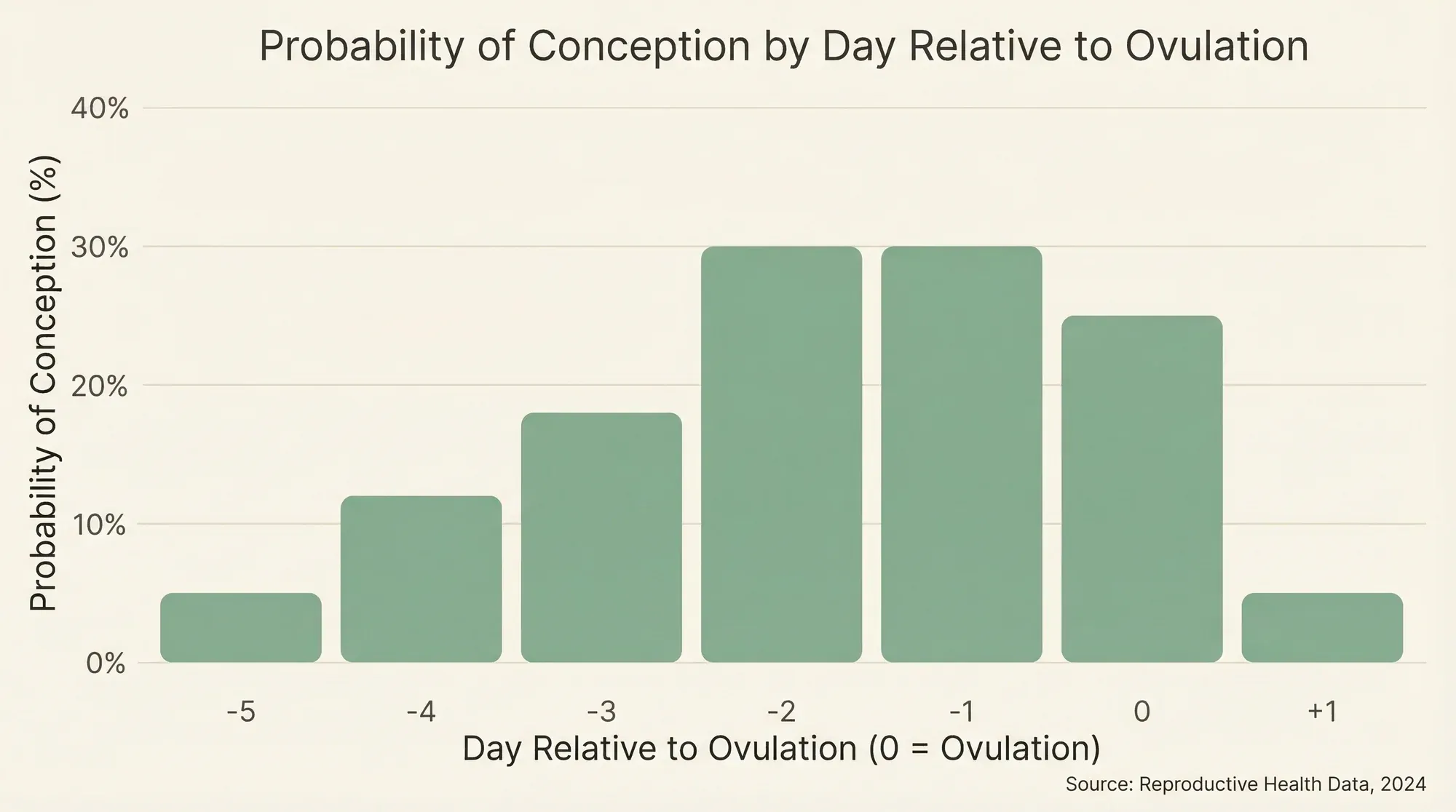
People search for "ovulation calculator" when what they really need is a fertile window calculator — because fertility isn't a single day, it's a window of about 6 days.
Your fertile window opens approximately 5 days before ovulation (because sperm can survive that long in fertile cervical mucus) and closes about 24 hours after ovulation (when the unfertilised egg degrades). That's 6 days total, but they're not all equal.
The probability of conception by day, based on the Wilcox et al. data:
- 5 days before ovulation: ~4% chance
- 4 days before: ~8%
- 3 days before: ~15%
- 2 days before: ~29%
- 1 day before: ~34%
- Ovulation day: ~8-10%
- 1 day after: near zero
That dip on ovulation day surprises people. By the time you confirm ovulation through a temperature rise or a positive OPK, the optimal window has often already passed. This is why the "trying earlier and more often" strategy consistently outperforms "waiting for the exact right day."
A 2019 study analysing over 600,000 menstrual cycles (Bull et al., NPJ Digital Medicine) confirmed that cycle variability is far greater than most people assume. The average cycle was 29.3 days, but only 13% of cycles were exactly 28 days. This means a fertile window calculator needs to account for your personal pattern, not a textbook average.
Making the Calculator Actually Useful
A calculator alone gives you an estimate. Combined with body literacy, it becomes genuinely powerful. Here's what I recommend to clients who want to maximise their chances:
Use the calculator to identify your approximate fertile window. Then layer on one or more confirmation methods: OPK strips starting 3-4 days before your estimated ovulation, cervical mucus checks throughout your cycle, or BBT tracking to confirm ovulation happened after the fact. The calculator points you to the right week. The confirmation methods pinpoint the right days.
Have sex every 1-2 days during your fertile window, not just on your estimated ovulation day. The data from Wilcox et al. is unambiguous: the highest probability of conception comes from intercourse in the 2 days before ovulation. Waiting for "the day" actually reduces your chances because you might miss it entirely, and the egg only survives 12-24 hours.
Track for at least 3 cycles before relying on the data. One cycle isn't a pattern. Three cycles give you a baseline. Six cycles give you confidence.

Signs You're Ovulating (That No Calculator Can Give You)
Your body gives you real-time ovulation signals that are more reliable than any calculator. Learning to read them takes a cycle or two, but once you know what to look for, you'll wonder why you ever relied on an app to tell you what your body was already saying.
Cervical mucus changes. This is the most reliable free indicator. In the days before ovulation, rising oestrogen transforms your cervical mucus from sticky or dry to wet, slippery, and stretchy — often described as egg-white consistency. When you notice this mucus, you're in your fertile window. It means your body is actively preparing for potential conception — the mucus literally creates channels that help sperm swim towards the egg.
Basal body temperature (BBT) shift. After ovulation, progesterone raises your resting body temperature by about 0.2-0.5°C. If you take your temperature at the same time every morning before getting out of bed, you'll see a clear shift that stays elevated until your period. The catch: BBT confirms ovulation after it's happened, so it's retrospective. Over multiple cycles, it helps you predict future ovulation timing — but it won't tell you "today is the day" in real time.
Mild pelvic twinges. About 20% of women feel ovulation happening — a phenomenon called mittelschmerz (German for "middle pain"). It's typically a brief, one-sided twinge or ache in your lower abdomen. Not everyone feels it, and it's not reliable enough to time intercourse by, but if you notice it consistently, it's a useful data point to cross-reference with other signs.
Increased libido. Research shows that sexual desire tends to peak around ovulation — an evolutionary mechanism that's been documented across cultures. If you notice a cyclical pattern in your sex drive, pay attention to when it peaks relative to your other fertility signs.
LH test strips. The most direct home confirmation. A positive OPK (ovulation prediction kit) means your LH is surging, and ovulation is likely within 24-36 hours. They cost as little as £10-15 for a pack of 50 online. Start testing a few days before your calculator says you'll ovulate, and test once or twice daily until you get a positive.
The best approach combines the calculator's estimate with one or more body-literacy methods. The calculator narrows your testing window (so you're not peeing on OPK strips for 20 days straight). The body signs confirm the timing.
When to Stop Using a Calculator and See a Specialist
Calculators are a starting tool. They have limits, and those limits matter.
See a fertility specialist if:
- You've been timing intercourse with your fertile window for 12 months without conceiving (6 months if you're over 35)
- Your cycles are consistently shorter than 21 days or longer than 35 days
- You're not getting positive OPK results despite testing throughout your cycle
- Your BBT chart shows no clear temperature shift — which may indicate anovulation
- You have known conditions that affect fertility (PCOS, endometriosis, thyroid disorders, prior chemotherapy)
- You're over 40 — time is a factor, and a specialist can assess your ovarian reserve and advise on the best approach
A calculator can't diagnose blocked fallopian tubes, low sperm count, uterine issues, or any of the other structural or hormonal factors that affect conception. It's a timing tool, and timing is only one piece of the puzzle.
Frequently Asked Questions
How accurate is an ovulation calculator?
For women with regular cycles (21-35 days, consistent within 2-3 days), calculators are reasonably accurate — typically within 1-2 days of actual ovulation. For irregular cycles, accuracy drops significantly. No calculator can account for cycle-to-cycle variation caused by stress, illness, or hormonal fluctuations. Think of it as a good estimate, not a guarantee.
Can I use an ovulation calculator if my periods are irregular?
You can, but the results will be unreliable. Use the widened-window method (shortest cycle minus 18 through longest cycle minus 11) to get a rough range, then rely on OPK strips, cervical mucus, or a fertility monitor for actual day-to-day guidance. A calculator assumes consistency your body isn't providing.
When is the best time to have sex to get pregnant?
The 2-3 days before ovulation. Not ovulation day itself — by then you're relying on an egg that only lives 12-24 hours. Sperm survive up to 5 days, so having them already waiting when the egg is released gives you the best odds. The landmark Wilcox et al. (1995) study found the highest conception probability on the 2 days before ovulation and the day of ovulation itself.
Do ovulation calculators work for gender selection?
No. The Shettles Method (timing intercourse for boy or girl) has been repeatedly tested and not supported by research. A 1995 NEJM study found no relationship between intercourse timing and baby sex. Any calculator claiming to help choose gender is not evidence-based.
References
- Wilcox AJ, Weinberg CR, Baird DD. Timing of sexual intercourse in relation to ovulation — effects on the probability of conception, survival of the pregnancy, and sex of the baby. N Engl J Med. 1995;333(23):1517-1521.
- Bull JR, et al. Real-world menstrual cycle characteristics of more than 600,000 menstrual cycles. NPJ Digit Med. 2019;2:83.
- Stanford JB, et al. Timing intercourse to achieve pregnancy: current evidence. Obstet Gynecol. 2002;100(6):1333-1341.
- American College of Obstetricians and Gynecologists. Methods for estimating the due date. Committee Opinion No. 700. 2017.
Medical Disclaimer: This calculator provides estimates only and should not be used as a method of contraception or as a substitute for medical advice. If you've been trying to conceive for 12 months without success (6 months if over 35), please consult a fertility specialist.
Written by

Subscribe to Fertilitys
All my Free Resources. No spam. Unsubscribe anytime.