How to Chart Your Basal Body Temperature for Fertility
A step-by-step guide to BBT charting: what it tells you about ovulation, how to read your chart, which thermometer to buy, and the common mistakes to avoid.


Why I recommend charting to every client
Before supplements, before diet changes, before anything else — I ask clients to chart their basal body temperature for at least two cycles. Not because it's the most exciting thing in fertility, but because it tells you something nothing else can: whether you're actually ovulating, and whether your luteal phase is long enough to sustain a pregnancy.
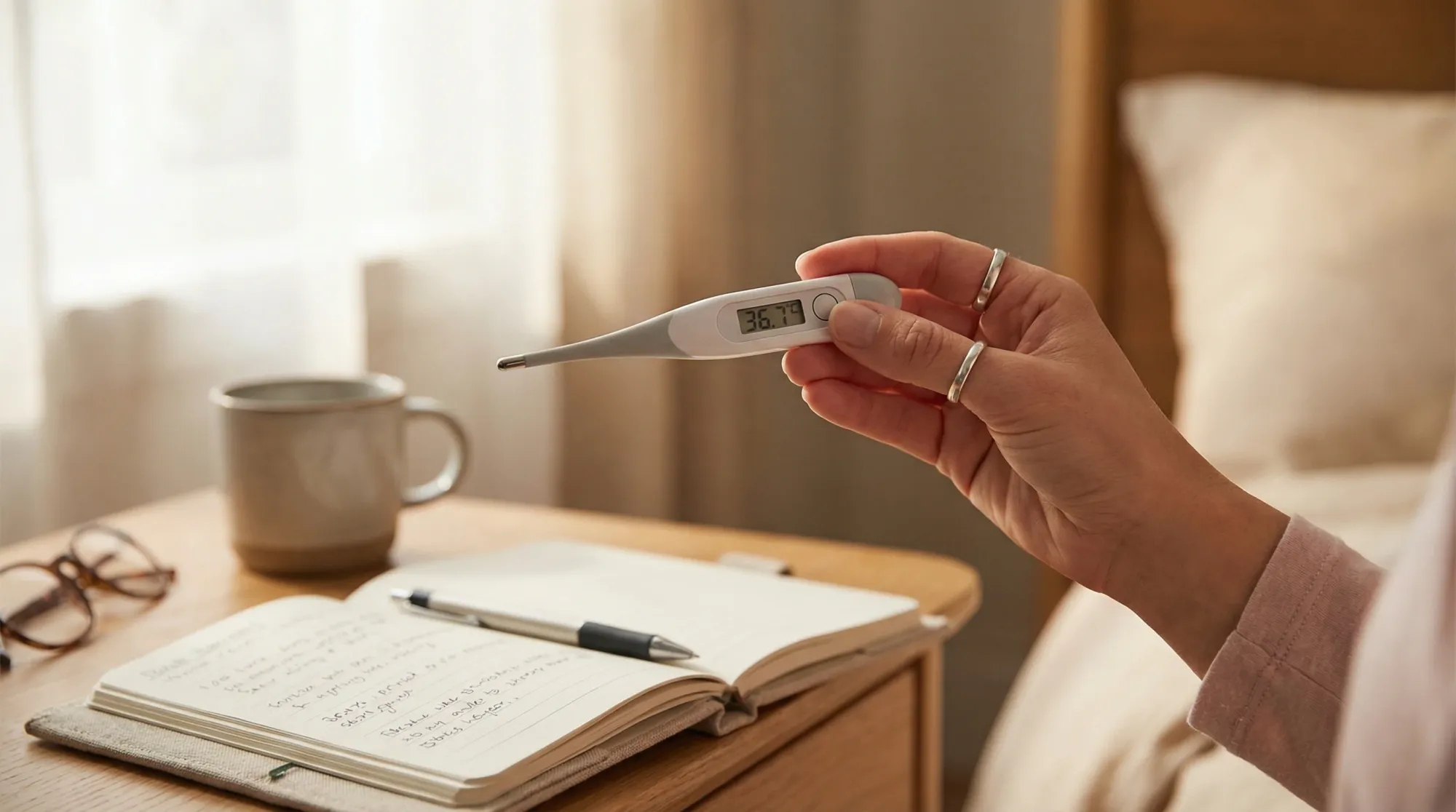
OPKs (ovulation predictor kits) tell you your body is gearing up to ovulate. BBT tells you it actually happened. That distinction matters more than most people realise.
What basal body temperature is
Your basal body temperature is your body's lowest resting temperature — the temperature you'd be at if you woke up and didn't move, speak, or get out of bed. It's measured first thing in the morning, before your feet hit the floor, at the same time every day.
Here's why it matters for fertility: after ovulation, your ovaries produce progesterone. Progesterone raises your core body temperature by approximately 0.2–0.5°C (about 0.4–1°F). This temperature shift — called the biphasic shift — is the gold standard confirmation that ovulation has occurred.
In a typical ovulatory cycle, your chart will show:
- Follicular phase (pre-ovulation): lower temperatures, usually between 36.1–36.4°C
- Ovulation: a slight dip followed by a sharp rise (though the dip doesn't happen for everyone)
- Luteal phase (post-ovulation): sustained higher temperatures, usually 36.5–36.8°C, lasting until your period arrives or (if you're pregnant) staying elevated

Research confirms the pattern: a 1977 study found that 70% of women with a biphasic BBT chart had confirmed ovulation via hormonal analysis (Moghissi, 1976). It's not perfect, but across multiple cycles, the pattern becomes increasingly reliable.
How to chart — step by step
What you need:
- A BBT thermometer accurate to 0.01°C (two decimal places). A regular fever thermometer won't work — the changes are too small to detect with single-decimal accuracy
- A charting app (Fertility Friend, Femometer, Natural Cycles, or a paper chart)
- Consistency — same time each morning, before getting up
Daily routine:
- Set an alarm for the same time every morning — within a 30-minute window. Temperature varies by about 0.1°C per hour of sleep, so timing matters
- Before you do anything else — before speaking, sitting up, checking your phone, going to the loo — reach for your thermometer. Keep it on your bedside table
- Take your temperature orally (under the tongue, mouth closed) for the recommended time (usually 60–90 seconds for digital thermometers). Vaginal measurement is more stable but less practical for most people
- Record the reading immediately in your app or on paper. Don't rely on memory — write it down or sync it while you're still in bed
- Note any disruptions: poor sleep, alcohol, illness, travel, different wake time. These all affect your reading and should be flagged so you can interpret the chart accurately
Start charting on cycle day 1 (the first day of your period). After 2–3 cycles, patterns will emerge that make interpretation much easier.
How to read your chart
You're looking for one main thing: the thermal shift. This is the sustained rise in temperature that confirms ovulation happened.
The cover line method:
- After you've seen what looks like a shift, draw a line 0.1°C above the highest of your last 6 low-phase temperatures. This is your "cover line"
- You can confirm ovulation when you have 3 consecutive temperatures above the cover line
- The shift typically occurs within 1–2 days of actual ovulation
| Chart Pattern | What It Tells You |
|---|---|
| Clear biphasic shift | Ovulation confirmed. Your luteal phase begins from the shift day. |
| Sustained high temps for 18+ days | Strong indicator of early pregnancy. Test if your period doesn't arrive. |
| Short luteal phase (<10 days elevated) | Possible luteal phase deficiency. Worth discussing with your specialist. |
| No clear shift (monophasic) | Anovulatory cycle — no ovulation detected. Occasional anovulatory cycles are normal; persistent ones need investigation. |
| Erratic temperatures | Often caused by inconsistent timing, poor sleep, or illness. Try to improve consistency before interpreting. |
| Slow, gradual rise (no sharp shift) | Can still indicate ovulation. Some women don't get a dramatic shift. Look for the overall trend across the cycle. |
Patterns are general guidelines. Individual charts vary — interpret over multiple cycles rather than one.
What BBT can and can't do
This is where I see the most confusion, so let me be direct:
BBT CAN:
- Confirm that ovulation happened (retrospectively)
- Reveal your luteal phase length — crucial for fertility
- Help identify anovulatory cycles
- Provide early indication of pregnancy (sustained high temps beyond 18 days)
- Show your specialist your cycle patterns — a chart is worth a thousand words in a fertility consultation
- Build body literacy — understanding your own cycle is empowering
BBT CANNOT:
- Predict ovulation in advance — the shift happens AFTER ovulation, which means the fertile window has passed by the time you see it. For timing intercourse, combine BBT with OPKs or cervical mucus tracking
- Pinpoint the exact day of ovulation — the shift typically occurs 1–2 days after ovulation
- Replace medical fertility testing — it confirms ovulation but doesn't assess egg quality, tubal patency, or sperm function
The real power of BBT emerges over multiple cycles. One chart is a data point. Three charts are a pattern. Six charts give you and your specialist a detailed picture of how your body cycles — and that's invaluable information.
Choosing a thermometer
Not all thermometers are equal for BBT. You need one that reads to two decimal places (e.g., 36.45°C, not just 36.4°C). Here's what to look for:
- Digital BBT-specific thermometers (£8–£15) — the most practical option. Brands like Femometer Vinca, Easy@Home, and iProven all produce thermometers accurate to 0.01°C with memory functions and app sync. I recommend these to most clients — they're affordable, reliable, and simple
- Wearable temp trackers (£100–£300) — devices like TempDrop and Ava measure temperature continuously overnight, which eliminates the need for same-time-every-morning discipline. Useful if your schedule is irregular, you're a shift worker, or you have broken sleep. The 2021 research in Journal of Medical Internet Research found wrist skin temperature tracking comparable to oral BBT for detecting the biphasic shift (Shilaih et al., 2021)
- Glass basal thermometers — the traditional option, extremely accurate, but slower to read and breakable. Fine if you prefer analogue
Whichever you choose, use the same thermometer throughout a cycle. Switching mid-cycle introduces calibration differences that muddy your chart.
Common mistakes (and how to avoid them)
Taking your temperature at wildly different times. A 6am reading and a 9am reading on consecutive days will show a difference that's about timing, not hormones. Stick within a 30-minute window. If you do sleep in, record it but flag it.
Getting out of bed first. Even a quick trip to the loo before temping can raise your reading. Keep your thermometer within arm's reach. I tell clients to make it the very first thing they do — before opening their eyes fully.
Obsessing over single readings. One high or low temperature means nothing on its own. It's the pattern across the whole cycle that matters. A bad night's sleep, alcohol, or fighting off a cold can all cause a one-day spike. Mark it, note the cause, and move on.
Expecting to see a clear shift in cycle 1. Many women need 2–3 cycles before they can confidently read their own charts. Your first month is a learning curve — treat it as practice, not a verdict.
Using BBT alone to time intercourse. By the time you see the thermal shift, ovulation has already happened. If you're using BBT to conceive, pair it with OPKs (which predict ovulation 12–36 hours in advance) or track your fertile window using cervical mucus.
🌿 Dani Recommends
A 2-minute morning meditation before temping
Before you even reach for your thermometer, take five slow breaths with your eyes closed. In for 4, out for 6. It takes less than two minutes and serves a dual purpose: it keeps you still and calm (better for an accurate reading), and it starts your day with a moment of intention instead of immediately reaching for your phone. I suggest this to all my clients who are charting — it turns a clinical task into a small act of self-care.
The bottom line
BBT charting is one of the simplest, cheapest, and most informative things you can do when trying to conceive. A £10 thermometer and two minutes each morning give you confirmed ovulation, luteal phase length, cycle regularity, and early pregnancy signals — information that would otherwise require blood tests and ultrasound monitoring.
It's not a crystal ball. It won't tell you when to have sex tonight (use OPKs for that). But over a few months, it builds a picture of your cycle that's genuinely useful — for you, for your confidence, and for any specialist you eventually see. Start charting today. Future you will thank you for the data.
What temperature rise confirms ovulation?
A sustained rise of 0.2–0.5°C above your pre-ovulation baseline, lasting for at least 3 consecutive days, confirms ovulation. This is called the biphasic shift. The rise is caused by progesterone, which is only produced after ovulation.
Can BBT predict ovulation?
No — BBT confirms ovulation after it's happened, not before. The temperature shift occurs 1–2 days after ovulation, meaning the fertile window has already closed by the time you see it. To predict ovulation in advance, use ovulation predictor kits (OPKs) or track cervical mucus alongside BBT.
Do I need a special thermometer for BBT?
Yes. You need a thermometer accurate to 0.01°C (two decimal places). Standard fever thermometers only read to one decimal place, which isn't precise enough to detect the small temperature shifts of ovulation. BBT thermometers are available from £8–£15 and many sync with fertility tracking apps.
What does a flat BBT chart mean?
A flat (monophasic) chart — where temperatures stay at roughly the same level throughout the cycle without a clear shift — may indicate an anovulatory cycle (no ovulation). Occasional anovulatory cycles are normal, but if you consistently see flat charts across 3+ cycles, consult your GP or fertility specialist for investigation.
How long should the temperature stay elevated after ovulation?
Temperatures typically stay elevated for 10–16 days (your luteal phase length). If they drop after fewer than 10 days, this may indicate a short luteal phase, which can make implantation difficult. If temperatures stay elevated for 18+ days without a period, take a pregnancy test — sustained high BBT is an early sign of pregnancy.
References
- Moghissi, K.S. (1976). Accuracy of basal body temperature for ovulation detection. Fertility and Sterility, 27(12), 1415–1421. PubMed
- Shilaih, M. et al. (2021). The Accuracy of Wrist Skin Temperature in Detecting Ovulation Compared to Basal Body Temperature. Journal of Medical Internet Research, 23(6). PMC
- Barron, M.L. & Fehring, R.J. (2005). Basal body temperature assessment: Is it useful to couples seeking pregnancy? MCN: The American Journal of Maternal/Child Nursing, 30(5), 290–296.
- NICE. (2013, updated 2017). Fertility problems: assessment and treatment (CG156). NICE
Medical disclaimer: This article is for informational purposes only and does not constitute medical advice. BBT charting is an informational tool, not a diagnostic test. If you have concerns about ovulation, cycle regularity, or fertility, consult your GP or a fertility specialist for proper assessment.
Written by

Subscribe to Fertilitys
All my Free Resources. No spam. Unsubscribe anytime.